

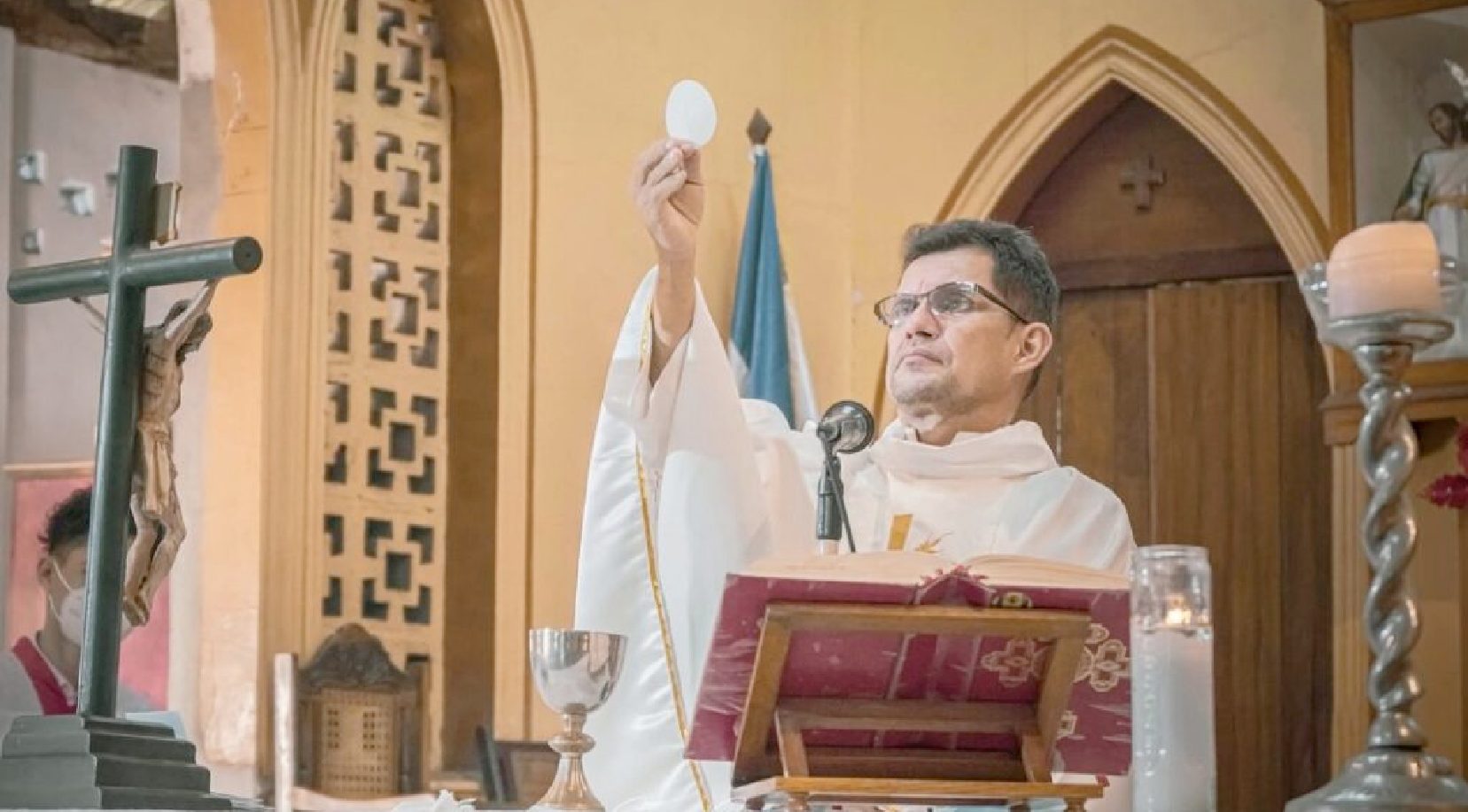
(ZENIT News / Managua, 02.19.2026).- When Father José Concepción Reyes Mairena landed at Managua’s international airport on 12 February, he was returning home after two years in Spain. Within hours, he was back on a plane—this time under compulsion. According to independent outlets including 100% Noticias and Artículo 66, the priest from the Diocese of León was detained by immigration officials, subjected to extended questioning and intimidation, and ultimately forced to leave the country.
His case is the latest episode in a sustained campaign by the government of Daniel Ortega and his wife and co-president Rosario Murillo against the Catholic Church in Nicaragua. Reyes Mairena, who had served as a formator at the Major Seminary of León, joins a growing list of clergy either expelled, barred from reentry, or compelled into exile.
The scale of the phenomenon is striking. According to figures compiled by exiled lawyer Martha Patricia Molina, 309 priests and religious sisters have been exiled, expelled, or denied entry into Nicaragua in recent years; more than 95 percent of them are Nicaraguan nationals. In a broader accounting of state hostility toward the Church, Molina’s August report documented 1,070 attacks since 2018 and alleged that 16,500 religious processions have been prohibited during that period—numbers she warns continue to rise.
These statistics help explain why two Nicaraguan priests were ordained this week in Costa Rica under near-secrecy. The ceremony, held without public announcement, livestream, or the presence of family members, was deliberately discreet. Organizers feared that publicity could trigger reprisals against relatives still living in Nicaragua. In a country where the act of gathering for a procession can be blocked, even an ordination has become a risk calculation.
The repression has also hollowed out diocesan leadership. Four dioceses—Jinotega, Matagalpa, Estelí and Siuna—are currently without their bishops in residence, according to Molina. Carlos Herrera, Bishop of Jinotega and president of the episcopal conference, was expelled in November 2024 after criticizing a local mayor aligned with the government who had disrupted a Mass with loud music. Rolando Álvarez, an outspoken critic of the administration, was deported to Rome in January of that same year. Isidoro Mora was expelled in the same group. Silvio Báez, auxiliary bishop of Managua, left Nicaragua in 2019 amid escalating threats and has since spoken forcefully from abroad.
In a homily delivered on 15 February in Miami, Báez condemned what he described as “criminal” actions against innocent people imprisoned for dissent. He spoke of “civil death,” noting that he had been stripped of his nationality, effectively erased in legal terms. Silence in the face of injustice, he warned, destroys dignity and hope. His remarks reflect a Church leadership increasingly vocal outside Nicaragua’s borders, even as space for expression narrows within them.
The expulsion of Reyes Mairena is particularly notable because there was reportedly no public intervention on his behalf from Sócrates René Sándigo Jirón, Bishop of León. Sándigo was the only Nicaraguan bishop to cast a vote in the 2021 presidential election that returned Ortega to office, a contest widely criticized by international observers as lacking democratic credibility. The absence of mediation in this case underscores the fragmentation within the local hierarchy and the delicate positioning of those bishops who remain in the country.
For the regime, the strategy appears twofold: constrain public religious expression and disrupt clerical continuity. Molina has warned that ordinations of deacons and priests are being obstructed in several dioceses. If accurate, such measures would not only silence present voices but also impede generational renewal within the Church.
The Nicaraguan crisis illustrates a broader pattern in which authoritarian governments perceive independent religious institutions as potential centers of moral authority and civic mobilization. Historically, the Catholic Church in Latin America has often occupied an ambivalent space—sometimes aligned with state power, sometimes a platform for resistance. In Nicaragua today, that tension has sharpened into open confrontation.
The Vatican has received several of the exiled bishops in Rome during 2025, signaling continued ecclesial solidarity. Yet diplomatic engagement remains constrained by the realities on the ground. Each forced departure further internationalizes what began as a domestic political struggle.
Father Reyes Mairena’s brief return and immediate expulsion encapsulate the present climate: a homeland that no longer guarantees entry to its own clergy, a Church operating between silence and exile, and a state that has transformed migration controls into instruments of ecclesiastical discipline. With 309 religious already displaced and over a thousand documented acts of hostility, the pattern is no longer episodic. It has become structural.
Thank you for reading our content. If you would like to receive ZENIT’s daily e-mail news, you can subscribe for free through this link.

