

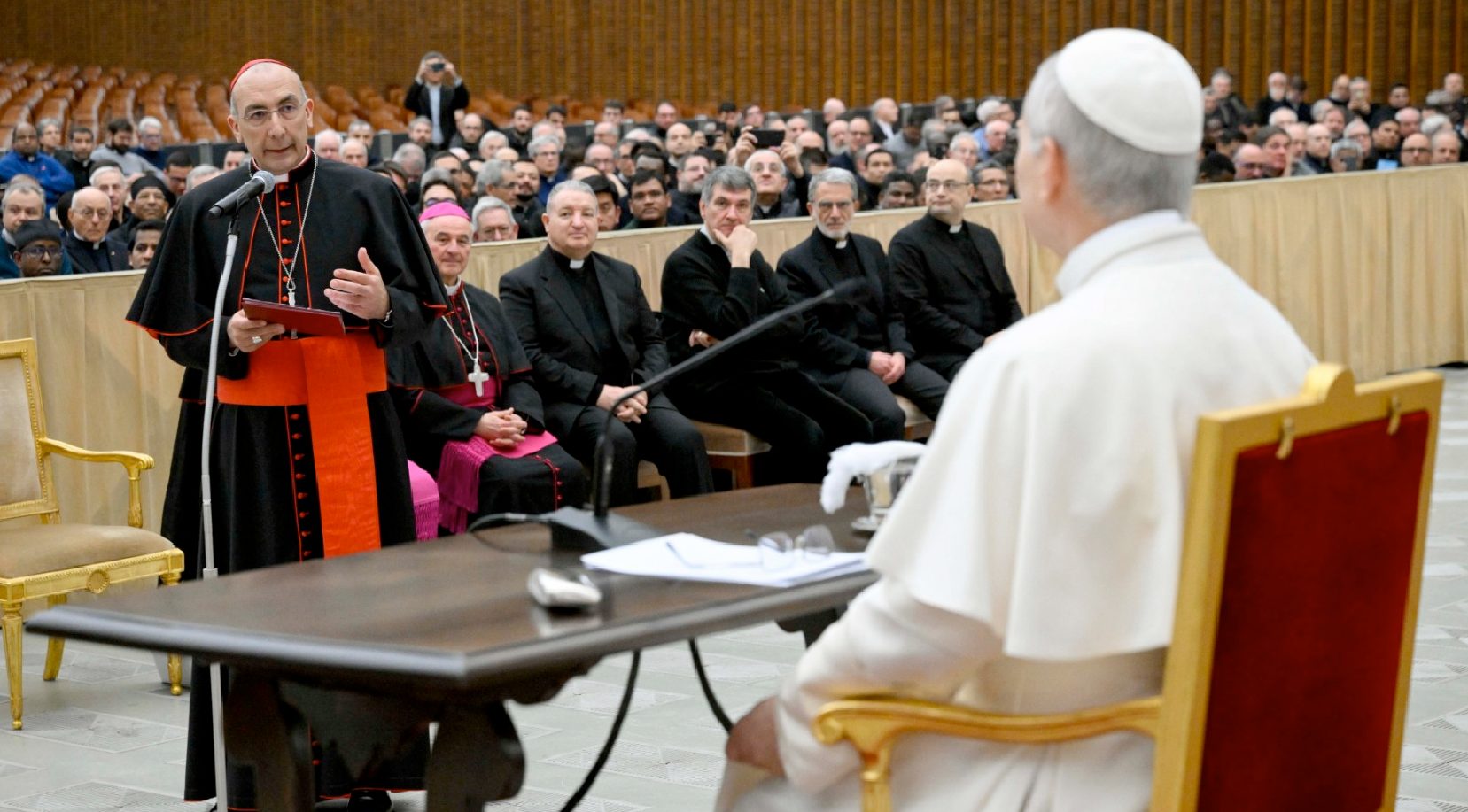
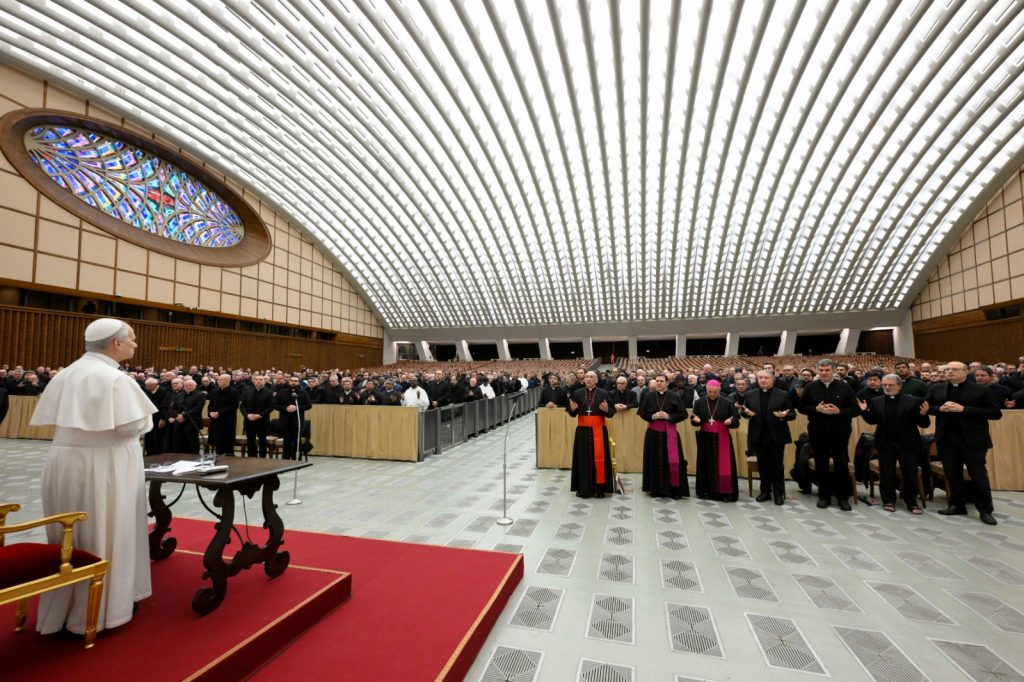
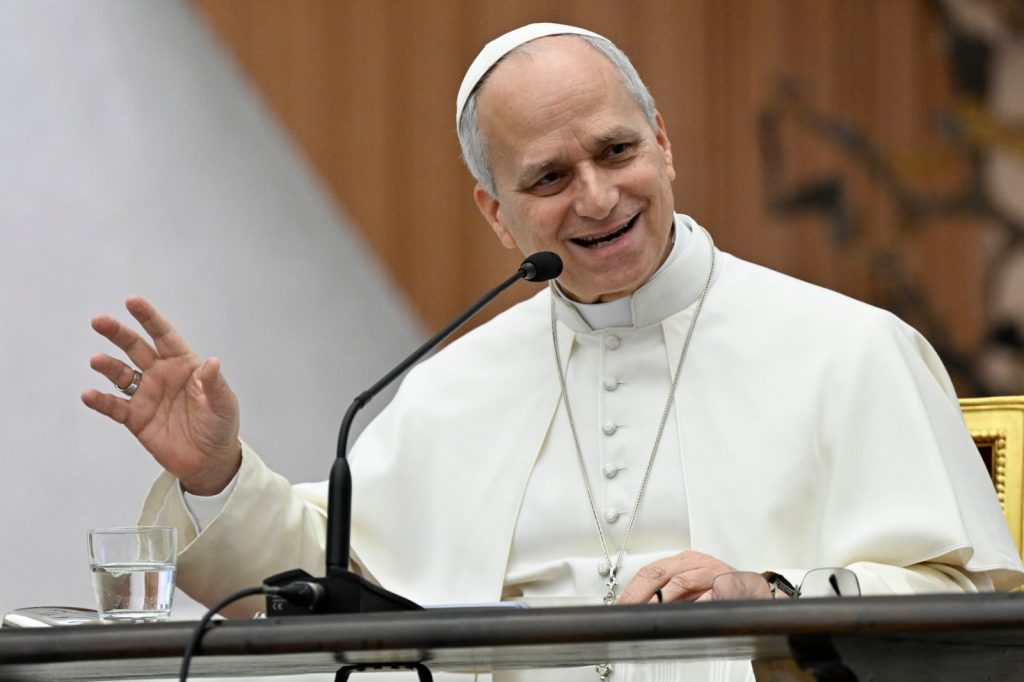
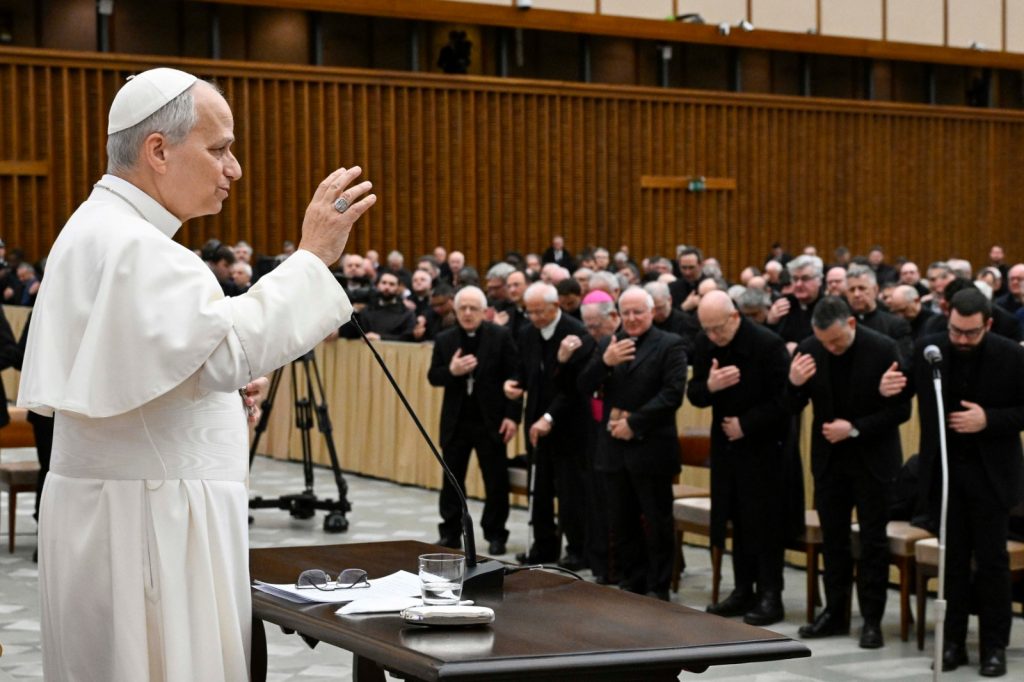
(ZENIT News / Vatican City, 02.19.2026).- Around midday on Thursday, February 19, Pope Leo XIV met with the clergy of the Diocese of Rome in the Vatican’s Paul VI Hall. This meeting was especially significant for one reason: the Holy Father is the Bishop of Rome, and, consequently, these are the clergy who assist Leo XIV in the pastoral care of the people, parishes, and communities of the Diocese. The following is the English translation of the Pope’s address, prepared by ZENIT.
* * *
In the Name of the Father, of the Son and of the Holy Spirit,
Peace be with you.
Dear Brothers:
I greet you with great joy and thank you for your presence this morning. I thank the Cardinal Vicar for his words and cordially greet you all: the members of the Episcopal Council, the parish priests, and all the priests present. And I say to you: while it is true that we are at the beginning of this Lenten journey, it is not an act of penance: it brings, at least for me, great joy! And I say this sincerely!
At the beginning of the pastoral year, we are inspired by the words of Jesus to the Samaritan woman at Jacob’s well: «If you knew the gift of God» (John 4:10).
Giving, as we know, is also an invitation to live out a creative responsibility. We do not simply immerse ourselves in the river of tradition as passive executors of a predefined pastoral ministry, but rather, with our creativity and our charisms, we are called to collaborate in the work of God. In this sense, the words of the Apostle Paul to Timothy are illuminating: «I remind you to rekindle the gift of God that is within you» (2 Timothy 1:6). These words are addressed not only to the individual, but also to the community, and today we can hear them addressed to us: Church of Rome, remember to rekindle the gift of God!
What does «rekindle» mean? Paul addresses this exhortation to a community that, in some way, has lost the freshness of its origins and its pastoral zeal; with the change of context and the passage of time, a certain weariness, a certain disappointment or frustration, a certain spiritual and moral decline is observed. Therefore, the Apostle says to Timothy and to that community: remember to rekindle the gift you have received. This verb used by Paul — «rekindle» — evokes the image of embers under the ashes and, as Pope Francis said, «suggests the image of someone who stirs the fire to rekindle its flame» (Catechesis, October 30, 2024).
We can also say of the pastoral path of our Diocese: the fire is lit, but it must always be rekindled.
The burning fire is the irrevocable gift that the Lord has given us; it is the Spirit who has traced the path of our Church, the history and tradition we have received, and what we routinely carry out in our communities. At the same time, we must humbly admit that the flame of this fire does not always retain the same vitality and needs to be rekindled. Pressed by rapid cultural changes and the environments in which our mission unfolds, sometimes beset by weariness and the weight of routine, or discouraged by a growing detachment from faith and religious practice, we feel the need to feed and rekindle this fire. This is particularly true in some areas of pastoral life, which I would like to address briefly.
I
The first, undoubtedly, concerns the ordinary pastoral work of parishes. And here, first of all, I would like to share with you a thought of gratitude, recalling the words that Pope Francis addressed to you in one of his more recent Chrism Masses: “Thank you for your service; thank you for all the hidden good you do […]; thank you for your ministry, which often unfolds amidst so many difficulties, misunderstandings, and little recognition” (Homily at the Chrism Mass, April 6, 2023). However, difficulties and misunderstandings can also be an opportunity to reflect on the pastoral challenges we face. In particular, regarding the relationship between Christian initiation and evangelization, we need a radical change. Ordinary pastoral care is structured according to a classical model that is primarily concerned with ensuring the administration of the Sacraments, but this model presupposes that faith is transmitted in some way by the environment, both by society and by the family. In reality, the cultural and anthropological changes that have occurred in recent decades indicate that this is no longer the case; in fact, we are witnessing a growing erosion of religious practice.
Therefore, it is urgent to resume proclaiming the Gospel: this is the priority. With humility, but without being discouraged, we must recognize that «a portion of our baptized people do not experience their belonging to the Church,» and this also demands vigilance against «sacramentalization without other forms of evangelization« (Evangelii Gaudium, 63). Let us recall the questions of the Apostle Paul: «But how can people call on Him in whom they have not believed? And how can they hear without a preacher?» (Romans 10:14). Like all large urban agglomerations, the city of Rome is characterized by constant mobility, by a new way of inhabiting the territory and experiencing time, by an increasingly pluralistic and, at times, frayed relational and familial fabric. Therefore, parish ministry must be oriented toward proclamation, seeking ways to help people reconnect with the promise of Jesus. In this context, Christian initiation, often dictated by the school curriculum, needs to be revised: we need to experiment with other ways of transmitting the faith, even beyond traditional paths, to seek to involve children, young people and families in new ways.
II
A second aspect is this: learning to work together, in communion. To prioritize evangelization in all its many forms, we cannot think or act alone. In the past, the parish was more firmly tied to the territory, and all who lived there belonged to it; today, however, lifestyles and models have evolved from stability to mobility, and many people, not only because of work but also because of various experiences, live relationships beyond their territorial and cultural boundaries. The parish alone is not enough to initiate a process of evangelization capable of reaching those who cannot participate adequately. In a territory as vast as Rome, we must overcome the temptation of egocentrism, which generates overexertion and dispersion, and work ever more closely together, especially among neighboring parishes, sharing charisms and potential, planning together, and avoiding duplication of initiatives. Our priestly communion is essential.
III
One last aspect I would like to emphasize: closeness to young people. Many of them, we know, «live without any reference to God and the Church.» (Address to the Participants in the Plenary Session of the Dicastery for the Doctrine of the Faith, January 29, 2026). It is therefore a matter of understanding and interpreting the profound existential unease that dwells within them, their confusion, their many difficulties, as well as the phenomena that affect them in the virtual world and the symptoms of a worrying aggressiveness, which sometimes leads to violence. I know you are aware of this reality and are committed to addressing it. We don’t have easy solutions that guarantee immediate results, but whenever possible, we can listen to young people, be present, welcome them, and share a little of their lives. At the same time, since these issues affect various aspects of life, we also seek, as parishes, to engage in dialogue and interaction with local institutions, schools, education and humanities specialists, and all those who are concerned about the destiny and future of our young people.
And speaking of young people, I would like to offer a word of encouragement to young priests – almost all of you, right? — who often experience firsthand the potential and difficulties of their generation and of this era. In a more difficult and less rewarding social and ecclesial context, there is a risk of quickly exhausting energies, accumulating frustrations, and falling into loneliness. I encourage you to be faithful daily in your relationship with the Lord and to work with enthusiasm, even if you do not yet see the fruits of your apostolate. Above all, I urge you never to withdraw into yourselves: do not be afraid to talk about yourselves, even about your own weariness and crises, especially with brothers who you believe can help you. Of course, we are all called to an attitude of listening and attention, through which we can concretely live our priestly fraternity. Let us accompany and support one another.
Dear friends, I am happy to have shared this moment with you. As I recently reminded you, our first commitment is «to persevere and foster our vocation through a constant journey of conversion and renewed fidelity, which is never merely an individual journey, but rather commits us to caring for one another» (Apostolic Letter, A Fidelity that Generates a Future, 13). In this way, we will take steps according to the heart of God and will be able to better serve our Diocese of Rome. Thank you!

