The year with the highest Bible sales in history: 2025 is set to break records in the USA
Descripción corta: According to recent data from Circana, Bible sales rose another eleven percent this year compared with 2024, continuing a steady climb that has accelerated since the pandemic years
(ZENIT News / Washington, 11.28.2025).- From the outside, it seems paradoxical: a country where fewer people say religion shapes their daily lives is simultaneously buying more Bibles than at any moment in recent memory. Yet in 2025, that is precisely the reality unfolding across the United States.
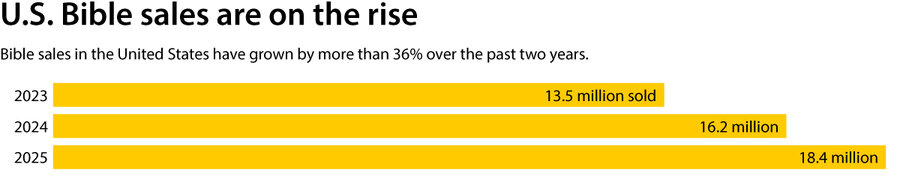
According to recent data from Circana, Bible sales rose another eleven percent this year compared with 2024, continuing a steady climb that has accelerated since the pandemic years. More than eighteen million copies have already been purchased in 2025, including an astonishing 2.4 million just in September. Analysts noted that part of the spike coincided with the death of conservative Christian activist Charlie Kirk, an event that appears to have stirred renewed interest among segments of his audience.
For Brenna Connor, a BookScan analyst at Circana, the trend reflects something more than seasonal fluctuations or passing controversies. She describes a multiyear surge that started in 2021 and shows no sign of slowing. Annual Bible sales reached a twenty-year high in 2024, she noted, and 2025 seems on track to surpass it. In her view, Americans may not be increasingly religious, but they are increasingly curious about religious content.
What people choose to buy also hints at the diversity of motivations behind the boom. The best-selling title is an inexpensive edition of the English Standard Version, a kind of utilitarian Bible for everyday readers. Children’s editions remain strong, as do niche products like the women-oriented “She Reads Truth” Bible. Some buyers gravitate to devotional aesthetics: a pink, giant-print King James gift Bible has been a perennial hit. Others respond to cultural signals. A patriotic-themed Bible promoted by former President Donald Trump earned him more than a million dollars in royalties last year.
Publishers say they can track sales volumes but know little about who is making the purchases. Still, people working close to the ground have their theories. Tim Wildsmith, a former campus minister who now runs a popular Bible-review channel on YouTube, suspects that social turbulence plays a role: years marked by a pandemic, deep political rifts, and economic anxiety have left many Americans searching for something stable. When the world feels disordered, he said, people instinctively reach for sources of reassurance.
At Christian Connection, a modest bookstore in Sycamore, Illinois, owner Kelli Malm has noticed the same pattern. One of the store’s best-selling editions is the New Living Translation, particularly copies linked to a digital app produced by its publisher, Tyndale. The combination of readable prose and easy-to-access study tools appeals both to newcomers and younger Christians who prefer a hybrid print-digital experience. Malm has seen an uptick in sales since September, including at least one customer who returned to church life after Kirk’s death. The demographic of buyers is slowly shifting: the core remains older Christians, but more thirty- and forty-somethings are appearing at the counter, often describing themselves as rediscovering a faith they once left behind.
For others, the attraction is tactile. Colton Burkhart, a freshman at the University of Wisconsin–Whitewater, says he has tried reading Scripture on his phone, but the distractions overwhelmed him. He wears out his print Bibles instead: his latest, a MacArthur Study Bible, is thick with color-coded tabs and handwritten notes. For him, studying Scripture is something that requires paper, ink and focus.
Publishers are adapting quickly to these varied needs. Amy Simpson of Tyndale House says the company now offers hundreds of editions across multiple formats and color palettes. Nothing in particular is driving sales, she explains; rather, the breadth of choices allows people to find a Bible that fits their habits and identity. Melinda Bouma of HarperCollins Christian Publishing echoes that view. Her company publishes twenty-two English and Spanish translations in countless editions, which makes it easier to meet demand when one version sells out. Even long-established products are gaining momentum: the NIV Study Bible, now four decades old, recently surpassed ten million copies sold.
Children’s Bibles are also posting notable gains, and editions aimed at Generation Z—like The Jesus Bible—are resonating with younger readers who might otherwise remain distant from religious institutions. Bouma points to data showing a modest but meaningful return of spiritual interest among younger adults and teens, reflected in how they buy and use Scripture.
Yet the national picture remains complicated. The American Bible Society’s annual State of the Bible report says that about 41 percent of Americans qualify as “Bible users”—meaning they read Scripture at least three times a year outside church services. That is up slightly from last year but still well below 2021 levels. Only one in five Americans would be considered deeply “Scripture engaged.” At the same time, a Gallup poll released in mid-November found that fewer than half of Americans now view religion as important in their lives, continuing a long downward trajectory.
This contradiction—declining religiosity alongside rising Bible purchases—is precisely why some church leaders see an opportunity. Jennifer Holloran, president of the American Bible Society, argues that the moment calls for thoughtful pastoral guidance. If millions of people are opening Bibles for the first time or returning to them after years away, she said, churches have not only an educational responsibility but also a spiritual one: to accompany new readers through the unfamiliar terrain of Scripture and help them interpret what they encounter.
For Wildsmith, whose online reviews now reach more than a quarter of a million followers, the Bible’s resurgence has been personally transformative. He began posting videos in 2020 to help confused first-time buyers choose among the vast array of editions. One of his earliest clips—an unassuming review of a premium ESV Bible—unexpectedly drew tens of thousands of views and launched a new career. He has since written a guide titled “Bible Translations for Everyone” and receives more review copies than he can reasonably handle.
If someone had told him a few years ago that Americans would be buying record numbers of Bibles—and that he would make a living helping them choose—he says he would not have believed it. But here he is. In a nation wrestling with division, uncertainty and decline in traditional religious structures, the printed Scriptures remain one of the few constants people continue to reach for.
Whether that marks the beginning of a spiritual reawakening or simply a cultural search for stability is an open question. What is certain is that, in 2025, the Bible has found its way back into America’s hands, even as faith wavers in its heart.
Thank you for reading our content. If you would like to receive ZENIT’s daily e-mail news, you can subscribe for free through this link.
