Major biblical discovery in 2026: 42 lost pages of the New Testament manuscript discovered
ID del artículo: 226672
Descripción corta: Professor Allen continues: “Given that Codex H is such an important witness to our understanding of Christian scripture, to have discovered any new evidence – let alone this quantity - of what it originally looked like is nothing short of monumental.”
(ZENIT News / Glasgow, 05.05.2026).- An international team of academics led by Professor Garrick Allen at the University of Glasgow has successfully recovered 42 lost pages from one of the world’s most important early New Testament manuscripts: Codex H.
The manuscript, a 6th-century copy of the Letters of St Paul, was lost to history when it was disassembled at the Great Lavra Monastery on Mount Athos, Greece, in the 13th century. Its pages were re-inked and reused as binding material and flyleaves for multiple other manuscripts. Today, the surviving fragments are scattered across libraries in Italy, Greece, Russia, Ukraine, and France.
Professor Garrick Allen explains the process that led to the discovery: “The breakthrough came from an important starting point: we knew that at one point, the manuscript was re-inked. The chemicals in the new ink caused ‘offset’ damage to facing pages, essentially creating a mirror image of the text on the opposite leaf – sometimes leaving traces several pages deep, barely visible to the naked eye but very clear with latest imaging techniques.
“In partnership with the Early Manuscripts Electronic Library (EMEL), researchers used multispectral imaging to process images of the extant pages, in order to recover ‘ghost’ text that no longer physically exists, effectively retrieving multiple pages of information from every single physical page. To ensure historical accuracy, the team also collaborated with experts in Paris to perform radiocarbon dating, confirming the parchment’s 6th-century origin.”
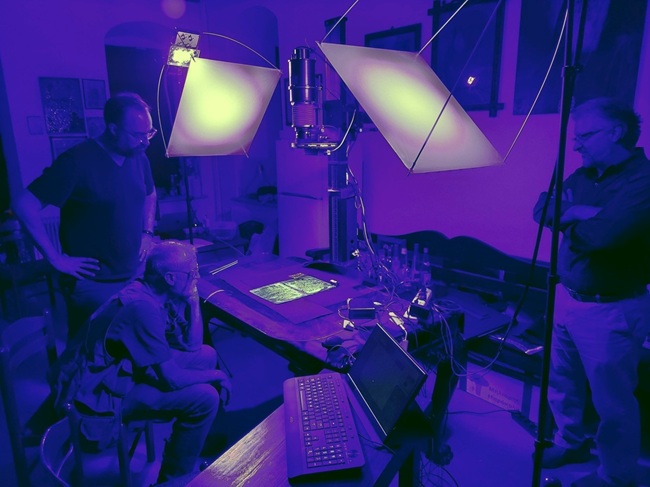
While the recovered text contains known portions of Paul’s Letters, the discovery offers a unique insight into how the New Testament has evolved and been understood through the centuries. It sheds new light on the people who made and used the manuscript, the way that people interacted with their sacred texts, and the ways that books were reused once they fell into disrepair.
Professor Allen continues: “Given that Codex H is such an important witness to our understanding of Christian scripture, to have discovered any new evidence – let alone this quantity – of what it originally looked like is nothing short of monumental.”
Key findings include:
- Ancient chapter lists. The pages contain the earliest known examples of chapter lists for Paul’s Letters, which differ drastically from how we divide these letters today.
- Scribal insights: The fragments show how 6th-century scribes corrected, annotated and interacted with sacred texts.
- Medieval recycling: The physical state of the manuscript reveals how sacred works were reused and repurposed once they fell into disrepair.
This project was made possible through funding from Templeton Religion Trust and the Arts and Humanities Research Council (UK), with the cooperation of the Great Lavra Monastery.
A new print edition of Codex H is forthcoming and a digital edition is freely available at https://codexh.arts.gla.ac.uk/, making these recovered pages available to the public and scholars for the first time in centuries.
Thank you for reading our content. If you would like to receive ZENIT’s daily e-mail news, you can subscribe for free through this link.

Publicaciones relacionadas:
 FOX to present 8-part series on the lives of saints produced and directed by Martin Scorsese
 Catholic institute that is an icon of evangelistic development in the USA moves to a 250 acres campus
 Zaragoza’s Basilica of the Pillar Marks Record-Breaking Global Pilgrimage Surge: Americans are the largest group
 PHOTO GALLERY: Amidst the war, a beautiful new Catholic basilica is blessed and inaugurated in Ukraine