Study Reveals Increase in Church Attendance (and Donations): The Surprising (and Encouraging) Findings You Should Know
ID del artículo: 226800
Descripción corta: Digital giving expanded dramatically during and after the pandemic. In 2020, only 58 percent of congregations offered online giving options. By 2025, that number had climbed to 76 percent. Researchers estimate that roughly 40 percent of church income now arrives through online donations.
(ZENIT News / Rome, 05.10.2026).- For more than two decades, the dominant narrative surrounding religion in the United States has been one of erosion: shrinking congregations, closed parishes, exhausted pastors, and the relentless expansion of the religiously unaffiliated. The COVID-19 pandemic seemed, for many observers, to accelerate an already irreversible decline. Sanctuaries emptied, ministries moved online, and thousands of churches struggled simply to survive.
Yet a new national study suggests that the story may be entering a more complicated chapter.
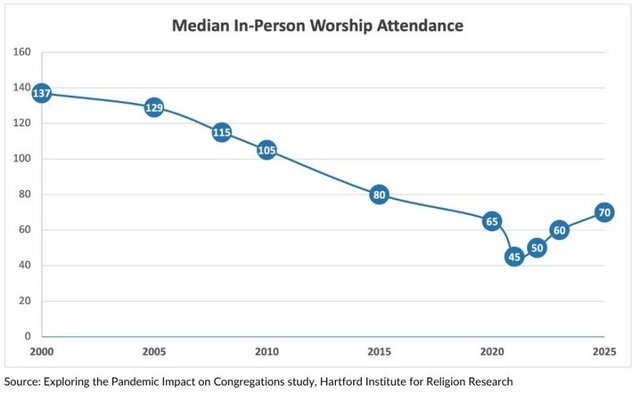
Researchers at the Hartford Institute for Religion Research reported an unexpected development in their latest nationwide survey of American congregations: average in-person worship attendance rose in 2025 for the first time in roughly a quarter century. The increase is modest, and scholars are careful not to describe it as a religious revival. Nevertheless, after years of contraction, even a small reversal has drawn serious attention from church leaders and sociologists alike.
The findings come from a survey of 7,453 congregational leaders conducted between September and December 2025 as part of the long-running “Faith Communities Today” research initiative. According to the report, the average congregation now gathers around 70 adults for in-person services, compared with 65 before the pandemic and just 45 during the height of COVID-era restrictions.
To understand why researchers consider this significant, historical context matters. In the year 2000, the average congregation welcomed 137 worshippers. Attendance then steadily deteriorated over the following decades amid secularization, demographic changes, scandals affecting religious institutions, and growing distrust of organized religion. Against that backdrop, any measurable increase is unusual enough that the Hartford researchers initially suspected an error in the data.
Scott Thumma, director of the Hartford Institute, admitted that his team expected continued decline. Instead, they discovered signs that at least some congregations have stabilized after years of institutional turbulence. Alison Norton, co-director of the institute, described the current moment as one of “cautious optimism,” emphasizing that churches appear to be moving beyond emergency survival strategies and beginning to think about long-term mission again.
The numbers reveal a landscape that remains deeply uneven.
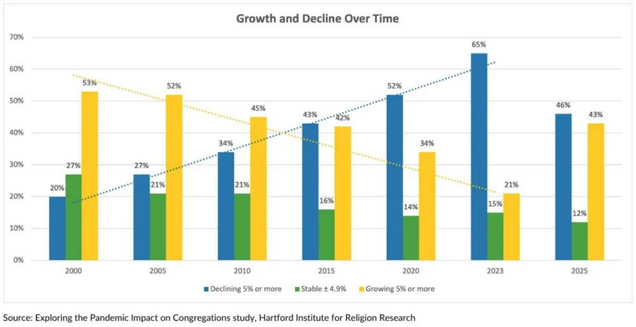
Almost half of congregations — 46 percent — still reported attendance declines of at least 5 percent between 2020 and 2025. More than a quarter experienced losses exceeding 25 percent. Yet 43 percent reported growth of at least 5 percent, while 29 percent said attendance had increased by more than 25 percent. Another 12 percent described themselves as essentially stable.
What appears to be happening is not a uniform resurgence of Christianity, but a restructuring of American religious life.
Large congregations continue to gain strength, while many smaller churches remain vulnerable. Congregations with more than 250 attendees were the most likely to grow, whereas churches with fewer than 50 worshippers often faced steep decline. Researchers noted that many newcomers are not first-time believers but Christians transferring from smaller communities into larger and more dynamic ones.
Indeed, only 8 percent of new attendees had never previously belonged to a congregation. Most arrivals — 69 percent — came from another church, while 22 percent were returning after a long absence from religious practice. The data suggest less a wave of conversions than a process of consolidation and return.
That pattern can also be seen across denominational lines.
Evangelical Protestant churches showed modest growth over the last five years, while Catholic, Orthodox, and non-Christian congregations largely held steady. Mainline Protestant churches, however, continued to decline significantly, dropping by around 20 percent. Catholic and Orthodox congregations nevertheless maintained the highest average attendance figures, roughly 200 worshippers per parish, partly because those traditions generally operate fewer but larger communities.
Southern Baptist churches also reported measurable gains. Average weekly attendance across the denomination rose to more than 4.46 million in 2025, an increase of more than 156,000 worshippers compared with the previous year.
Researchers argue that the pandemic itself may have forced churches into a painful but necessary reckoning. Congregations that once relied heavily on institutional inertia suddenly had to confront fundamental questions about identity, outreach, technology, and mission. Many adapted rapidly, livestreaming liturgies, reorganizing pastoral care, and experimenting with new forms of ministry. Others struggled to recover.
Charissa Mikoski, an assistant professor involved in the Hartford study, said the churches now showing signs of vitality are often those that learned to adapt creatively during the crisis years rather than simply waiting for normality to return.
The financial picture also changed considerably.
Digital giving expanded dramatically during and after the pandemic. In 2020, only 58 percent of congregations offered online giving options. By 2025, that number had climbed to 76 percent. Researchers estimate that roughly 40 percent of church income now arrives through online donations. Median congregational income increased from $120,000 in 2020 to $205,000 in 2025, although rising insurance and maintenance costs continue to place severe pressure on many communities.
Pastoral morale appears to be improving as well. Clergy are reportedly less likely than before to consider leaving ministry, a notable development after years of burnout and discouragement intensified by the pandemic.
Still, researchers repeatedly caution against triumphalism. The broader trajectory of American religious life remains one of long-term decline, particularly when compared with the vitality churches once enjoyed in the mid-20th century. Americans continue to drift away from institutional religion in significant numbers, and thousands of churches close each year. Estimates from Lifeway Research suggest that roughly 4,000 Protestant churches shut down in 2024 alone.
Nor do Americans themselves perceive religion as particularly healthy. Surveys continue to show that many believe Christianity in the United States is either declining or dying altogether.
Yet the Hartford findings indicate that the situation may no longer be one of uninterrupted collapse. Instead, American Christianity could be entering a transitional phase in which fewer congregations survive, but those that do become more intentional, mission-focused, and structurally resilient.
For Catholic observers, the data resonate with a broader conversation taking place under the pontificate of Pope Leo XIV about evangelization in secular societies. Across the Western world, church leaders increasingly acknowledge that Christianity can no longer rely on cultural habit or inherited affiliation. Communities that endure will likely be those capable of offering genuine spiritual conviction, coherent identity, and meaningful relationships in an age marked by fragmentation and loneliness.
The Hartford report does not announce a religious awakening on the scale of America’s historic revivals. But it does suggest that after years of defensive retreat, at least some congregations are rediscovering confidence in their purpose.
That alone represents a significant shift in tone.
Thank you for reading our content. If you would like to receive ZENIT’s daily e-mail news, you can subscribe for free through this link.

Publicaciones relacionadas:
 New Cardinal And President of WYD Said “We Don’t Want to Convert Young People to Christ, to The Catholic Church,” But What Was the Context?
 The Pope’s Accounts: The Countries that Contribute Most and How the Money Is Spent that the Pope Receives
 Religious Freedom Under Siege: ACN Report Highlights Escalating Persecution
 China: Xi Jinping Walks Into Your Home—and Tells You to Have Babies