How Many Catholics Support the Death Penalty? U.S. Study Releases Findings
ID del artículo: 228650
Descripción corta: A new Pew Research Center survey found that 65% of U.S. Catholics favor the death penalty for people convicted of murder, including 28% who say they support it strongly. Yet the position articulated repeatedly by Pope Leo XIV points in the opposite direction
(ZENIT News / Washington, 08.19.2026).- A striking gap has emerged between Catholic opinion in the United States and the direction of recent Catholic teaching on one of the most difficult questions in criminal justice: whether the state should have the power to execute a person convicted of murder.
A new Pew Research Center survey found that 65% of U.S. Catholics favor the death penalty for people convicted of murder, including 28% who say they support it strongly. Yet the position articulated repeatedly by Pope Leo XIV points in the opposite direction. He has argued that human life must be respected and protected from conception until natural death, explicitly including those who have committed serious crimes.
The disagreement is not marginal. It exposes the distance that can exist between Catholic teaching and the moral instincts of Catholics themselves.
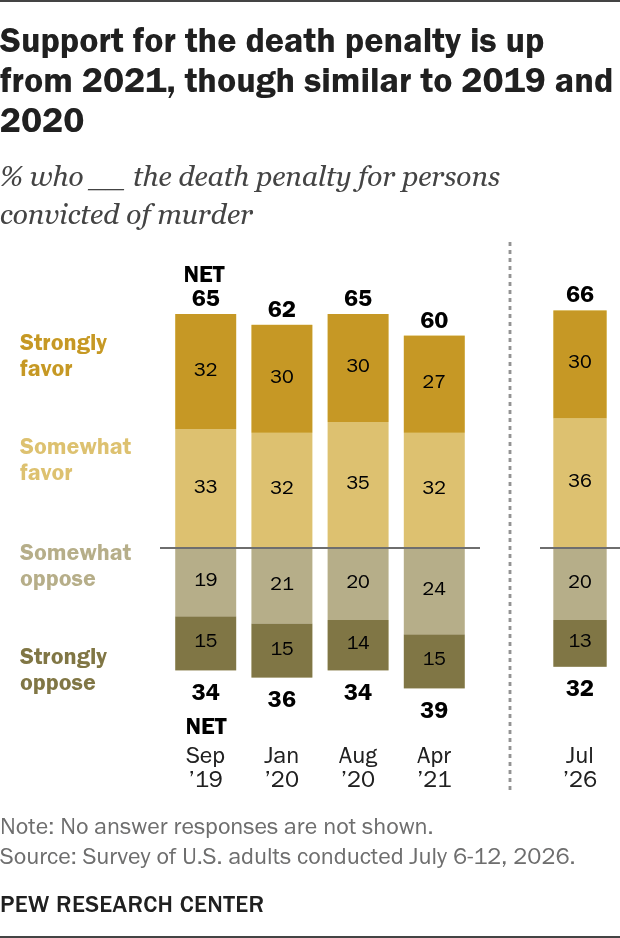
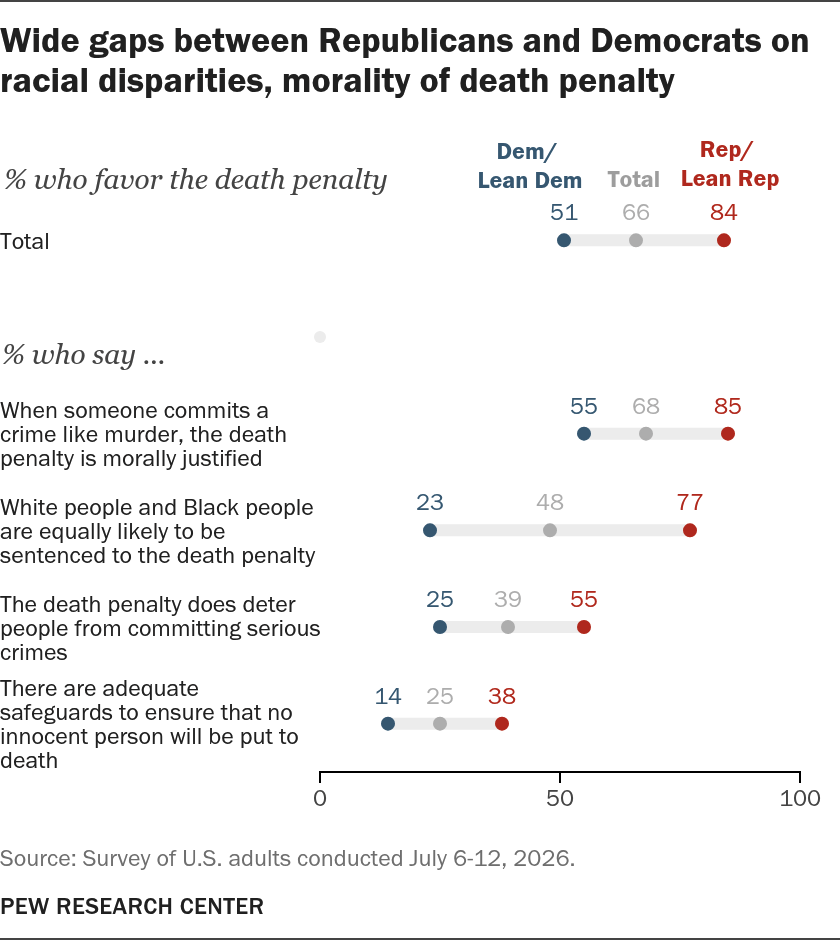
The Pew survey, conducted from July 6 to 12 among 3,554 U.S. adults, found that 66% of Americans overall favor capital punishment for murder convictions. Thirty-two percent oppose it, while 13% say they strongly oppose it. Among Catholics, opposition rises slightly to 34%, with 15% strongly opposed.
The margin of sampling error for the full survey was plus or minus 1.9 percentage points.
The figures also reveal that Catholic attitudes are remarkably close to those of the wider American population. That is significant because the Church’s current teaching is considerably more restrictive than public opinion, including among Catholics.
Pope Leo has made his position unmistakable. In April, he said he condemned the death penalty and insisted that human life deserves protection throughout its entire existence. His position follows the development of Catholic teaching under Pope Francis, who in 2018 approved a revision of the Catechism stating that the death penalty is inadmissible because it attacks the inviolability and dignity of the human person.
The Catholic argument, therefore, is no longer simply a question of whether an exceptionally grave crime can merit an exceptionally severe punishment. The deeper issue is whether deliberately taking the life of a convicted criminal remains morally permissible when society has other means of protecting itself.
That distinction matters.
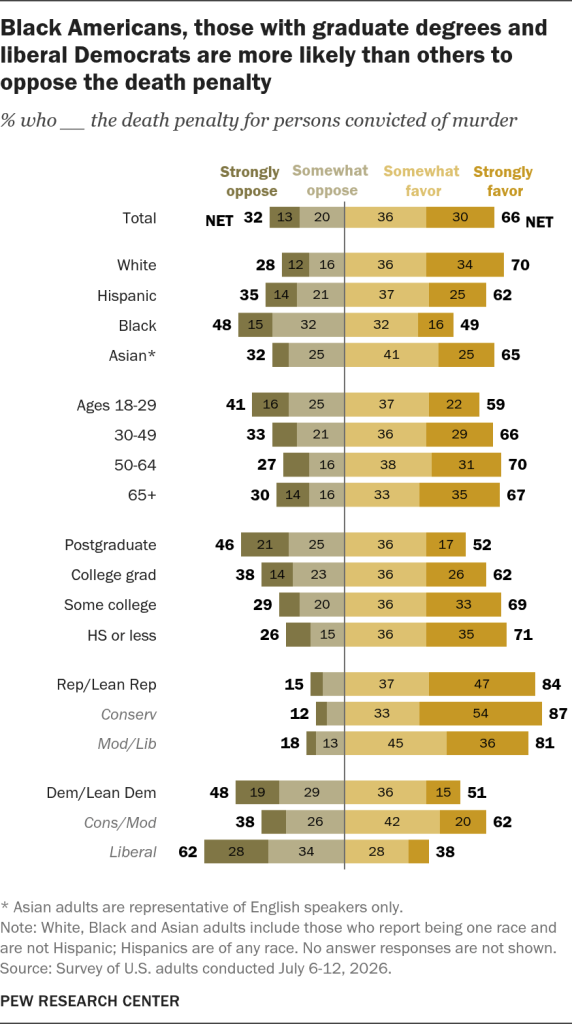
The survey shows that Americans are not necessarily supporting executions because they believe they prevent future murders. In fact, 59% said the death penalty does not deter crime, compared with only 39% who believe that it does.
Nor is public confidence in the justice system absolute. Nearly three-quarters of Americans, 73%, acknowledged that there is at least some risk that an innocent person could be executed. Only about one-quarter said safeguards exist that adequately prevent such an outcome.
Yet support remains high.
That suggests that attitudes toward capital punishment are rooted in considerations beyond deterrence: punishment, retribution, moral responsibility and the belief that certain crimes can justify the ultimate penalty.
Among Catholics, 64% said the death penalty is morally justified when someone has committed murder, while 32% considered it morally wrong.
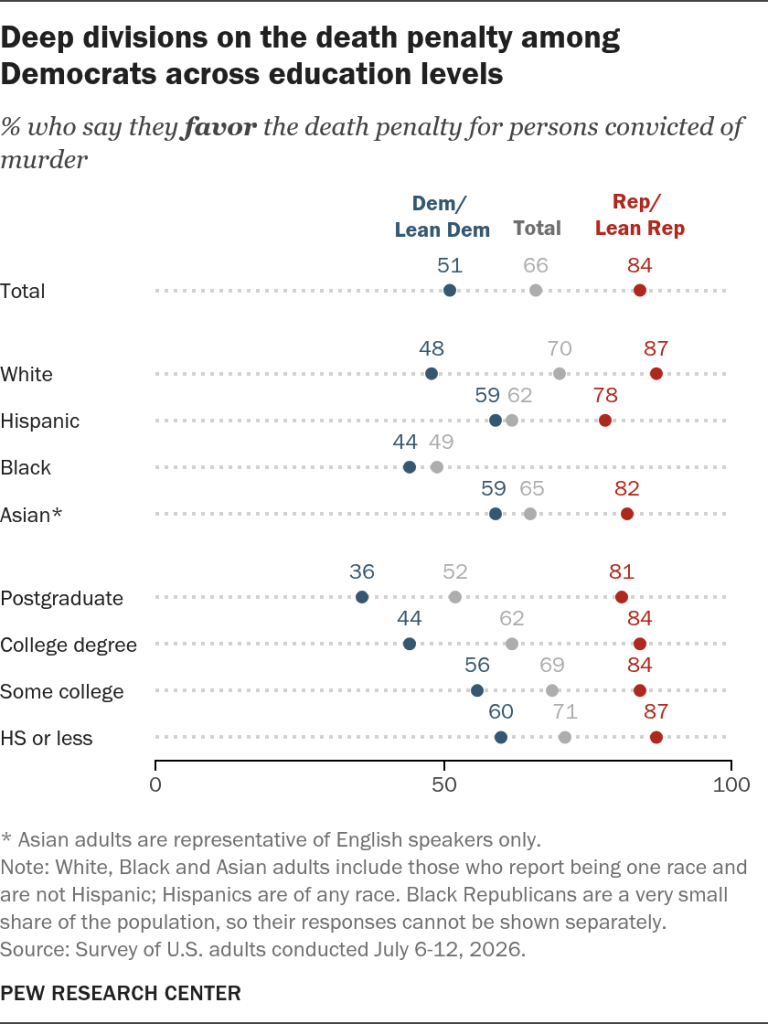
The political divide is even sharper. Eighty-four percent of Republicans and Republican-leaning independents support capital punishment, including 47% who strongly support it. Democrats and Democratic-leaning independents are almost evenly divided, with 51% supporting it and 48% opposing it.
The moral question follows a similar pattern: 85% of Republicans consider capital punishment morally justified for murder, compared with 55% of Democrats.
Age also matters. Younger Americans are substantially more skeptical of the practice. Among adults aged 18 to 29, 58% said the death penalty is morally wrong, compared with 47% among those aged 65 and older. Educational attainment produces smaller differences, with people holding graduate degrees somewhat less likely to support capital punishment than those with less education.
Another fault line concerns racial fairness. Seventy-seven percent of Republicans said Black and White people are equally likely to receive the death penalty for comparable crimes, while only 23% of Democrats agreed.
For the Catholic Church, however, the debate cannot ultimately be reduced to partisan preference or confidence in the criminal justice system.
Catholic opposition to the death penalty is connected to a broader understanding of human dignity. A person does not cease to possess that dignity because he has committed a terrible crime. At the same time, the Church does not deny the gravity of murder or the legitimate duty of the state to protect its citizens and uphold justice.
This is where the Catholic position can be difficult to communicate in a culture accustomed to viewing justice principally through punishment.
Rejecting execution does not mean declaring murder insignificant, abandoning victims or refusing to hold criminals accountable. It means maintaining that punishment has limits and that the state can protect society without intentionally killing the offender.
That principle also explains why the death penalty occupies a distinctive place within Catholic teaching on life. The Church’s defense of human life is not intended to apply only to people considered innocent, sympathetic or socially useful. Its moral consistency is tested precisely when the person whose life is at stake is difficult to defend.
The Pew numbers show that this teaching has not yet become the instinctive position of most American Catholics.
That gap should not be interpreted simply as evidence that Catholics are rejecting the Church. It may also reveal how deeply ideas of retributive justice remain embedded in American culture, including among believers who accept many other Catholic teachings. It also demonstrates that a doctrinal development can take considerable time to filter from official teaching into the moral reasoning of ordinary Catholics.
For Leo XIV, the challenge is therefore larger than opposing executions. He must articulate why the Church believes that even a person convicted of the gravest crimes remains within the protection of human dignity.
That argument is unlikely to win every Catholic immediately.
But the survey suggests precisely why it matters. A majority may believe that a murderer deserves death. The Church is asking a more demanding question: whether justice requires us to take a life when justice can be achieved without doing so.
Thank you for reading our content. If you would like to receive ZENIT’s daily e-mail news, you can subscribe for free through this link.

Publicaciones relacionadas:
 Communion in the Hand or in the Mouth? Results Are Published of the Largest Survey in the U.S. on the Eucharist
 Trump claims the Pope wants them to vote for him and answers why he posts the Virgin Mary on social networks
 Pope Leo XIV accepts resignation of bishop whom Pope Francis appointed cardinal, but who “did not want” to receive the appointment
 Breaking the silence: the nun who shows her face and accuses an Indian bishop of ongoing sexual abuse