

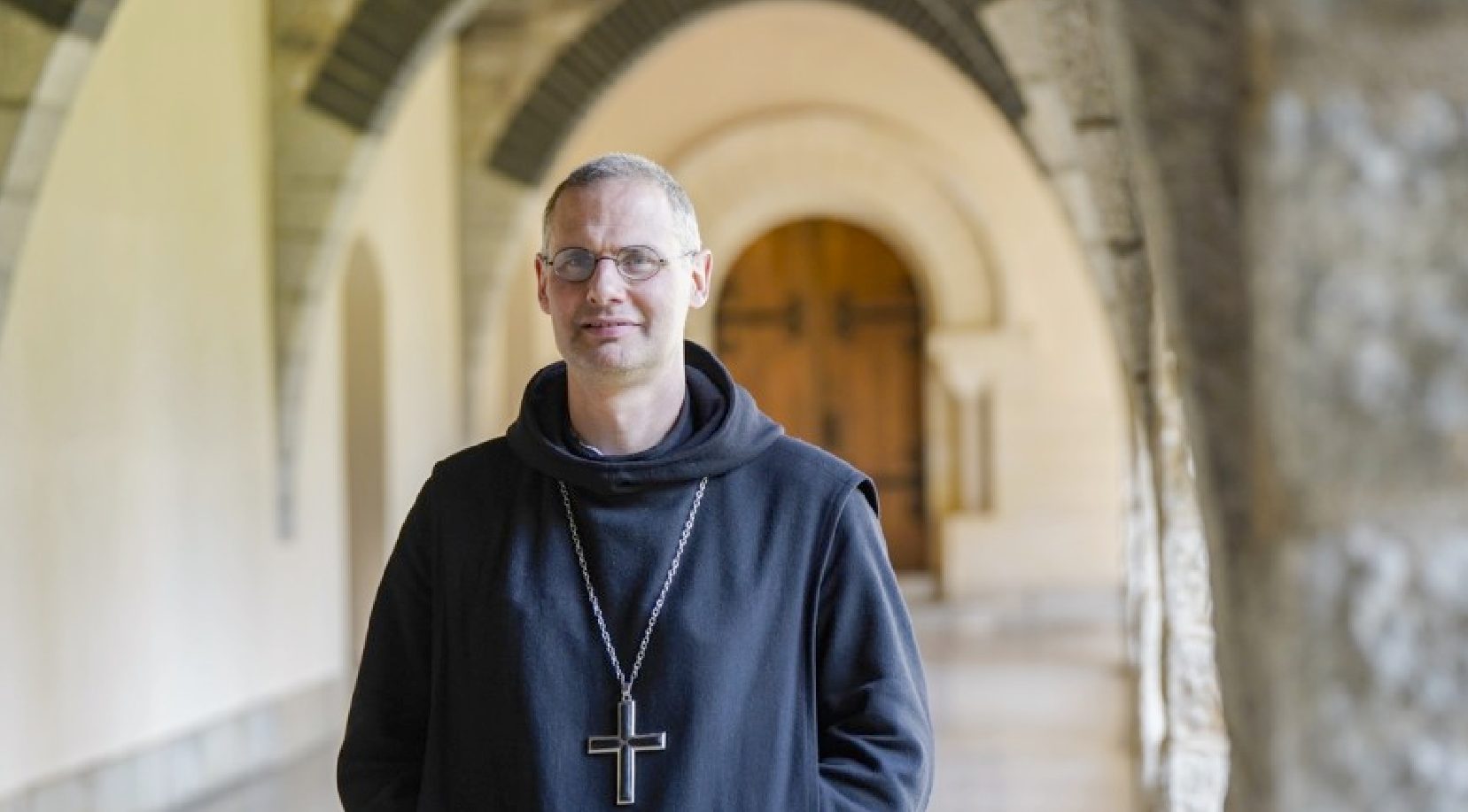
(ZENIT News / Rome, 03.23.2026).- In a Church still marked by half a century of liturgical tensions, a French Benedictine abbot has put forward an idea as ambitious as it is delicate: to bring opposing ritual sensibilities under the same institutional roof—literally, within a single missal.
The proposal comes from Geoffroy Kemlin, head of the renowned Abbey of Saint-Pierre de Solesmes and president of a Benedictine congregation that already lives, in miniature, the very coexistence he now suggests for the universal Church. In a letter addressed to Pope Leo XIV and dated November 12, 2025, Kemlin outlines a plan to integrate the pre–Vatican II Ordo Missae—commonly referred to as the Vetus Ordo—into the current Roman Missal, without altering the postconciliar liturgy introduced under Pope Paul VI.
At stake is more than a technical reform. Since the liturgical changes that followed the Second Vatican Council, the Roman Rite has effectively existed in two parallel forms: the older Tridentine structure and the reformed liturgy. While successive pontificates have attempted to regulate their coexistence—most notably through Summorum Pontificum of Pope Benedict XVI and later the more restrictive Traditionis custodes of Pope Francis—the underlying tensions have never fully subsided.
Kemlin’s diagnosis is rooted in lived experience. His congregation includes monasteries such as Fontgombault that have preserved the older rite, alongside Solesmes itself, which embraced the conciliar reform while maintaining Latin and Gregorian chant. Having personally inhabited both liturgical worlds, the abbot speaks less as a theorist than as a witness to an internal fracture. “The liturgy is meant to build unity, not division,” he has said, describing the current polarization as a source of personal suffering.
His solution avoids the path that many reform-minded voices have occasionally suggested: modifying the modern missal to resemble the older one. That approach, Kemlin argues, would satisfy no one and could even produce a more fragmented landscape—“not two, but three missals.” Instead, he proposes a structural integration. The current Missale Romanum would remain intact, but would incorporate the older Ordo Missae as an additional, fully recognized option within the same liturgical book.
The implications are far-reaching. Under such a model, priests could celebrate within a unified framework while drawing, where pastorally appropriate, on elements of the older rite—such as the prayers at the foot of the altar or the traditional offertory—without stepping outside the normative liturgical structure. At the same time, the Vetus Ordo itself would not remain untouched: Kemlin envisions a limited adaptation, including optional use of the vernacular, concelebration, and access to the expanded lectionary introduced after Vatican II, which he describes as “much richer” in scriptural content.
The theological realism of the proposal lies in its acknowledgment of a fact often minimized in official discourse: the two forms of the Roman Rite are not merely stylistic variants. They embody, in Kemlin’s words, different “liturgical sensibilities” and even distinct underlying anthropologies—different ways of approaching God, prayer, and the role of the assembly. For this reason, he argues, it is unrealistic to expect adherents of the older form simply to transition into the newer one.
Rather than viewing this attachment as ideological resistance, the abbot interprets it as a sign of authentic spiritual experience. Most faithful who prefer the older liturgy, he insists, do so because they encounter there a depth they do not find elsewhere. Recognizing this, he suggests, is a prerequisite for any genuine reconciliation.
Yet precisely here lies the vulnerability of his proposal. Critics, including voices in the French Catholic press, question whether placing two structurally and theologically distinct liturgical orders within a single missal would resolve tensions or merely reframe them. If the divergence is as profound as Kemlin himself admits, can institutional unity truly bridge it—or might it render the differences even more visible?
There is also the question of scalability. Within the Benedictine world, coexistence has been facilitated by monastic discipline and a cultivated culture of mutual respect. Monks from different liturgical traditions regularly adapt to one another’s practices when visiting sister houses. Whether such flexibility can be extended to the global Church, with its vastly more complex pastoral realities, remains uncertain.
Kemlin situates his initiative within a longer historical arc, invoking Prosper Guéranger, the restorer of Solesmes and a key figure in the 19th-century liturgical revival that ultimately influenced Vatican II’s constitution on the liturgy, Sacrosanctum Concilium. By appealing to that legacy, the abbot frames his proposal not as a rupture, but as a continuation of a tradition that has always sought to balance fidelity and renewal.
The tone of his letter, however, is notably cautious. He asks forgiveness for what he calls his “boldness” and emphasizes that he is offering not a blueprint to be imposed, but a “path for reflection” aimed at healing divisions that, in his words, wound the Church.
The proposal arrives at a moment when liturgical questions—once considered largely settled—are again resurfacing with urgency. Whether Kemlin’s idea will be seen as a creative breakthrough or an impractical synthesis, it forces a fundamental question back into the open: can unity in the Catholic Church be achieved by choosing between traditions, or only by learning to hold them together within a single, if tension-filled, whole?
Thank you for reading our content. If you would like to receive ZENIT’s daily e-mail news, you can subscribe for free through this link.

Publicaciones relacionadas:
 Vatican approves new lectionary for Advent in England, Wales and Scotland
 Questions about liturgy: Genuflections Toward the Tabernacle
 The traditional Latin Mass celebrated in St. Peter’s Basilica marks a new chapter under the pontificate of Pope Leo XIV
 Questions about liturgy: Adoration When There Is No Tabernacle
