

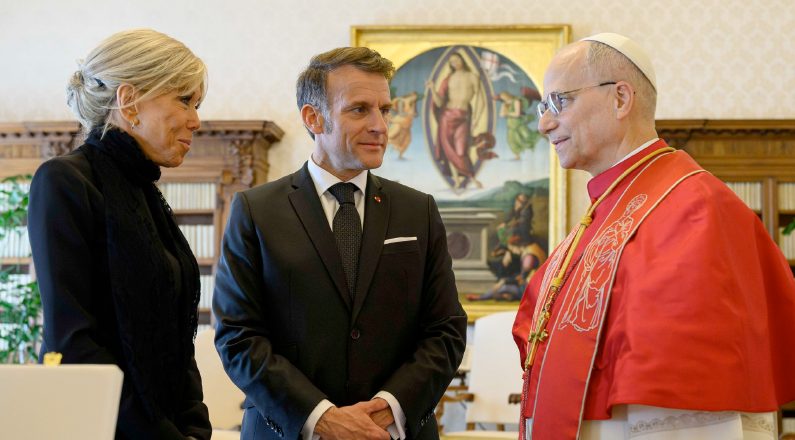
(ZENIT News / Rome, 04.10.2026).- The first formal encounter between President Emmanuel Macron and Pope Leo XIV unfolded in the Apostolic Palace under the sign of discretion, but against a backdrop of unusually charged international dynamics. Lasting nearly an hour behind closed doors and followed by broader discussions in the Secretariat of State, the meeting marked not only a personal introduction between the French leader and the first American-born pontiff, but also a moment of convergence on some of the most contentious geopolitical questions of the present.
Très heureux de rencontrer Sa Sainteté le Pape Léon XIV.
Nous portons une même conviction : face aux fractures du monde, l’action pour la paix est un devoir et une exigence. La France œuvrera toujours pour le dialogue, la justice et la fraternité entre les peuples. pic.twitter.com/2YLhOeA6C4
— Emmanuel Macron (@EmmanuelMacron) April 10, 2026
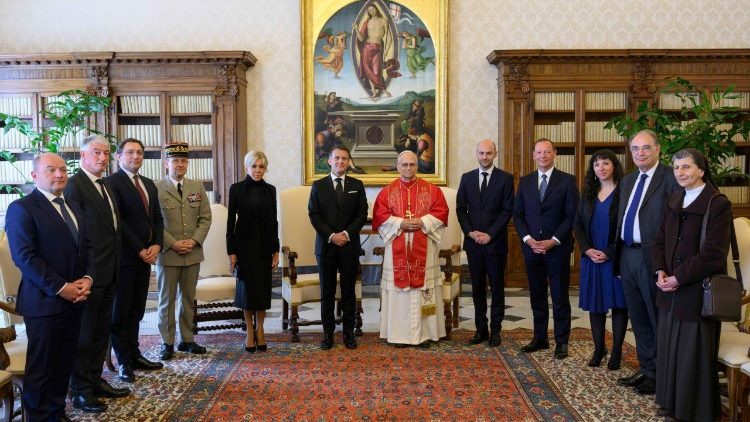
Macron arrived at the Vatican shortly before 10 a.m. on April 10, accompanied by his wife Brigitte, entering through the traditional route of Via della Conciliazione before being received in the San Damaso Courtyard. The choreography of the visit adhered to the established protocol for heads of state, yet the substance of the conversation pointed beyond ceremonial formalities. While no details have been officially disclosed regarding the private audience, subsequent statements from the Holy See confirmed that the talks were cordial and centered on major international issues, with particular attention to ongoing conflicts and the pursuit of peace through dialogue.
Ver esta publicación en Instagram
That emphasis was echoed in Macron’s own public remarks, in which he framed the meeting as grounded in a shared conviction: that working for peace is both a duty and an imperative. The formulation is not accidental. In recent weeks, both leaders have expressed concern over escalating tensions linked to U.S. foreign policy, especially in relation to Iran. Pope Leo XIV has warned against the normalization of military solutions, describing certain threats as unacceptable, while Macron has criticized what he sees as destabilizing rhetoric and inconsistent strategic messaging.
Although the Holy See’s official communiqué avoided naming specific regions, the composition of the French delegation offered clues. Among those present were figures closely tied to the Middle East, including representatives engaged with Lebanon, a country where France maintains longstanding historical and political interests. Their presence suggests that the crisis in that region—alongside broader concerns in the Persian Gulf—figured prominently in the exchange.
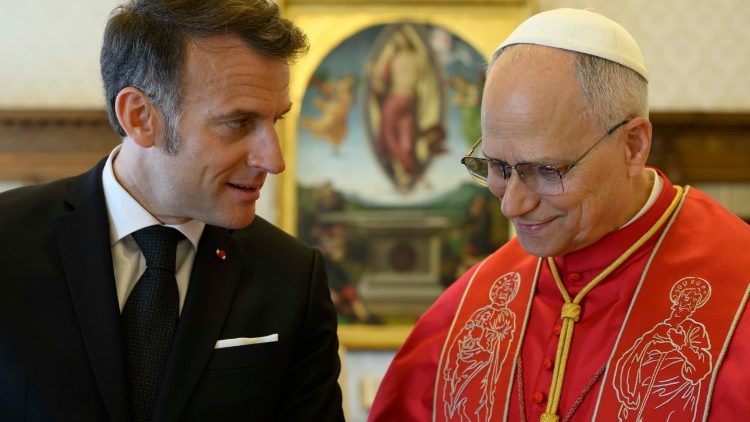
The subsequent meeting between Macron and Cardinal Pietro Parolin, the Vatican’s Secretary of State, alongside Archbishop Paul Richard Gallagher, responsible for relations with states, expanded the scope of the dialogue. According to the Holy See, the discussions revisited the traditionally strong ties between France and the Vatican while addressing global flashpoints, humanitarian emergencies, multilateral cooperation, and climate concerns. The language used—highlighting “dialogue and negotiation” as pathways to restoring peaceful coexistence—reflects the diplomatic grammar of the Holy See, which seeks to position itself as a moral interlocutor rather than a geopolitical actor.
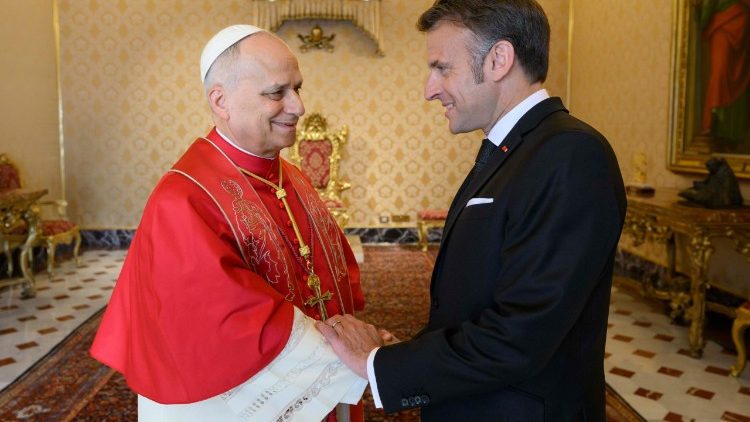
Beyond geopolitics, the visit carried symbolic and historical undertones. Macron’s itinerary in Rome deliberately avoided bilateral meetings with Italian political authorities, a choice described by the Élysée as consistent with the “republican and secular” nature of the trip. Instead, the president’s program combined institutional engagement with religious and cultural gestures. On the eve of his Vatican audience, he visited the Community of Sant’Egidio, a lay Catholic movement known for its mediation efforts in conflict zones, where he paid tribute to Blessed Floribert Bwana Chui, a Congolese customs officer killed in 2007 after refusing to allow spoiled food to reach vulnerable populations. The act underscored themes of moral resistance and social justice that resonate with both Sant’Egidio’s mission and the Vatican’s diplomatic ethos.
Macron also maintained a longstanding French tradition by visiting the Basilica of St. John Lateran, where French heads of state hold the honorary title of protocanon, a vestige of historical ties between the French crown and the papacy. Such gestures, while largely ceremonial today, continue to signal the enduring cultural dimension of France’s relationship with the Holy See.
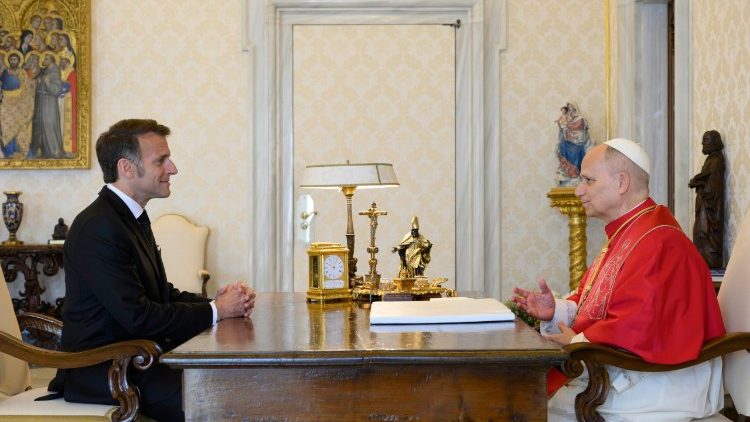
The exchange of gifts between Macron and Pope Leo XIV further illustrated this interplay of history, culture, and contemporary identity. The French president presented, among other items, a signed jersey from the national basketball team, a facsimile of a map by the 17th-century missionary Jacques Marquette, and a collection of wartime writings by Catholic author Georges Bernanos. He also offered a volume on the reconstruction of Notre-Dame Cathedral following the 2019 fire, a project that has become emblematic of national resilience and cultural heritage. These choices, blending religious memory with modern national symbols, can be read as an attempt to situate France’s secular republic within a broader civilizational narrative that remains attentive to its Christian roots.
If the meeting avoided overt political declarations, its significance lies in the alignment—however measured—between Paris and the Vatican on the primacy of diplomacy over force. This alignment does not translate into a formal alliance, nor does it erase the complexities inherent in the relationship between a secular state and a religious authority. Yet it signals a shared concern over the trajectory of global conflicts and the language used to justify them.
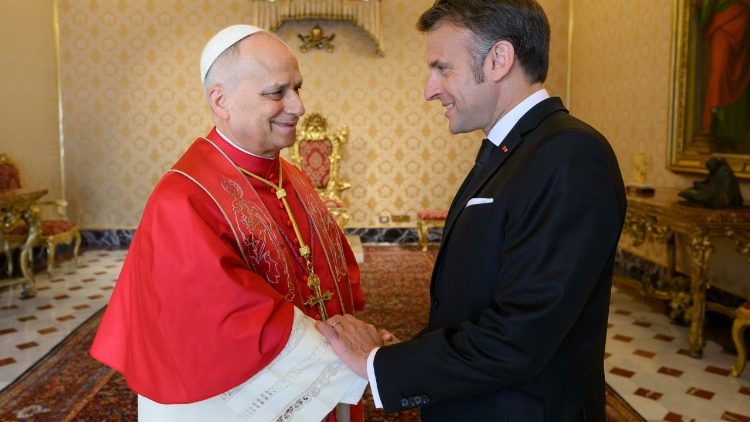
For Pope Leo XIV, still in the early phase of his pontificate, the encounter offered an opportunity to engage a major European leader while reinforcing his emerging profile as a vocal advocate for peace in an increasingly polarized international environment. For Macron, it provided a platform to situate France within a multilateral and dialogical framework at a time when Western unity appears strained.
In the careful balance between silence and signaling that defined the meeting, both sides appear to have achieved a common objective: to affirm the possibility of dialogue in a world where it is often overshadowed by the logic of confrontation.
Thank you for reading our content. If you would like to receive ZENIT’s daily e-mail news, you can subscribe for free through this link.

Publicaciones relacionadas:
 Pope’s moving, grateful and encouraging address to his nuncios (ambassadors) summoned to Rome
 German president visits the Pope: invitation to the country, role of the Holy See in the current situation, and ecclesial life in Germany are the topics
 Nicolás Maduro asks the Pope for diplomatic mediation in conflict with Trump and the United States
 Why didn’t the Pope pray in a Turkish mosque? Trump, Ukraine, and Pope Leo XIV’s next residence
