

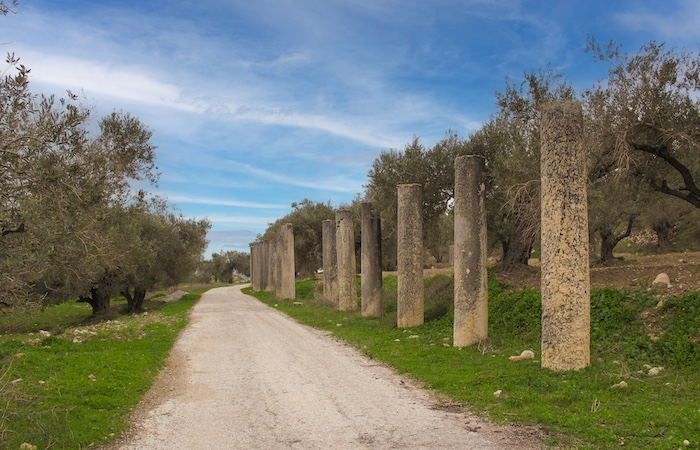
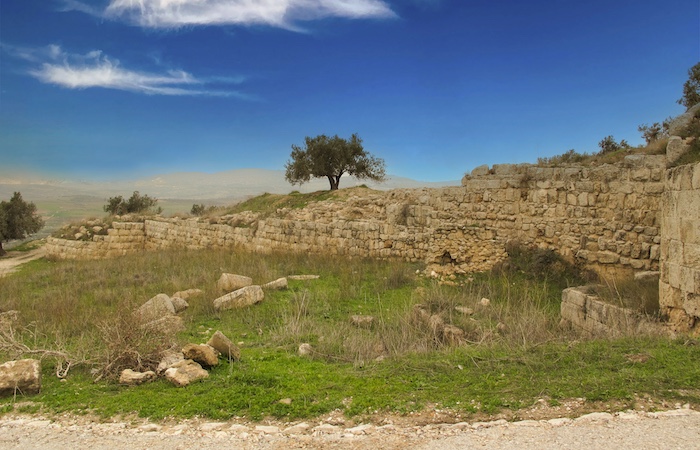
(ZENIT News – Terra Santa Net / Jerusalem, 08.19.2026).- Sebastia is one of the most renowned archaeological sites in the West Bank, featuring layers representing three thousand years of history: Israelite, Greek, Roman, Byzantine, Crusader, and Ottoman. According to tradition, the tomb of John the Baptist lies beneath its stones. Until recently, at least three hundred Palestinians made a living from activities catering to visitors.
Today, the shops are closed and the streets are silent. The land surrounding the Roman columns — olive groves cultivated by families for generations –, is under an Israeli confiscation order. In November 2025, the Israeli Civil Administration issued an expropriation order for approximately 180 hectares of private land around the site; this represents the largest confiscation linked to an ancient site since the 1967 Occupation, encompassing thousands of olive trees and hundreds of plots belonging to local residents and the neighboring village of Burqa.
The town center of Sebastia falls within Area B, subject to joint Palestinian-Israeli jurisdiction under the Oslo Accords, whereas the archaeological site lies in Area C, under full Israeli civil and security control. The Israeli project envisions a new road that would allow settlers to manage tourist flows and reap economic benefits from them, further isolating the Palestinian population from the site and the employment opportunities associated with it.
On May 20, Netanyahu and several Ministers announced a 259-million-shekel plan (over 70 million euros) for the development of historical heritage sites in the West Bank. The project, dubbed «Road, Land, Heritage» and hailed as a «revolution in Judea and Samaria» (the terms used by the Israeli nationalist and religious right to refer to the West Bank), approves the establishment of around a hundred new settlements.
«We are investing in the preservation of our past to reinforce our control over the Land of Israel and to transmit our people’s heritage, identity, and historical truth to future generations,» said the Prime Minister. Control over ancient sites is thus linked to territorial expansion. All this takes place in violation of international law, while the Palestinian Authority currently finds itself with minimal operational capacity, on the verge of financial collapse.
The City of David: Science and Propaganda
What happened in Sebastia is a microcosm of what is occurring throughout the Occupied West Bank: expropriations justified by the need to safeguard cultural heritage, restrictions on the banking system, and the blocking of funds to the Palestinian Authority.
According to Emek Shaveh, an Israeli Association that monitors the ideological use of archaeology, this is a far-reaching development policy. «For two decades, archaeology has become an instrument to justify settlements and the displacement of Palestinians throughout the territory,» stated spokesperson Talya Ezrahi. The Association, founded in 2008, denounces the same mechanism at the City of David excavations in Jerusalem: scholars work there according to scientific standards, yet the narrative presented to visitors links the past and present in a way that borders on propaganda.
The Israel Antiquities Authority conducts the excavations, but the park’s management is entrusted to Elad, a settler organization whose stated mission is to unearth the ancient City of David and establish a Jewish presence in the surrounding area. The tourist experience focuses almost exclusively on the biblical narrative of David, ignoring or downplaying subsequent centuries — the Byzantine, Islamic, Ottoman, and modern Palestinian history of the surrounding Silwan neighborhood.
Archaeological campaigns driven by political agendas often focus on the strata from the Kingdom of Israel (9th and 8th centuries, BC) while sidelining the rest — Greek columns, Roman temples, Byzantine churches, and Ottoman mosques — because they do not serve the story being told.
Minister Eliyahu’s Vision
The current Minister of Heritage, Amihai Eliyahu, belongs to the faction of Itamar Ben-Gvir, one of the most extremist figures in the incumbent government. He has replaced the term «antiquities» with «heritage», a powerful semantic shift useful for propaganda purposes, thereby justifying settlements and the expansion of Jewish life throughout the West Bank, including areas under Palestinian control.
The opposition newspaper Haaretz has repeatedly accused Eliyahu of seeking to instrumentalize the Israel Antiquities Authority (IAA), shifting its mission from the scientific reconstruction of the Holy Land’s history to demonstrating a Jewish right to the land, an attitude that views science as an enemy, typical of authoritarian regimes.
Last May, Eliyahu attempted to appoint Esther Schreiber to head the Authority, but the appointment was rejected in late June because she lacked the managerial experience required by law. The move also prompted a petition to the Supreme Court signed by some sixty Israeli archaeologists.
Schreiber heads I.Next.G (Israel’s Next Generation), a religious NGO linked to Chabad, an international movement within Orthodox Hasidic Judaism. Ben-Gvir, a political ally of Eliyahu, declared that the «deep state» had blocked Schreiber «because she is an openly observant person.»
According to The Times of Israel, the candidacy was linked to the government’s attempt to establish a separate antiquities authority, under the Ministry of Heritage, with jurisdiction over archaeological activities in the West Bank and Gaza. The initiative sparked strong reactions within Israeli academia and the Palestinian Authority, as it amounted to de facto annexation; Netanyahu reportedly halted the legislative process due to the ensuing controversy.
Archaeologist Aren Maeir of Bar-Ilan University noted that the bill for the new authority would have made «our efforts to fight the boycott more difficult.» The Israeli archaeological community realizes that replacing the internationally recognized Archaeology Staff Officer (commonly known as Kamat), who manages Palestinian sites on behalf of the occupying power’s Civil Administration, with an unrecognized new heritage authority would only provide ammunition to those arguing that archaeology in Israel should be boycotted.
Other Sites in the Spotlight
In any case, the pattern appears well-defined. The use of archaeological heritage as a mechanism for acquiring land follows the scenario described by Haaretz columnist Moshe Gilad: Israeli politicians view archaeology as a way to demonstrate that Jews possess this land.
Meanwhile, Palestinian public finances are being strangled: the transfers stipulated by the bilateral economic agreement, in place since the Oslo era, are blocked. Israel collects customs duties and trade taxes on Palestinian imports on behalf of the Palestinian Authority, with an obligation to make monthly transfers — revenue that accounts for approximately 70 percent of the Authority’s total income — yet not a single payment has been made over the past year.
In addition to Sebastia, the main sites currently under pressure are the Tomb of the Patriarchs in Hebron, the Herodium, Herod the Great’s desert palace-fortress, the Tel Shiloh site, the Hasmonean palaces in Jericho, and the Atara site near Ramallah.
Once the management of Sebastia passes to the settlers — whether through the Regional Council or a private organization — serious consequences are foreseen for the Palestinian town: a permanent military presence, stricter restrictions on freedom of movement, and the de facto suppression of normal life in the village.
Translation of the Italian original into Spanish by ZENIT’s Editorial Director and, into English, by Virginia M. Forrester

Publicaciones relacionadas:
 Israeli government minister calls for construction of synagogue on Temple Mount (where Muslim mosque now stands)
 Pope Leo calls on Catholics in Gaza; more than 500 Catholic priests announce march in support of Gaza in Rome
 From Castel Gandolfo, Pope Leo XIV Calls for Peace Amid Gaza’s Agony and UN Genocide Allegations
 Pope Leo XIV comments on Trump’s peace plan for Gaza (and other current topics of general interest)
