

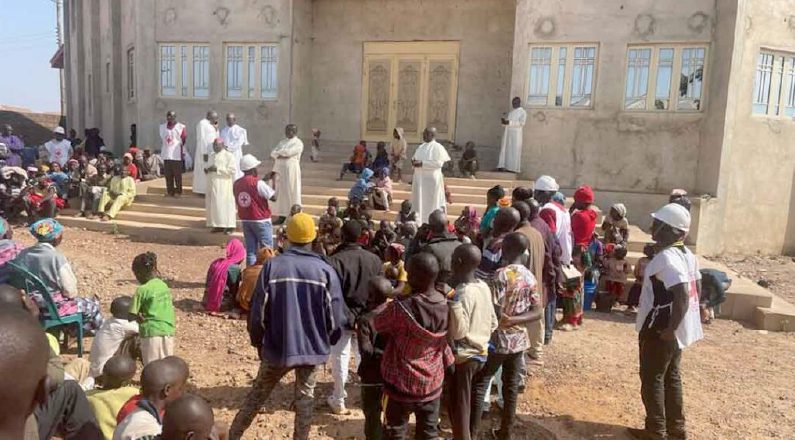
(ZENIT News / Rome, 10.23.2025).- For years, Nigeria’s Christian communities have lived under the shadow of relentless violence—villages razed, churches burned, and thousands of faithful slaughtered in attacks that rarely make international headlines. Now, a U.S. investigator has given official voice to what Church leaders and human rights advocates in the country have been warning about for over a decade: there is a coordinated plan to wipe out Christianity in Africa’s most populous nation.
Mike Arnold, a former mayor from Blanco City, Texas, unveiled his findings on October 14, after years of research into Nigeria’s complex web of religious and ethnic conflict. In his statement, titled “Declaration on Widespread Violence and Displacement in Nigeria,” Arnold described what he called a “calculated, ongoing genocide” against Christian communities. “Villages are systematically destroyed, churches are demolished, and tens of thousands are dead,” he told a stunned audience, adding that the violence could no longer be dismissed as mere clashes between farmers and herders.
“This is systematic terrorism, not grazing disputes,” Arnold said. “For centuries, farmers and herders coexisted with only rare, localized tensions. What we are seeing today is the weaponization of historical land grievances to disguise a jihadist conquest.” Citing Article II of the United Nations Genocide Convention, he argued that the scale, intent, and organization of the killings meet the legal definition of genocide.
His blunt assessment was not what the Nigerian authorities expected. Arnold had been invited by the government to evaluate the situation—likely in hopes of a more conciliatory report. But what he delivered, witnesses say, left officials in “deathly silence.”
While government representatives scrambled to dismiss his conclusions, Church and civil society leaders in Nigeria described Arnold’s report as a long-overdue vindication. “There is joy in our hearts,” said Emeka Umeagbalasi, director of the Catholic-inspired International Society for Civil Liberties and Rule of Law (Intersociety). “The government brought them here to cover up atrocities, but Arnold’s team saw the truth—and said it.”
Intersociety’s own data support the American investigator’s claims. According to the group’s latest report, between 2010 and October 2025, over 185,000 people have been killed—125,000 of them Christians, alongside 60,000 non-violent Muslims. More than 19,000 churches have been torched, and over a thousand Christian villages occupied by jihadist militias, often with alleged complicity from state security forces. The violence has displaced nearly 15 million people, creating one of the world’s most underreported humanitarian crises.
Perhaps most chillingly, the attacks have increasingly targeted clergy: at least 600 priests and pastors have been kidnapped, many later murdered or never seen again.
Umeagbalasi believes the roots of this terror reach deep into Nigeria’s political structures. Since the presidency of Muhammadu Buhari, himself of Fulani background, the activist claims that senior military and government posts have been systematically filled with ethnic Fulani Muslims, creating an environment of impunity. “The killings intensified under Buhari,” he said. “The government either looked away or helped cover up the crimes.”
Other observers, however, warn against reducing Nigeria’s tragedy to a simple Christian-versus-Muslim narrative. Stan Chu Ilo, a Nigerian Catholic theologian and professor of African Studies at DePaul University, describes the nation’s crisis as “a product of a corrupt, failing state rather than purely religious animus.”
“Yes, Christians are being killed,” he told CWR. “Yes, the government is complicit. But we must be honest: many of the same structures include Christians in positions of power. Nigeria’s elites—both Christian and Muslim—have betrayed their people.”
Ilo argues that the current government, led for the first time by both a Muslim president and vice president, represents the culmination of decades of misrule. “What we have is not governance but individuals looting the country’s resources and mortgaging its future. Ordinary Nigerians are paying the price—with their blood.”
Still, the convergence of multiple reports—both local and foreign—has intensified calls for action. Intersociety has issued a 21-point demand to restore Nigeria’s secular and constitutional order, as enshrined in the 1999 Constitution. Chief among its recommendations are the dismantling of what it calls “state-sponsored jihadism,” sweeping reforms of security forces, and the prosecution of military officials involved in religiously motivated violence.
The group also insists that Nigeria must end its “Muslim-Muslim presidency,” conduct a credible national census, and convene a broad constitutional conference to address the deep ethnic and religious fractures destabilizing the country. “Nigeria must return to pluralism,” said Umeagbalasi. “Muslims must be allowed to practice Islam peacefully, and Christians must be free to live their faith without fear. That is the foundation of any real democracy.”
Father Ilo echoes that vision, but with a pastoral twist. He calls on the Nigerian Church to adopt what he terms “an ecclesiology of protest”—a prophetic and courageous stance against both political corruption and religious persecution. “Many of our pastors have been silent, some even compromised by gifts and proximity to power,” he lamented. “The Church must be disruptive, prophetic, and united in defense of its people.”
Arnold’s findings have reopened an uncomfortable question for the international community: how long can the world look away? For over a decade, Nigeria has hovered at the edge of collapse—its religious violence dismissed as tribal conflict, its victims forgotten. But as the evidence mounts, so too does the moral urgency to act.
If current trends continue, Intersociety warns, Christianity could be virtually erased from northern Nigeria within half a century.
Thank you for reading our content. If you would like to receive ZENIT’s daily e-mail news, you can subscribe for free through this link.

Publicaciones relacionadas:
 The Challenge of the Priest’s Loneliness Explained by the Cardinal Responsible for the Clergy Worldwide
 Pope Leo writes for the first time to all the French bishops and this is what his letter says
 Cardinal Eijk Calls for Deeper Church Engagement on Gender Medicine and Bioethics
 Leo XIV to Personally Bestow Palliums in Return to Historic Ritual: A Subtle but Symbolic Shift in Papal Style
