

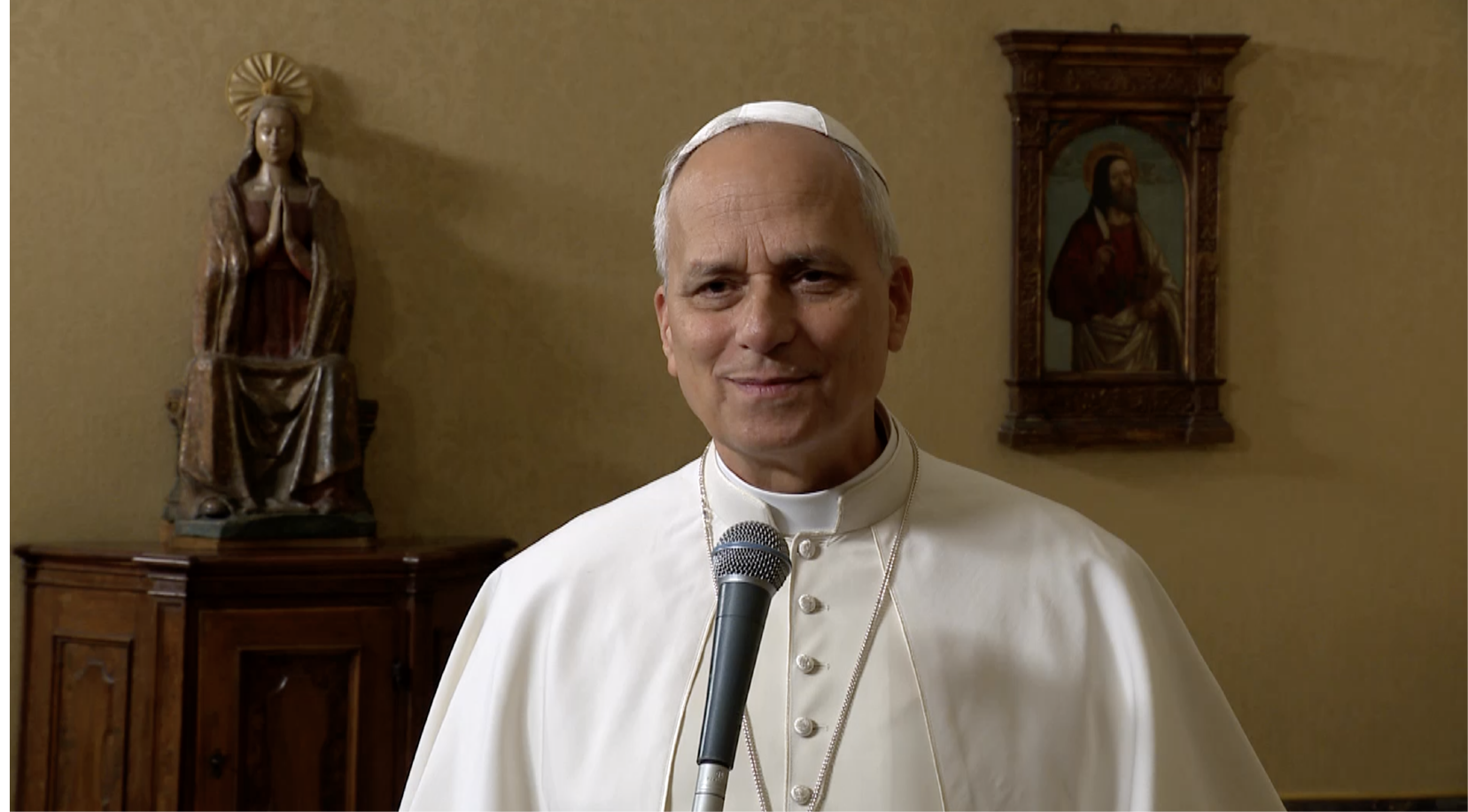
(ZENIT News / Rome, 11.12.2025).- Next Saturday, November 15, a quiet yet symbolically rich scene will unfold inside the Apostolic Palace. The corridors of the Vatican will welcome a constellation of filmmakers, actors, and artists from across the world—names that rarely share a stage, let alone an audience with the Bishop of Rome. Monica Bellucci, Cate Blanchett, Viggo Mortensen, George Miller, Spike Lee, Gus Van Sant, Giuseppe Tornatore, Emir Kusturica: the list reads like a who’s who of contemporary cinema. At the center of this unusual convergence will be Pope Leo XIV, who, in the year of the Jubilee, has decided to open a direct conversation with the art form that perhaps more than any other mirrors humanity’s longings, fears, and hope—the cinema.
The event, organized by the Dicastery for Culture and Education in collaboration with the Dicastery for Communication and the Vatican Museums, had once been a dream deferred. Under Pope Francis, an earlier plan to gather filmmakers at Cinecittà, Rome’s legendary studio complex, was cancelled when the pontiff’s fragile health forced him into hospital. Now, under his successor, the dialogue between the Church and the “seventh art” resumes—less as a cultural gesture than as an act of curiosity and gratitude.
Ahead of the gathering, the Vatican released a short video message in which Leo XIV shared four films that, he said, “speak to my heart.” His choices—Frank Capra’s It’s a Wonderful Life (1946), Robert Wise’s The Sound of Music (1965), Robert Redford’s Ordinary People (1980), and Roberto Benigni’s Life is Beautiful (1997)—are striking for their simplicity. No avant-garde experiments, no theological allegories. Instead, four stories of ordinary goodness surviving against the odds, each exploring in its own idiom the same mystery: how light endures in a world that forgets it.
Ver esta publicación en Instagram
Observers in Chicago, where Robert Francis Prevost once lived as an Augustinian friar before becoming Pope Leo XIV, recall his fondness for movies. “He used to say that films are modern parables,” one friend noted years ago. It is not difficult to imagine why these four titles might have stayed with him. Capra’s It’s a Wonderful Life is a cinematic sermon disguised as a Christmas tale, a meditation on despair and grace. Wise’s The Sound of Music turns song into a moral language, a protest against conformity under tyranny. Redford’s Ordinary People explores the fragile redemption that arises not from miracle but from communication. Benigni’s Life is Beautiful transforms tragedy into love’s final act of imagination.
Each of these films captures something of what the Pope has often described as “the vocation to humanize.” If theology once found its imagery in icons and frescoes, the modern imagination, Leo XIV seems to suggest, now speaks in celluloid and light. Cinema, in this vision, becomes not a rival to faith but one of its secular extensions: a place where the invisible becomes visible, where redemption takes human form through the struggle to remain good.
The upcoming audience will not be a lecture on aesthetics. It is more likely to be a conversation between a man who spent his life among Augustinian classrooms and those who have spent theirs telling stories that shape culture’s collective soul. Yet the symbolism is impossible to miss. At a time when the Church is often seen as distant from modern creativity, Leo XIV’s gesture reaches toward a reconciliation between transcendence and imagination.
The presence of directors such as Marco Bellocchio—whose recent film Rapito sharply criticizes the papacy of Pius IX—adds a note of tension. But the Vatican has chosen inclusion over defensiveness. The very fact that Bellocchio, along with provocateurs like Gaspar Noé and Spike Lee, will cross the threshold of the Apostolic Palace is itself a statement: art, even when critical, is part of the dialogue. The Church no longer claims to dictate culture’s moral vocabulary; it wishes instead to converse within it.
In that sense, Leo XIV’s meeting with filmmakers might echo what John Paul II once told artists in his 1999 Letter to Artists: that they are “custodians of beauty,” partners in the divine act of creation. But this pope, less a philosopher and more a pastor, seems drawn to the human stories beneath the aesthetics—to the George Baileys and Guido Orefices of the world, whose silent heroism affirms that goodness still makes sense.
Thank you for reading our content. If you would like to receive ZENIT’s daily e-mail news, you can subscribe for free through this link.

Publicaciones relacionadas:
 Vatican Puts Online Archives on World War II and Persecution of Jews
 Pope’s Courageous Address to Diplomats on Abortion, Religious Freedom, Ideological Colonization, Women’s Equality, etc.
 Oman: New Country with Which the Vatican Establishes Diplomatic Relations
 These Are the Two Objectives That the Pope Asked the Cardinal He Sent on the Russia-Peace Mission
