

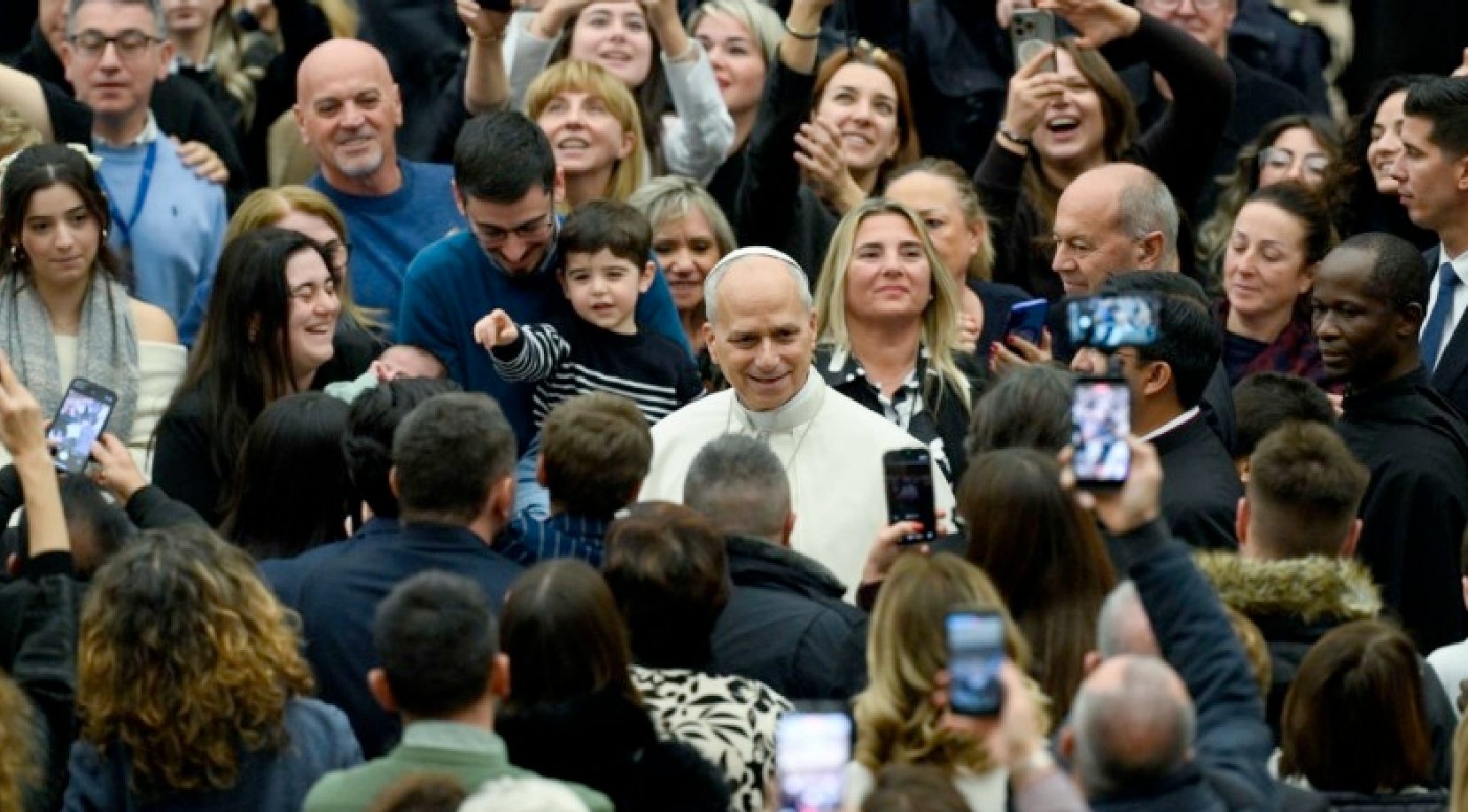
(ZENIT News / Vatican City, 12.22.2025).- Following the meeting with the cardinals residing in Rome and the heads of the dicasteries of the Roman Curia, Pope Leo XIV granted a special audience in the Paul VI Hall to the employees of the Holy See and the Roman Curia. This is another of the traditional pre-Christmas meetings in which the Pope takes the opportunity to thank those who serve the Church as employees. Below is the English translation of the Pope’s words. The Pope’s speech focused on work, based on a contemplation of the figures in the nativity scene.
***
In the name of the Father, and of the Son, and of the Holy Spirit.
Peace be with you!
Dear brothers and sisters,
Thank you for your warm greeting, and above all, thank you for coming to this Christmas event. As you know, for me it is the first, and it is the first time we all meet together, also with many of your family members, and this gives me great pleasure!
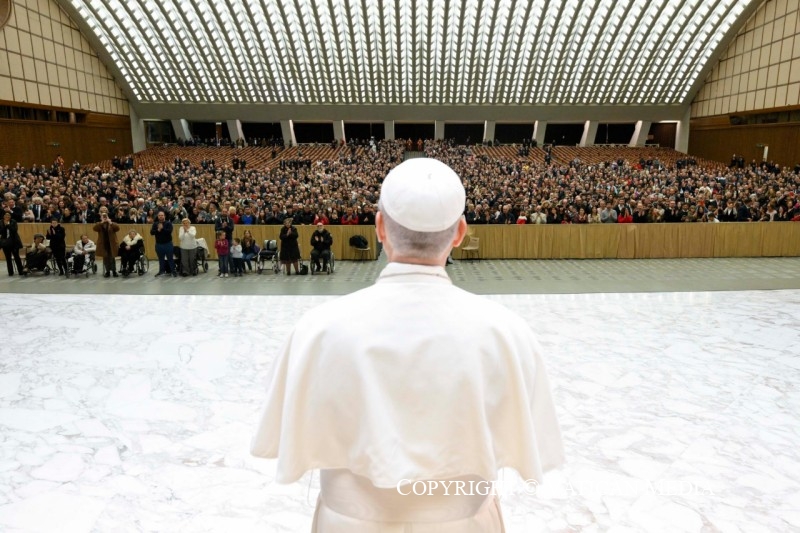
Today we must not talk about work, but I want to take advantage of this occasion to thank every one of you for the work you do. I am learning to know the Vatican as a large mosaic of offices and services, and gradually, with God’s help, I think I will also be able to meet you by visiting the various work environments.
But today I am happy about this family moment, now that Christmas Eve is almost upon us. We are experiencing it in front of the nativity scene, which is also present here, in this scene of the Nativity donated by Costa Rica. In the Nativity scene, popular imagination has often included many figures drawn from everyday life, who populate the space around the cave. And so, in addition to the inevitable shepherds, protagonists of the event according to the Gospel, we can find figurines representing various trades: the blacksmith, the innkeeper, the innkeeper’s wife, the washerwoman, the knife grinder, and so on. Of course, these are trades of the past: some of them have disappeared or been completely transformed. However, they retain their meaning within the nativity scene. They remind us that all our activities, our daily occupations, acquire their full meaning in God’s plan, which has its centre in Jesus Christ.
It is as if the Baby Jesus, lying in the manger, blesses everything and everyone. His gentle and humble presence spreads God’s tenderness everywhere. While Mary and Joseph adore the Child and the shepherds approach in wonder, the other characters go about their daily business. They seem detached from the central event, but this is not the case: in reality, each one participates in it just as they are, staying in their place and doing what they have to do, their job. I like to think that this can also be true for us in our working days: each of us carries out our task and we praise God precisely by doing it well, with commitment. Sometimes we are so caught up in our occupations that we do not think about the Lord or the Church; but the very fact of working with dedication, trying to give our best, and also – for you lay people – with love for your family, for your children, gives glory to the Lord.
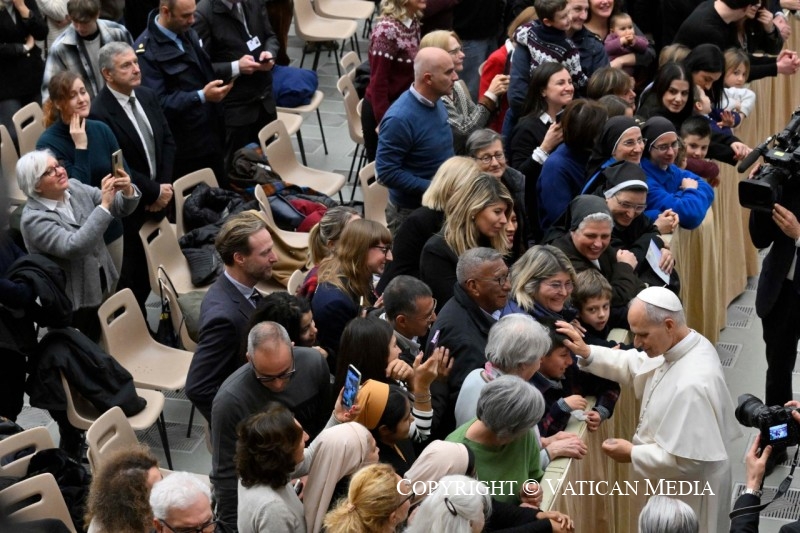
Dear friends, let us learn from the Christmas of Jesus the style of simplicity and humility, and let us all work together to ensure that this is increasingly the style of the Church in all her expressions. Please convey my greetings to your loved ones at home; especially to the elderly and the sick, tell them that the Pope is praying for them.
I wish you a holy Christmas, in the joy and serenity that Jesus gives us. Thank you!
Thank you for reading our content. If you would like to receive ZENIT’s daily e-mail news, you can subscribe for free through this link.

Publicaciones relacionadas:
 Why did Pope Leo give 500 euros to each Vatican employee?
 Another tradition revisited: Pope Leo XIV returns to the residence of Castel Gandolfo
 Pope Leo XIV inaugurates Borgo Laudato si’: Francis’ encyclical that became a reality in one place
 The traditional Latin Mass celebrated in St. Peter’s Basilica marks a new chapter under the pontificate of Pope Leo XIV
