

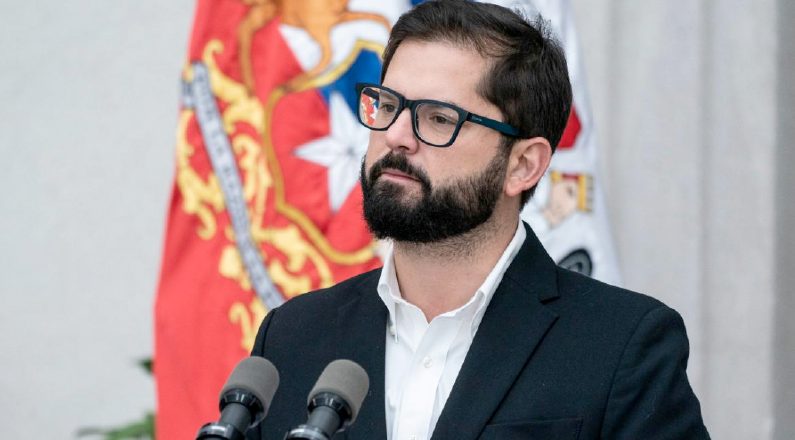
(ZENIT News / Santiago, 02.20.2026).- As fuel shortages darken Cuban cities and hospitals struggle to operate, Chile’s president has chosen an unexpected diplomatic channel: the Vatican.
President Gabriel Boric has formally appealed to Pope Leo XIV to help address what Santiago now describes as a full-scale humanitarian emergency in Cuba, a crisis exacerbated by tightening U.S. pressure on the island’s energy lifelines. The letter, delivered to the apostolic nuncio in Chile, Archbishop Kurian Mathew Vayalunkal, marks a calculated step: elevating Cuba’s plight to the moral and diplomatic arena of the Holy See.
According to Chile’s General Secretariat of the Presidency, Boric’s message expressed “concern over the living conditions of the population,” warning that the situation in Cuba has reached “a worrying humanitarian dimension.” The effects, as described by the Chilean government, extend far beyond economic discomfort. They now directly affect food distribution, hospital operations, public transportation, and the electrical grid.
The appeal arrives at a moment when Cuba’s energy crisis, already acute since mid-2024, has intensified. A recent escalation in Washington — including a January 29 presidential order imposing tariffs on entities that supply fuel to Cuba — has compounded fuel scarcity. The policy shift followed U.S. intervention measures in Venezuela and has contributed to what Santiago characterizes as a de facto oil siege.
The consequences are visible. Rolling blackouts have reached record levels. Aviation links have frayed. Airlines from Canada and Russia — Cuba’s two largest sources of tourists — temporarily suspended flights to Havana after evacuating stranded nationals amid fuel constraints. Tourism, one of the island’s essential revenue streams, now faces renewed instability precisely when hard currency is most needed.
Boric’s letter attempts to walk a tightrope familiar to Latin American diplomacy. “Without ignoring ideological differences, humanitarian welfare must be placed above conflicts between states,” he wrote, according to the official communiqué. The phrasing reflects a dual posture that has come to define his administration’s Cuba policy: condemnation of what he has called the “criminal” U.S. embargo, coupled with explicit criticism of Cuba’s political system, which he has described as a dictatorship.
La diplomacia es un bien escaso que sigue siendo insustituible como herramienta de contención, gestión de riesgos y de preservación de paz para un mundo más cohesionado y justo.
Agradezco a las y los representantes del cuerpo diplomático y de los organismos internacionales… pic.twitter.com/oU1oaHYdDH
— Gabriel Boric Font (@GabrielBoric) February 17, 2026
This balancing act has domestic implications. Boric governs with a broad coalition that includes his own Broad Front party, the Communist Party, and traditional center-left factions. Cuba has long been a symbolic touchstone within Chilean leftist politics. While Boric defended the Cuban model during his years as a student leader and legislator, his tone has shifted since assuming the presidency in March 2022. He now pairs denunciations of external sanctions with calls for democratic reforms and respect for human rights — a stance that has generated unease among Communist allies.
The letter to Rome underscores that tension. Boric emphasized that any sustainable resolution must include “advances in democracy and human rights,” highlighting concerns about fundamental freedoms and the situation of political detainees. In effect, he is asking the Vatican not only to advocate humanitarian relief but also to encourage structural political change.
Why the Holy See? The Vatican maintains diplomatic relations with both Havana and Washington and has historically served as a discreet intermediary in sensitive geopolitical matters. Its role in facilitating U.S.–Cuba rapprochement during the Obama era remains a reference point in diplomatic circles. While no formal mediation has been announced, Chile’s outreach signals confidence in the moral leverage and backchannel capacity of papal diplomacy.
Chile has not confined itself to rhetoric. In early February 2026, the government pledged $1 million in humanitarian assistance to Cuba through UNICEF, aligning with aid commitments from countries such as Mexico and Spain. Though modest in scale, the contribution situates Santiago within a broader coalition seeking to cushion the humanitarian fallout.
The Vatican has not publicly commented on Boric’s appeal. Yet the request places the Holy See in a familiar position: urged to act where statecraft has stalled, to speak where alliances divide. In Catholic social teaching, the principle that human dignity transcends political antagonism is foundational. Boric’s letter invokes precisely that logic.
Cuba’s predicament, however, is not solely the product of recent U.S. measures. Structural economic weaknesses, governance constraints, and years of limited reform have left the island vulnerable to external shocks. Energy scarcity magnifies every deficiency. When fuel runs short, refrigeration falters, transport halts, and hospital generators strain — cascading effects that transform economic policy into humanitarian emergency.
By turning to Pope Leo XIV, Boric is betting that moral authority can help unlock political space. Whether Rome will step beyond general appeals into more active engagement remains uncertain. But the gesture itself is telling: in a hemisphere long shaped by ideological rivalry, Chile’s president has chosen to frame Cuba’s crisis less as a battlefield of systems and more as a test of conscience.
Thank you for reading our content. If you would like to receive ZENIT’s daily e-mail news, you can subscribe for free through this link.

