

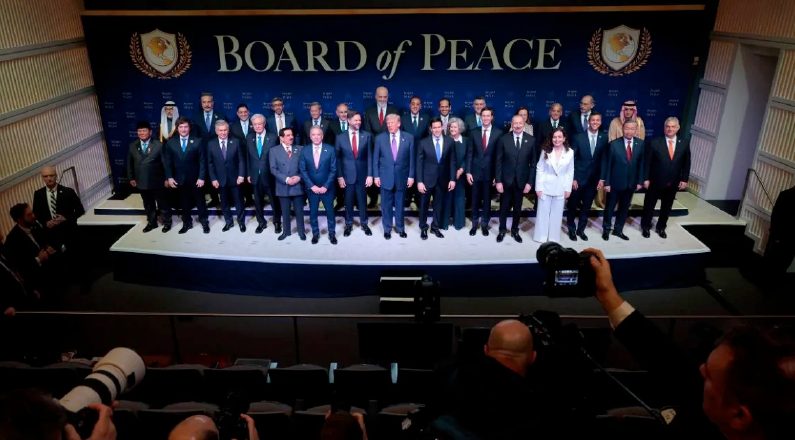
(ZENIT News / Washington, 02.20.2026).- The war may have paused, but the contest over who shapes Gaza’s future has only begun.
On February 19, President Donald Trump unveiled how $5 billion pledged by member states of a newly formed Peace Board will be deployed to rebuild Gaza, marking the first formal session of the body in Washington, D.C. The announcement comes four months after an October 2025 ceasefire ended two years of warfare between Israel and Hamas, a conflict triggered by the 2023 terrorist attacks that plunged the region into one of its bloodiest cycles in recent memory.
The Peace Board — an ad hoc coalition distinct from existing United Nations frameworks — includes key Middle Eastern actors such as Israel, Qatar, and Turkey. Its stated mandate is ambitious: coordinate reconstruction financing while pairing humanitarian relief with a temporary international stabilization force to prevent a relapse into violence.
White House Press Secretary Karoline Leavitt outlined the dual-track strategy on February 18. Aid delivery, she explained, will be synchronized with security oversight provided by an international stabilization contingent working alongside local police structures. The approach echoes provisions contained in the October ceasefire arrangement, which called for a temporary multinational force composed of troops from Arab and majority-Muslim countries tasked with training and vetting a reconstituted Palestinian police service.
The administration’s message is clear: bricks and mortar will rise only if security architecture rises with them.
What distinguishes the Peace Board initiative is not merely its funding scale — $5 billion in pooled commitments — but its attempt to create a political framework parallel to the U.N. system. That design choice has drawn hesitation from several traditional U.S. allies.
France, Sweden, and Norway declined invitations to join the board. Canada’s invitation was withdrawn by Trump himself. Most notably, the Vatican opted not to participate. According to Leavitt, the Holy See expressed concern that involvement might appear to compete with established U.N. peacekeeping mechanisms.
“It is deeply unfortunate,” Leavitt said, adding that peace efforts should not become “partisan, political, or controversial.” She emphasized that the board’s mission is narrowly focused: overseeing the reconstruction of a territory “ravaged by violence, bloodshed, and poverty for far too long.”
The Vatican’s hesitation carries symbolic weight. The Holy See has long positioned itself as a moral voice in Middle Eastern diplomacy, advocating a two-state solution and humanitarian corridors while maintaining dialogue with both Israeli and Palestinian leaders. Its refusal to sit on the Peace Board suggests either institutional caution or discomfort with a framework perceived as politically aligned with Washington’s strategic agenda.
At the same time, the absence of certain Western partners underscores a broader geopolitical recalibration. The Trump administration appears intent on constructing a coalition centered more heavily on regional stakeholders and selective global actors rather than on multilateral consensus.
The financial blueprint itself has not been disclosed in granular detail, but administration figures Jared Kushner and special envoy Steve Witkoff have recently promoted investment-driven reconstruction concepts. Their vision emphasizes attracting international capital — not merely public aid — to stimulate housing, infrastructure, and commercial development. In previous discussions, Kushner has argued that economic transformation can alter political trajectories, though critics question whether such investment can take root amid unresolved sovereignty disputes.
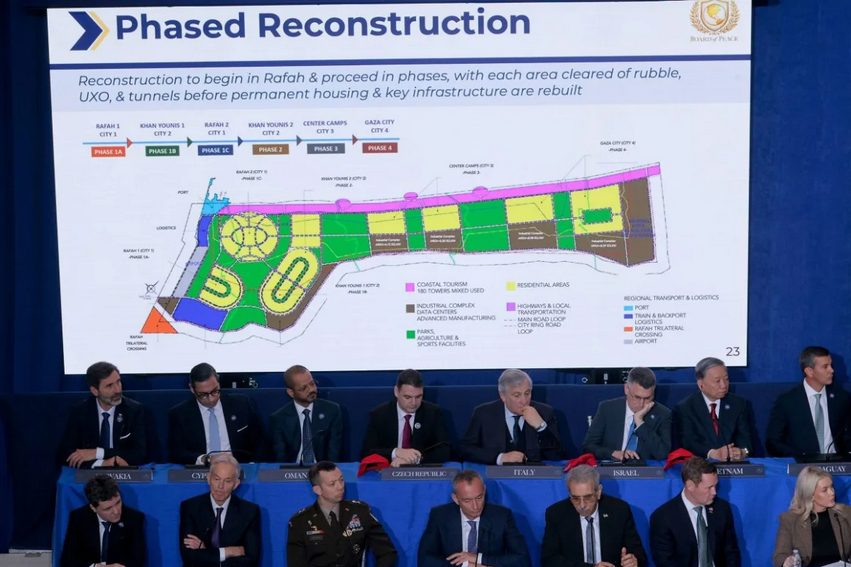
Security remains the linchpin. The Associated Press reported that the ceasefire terms include deploying a temporary international stabilization force drawn from Arab and majority-Muslim nations. This contingent would train and evaluate a new Palestinian policing body, theoretically replacing structures compromised by years of conflict and factional control.
The idea reflects lessons drawn from other post-conflict theaters: reconstruction without enforceable security guarantees risks collapse. Yet any foreign troop presence in Gaza is fraught with political sensitivities, particularly given the enclave’s history of contested governance and resistance to external control.
For Israel, participation in the Peace Board offers a channel to influence reconstruction oversight while maintaining vigilance against Hamas reconstitution. For Qatar and Turkey, both of which have played mediating roles in the past, the board provides diplomatic leverage and visibility in shaping postwar arrangements.
What remains uncertain is whether the $5 billion commitment represents a first tranche or a comprehensive ceiling. Gaza’s infrastructure — housing, hospitals, utilities, transportation corridors — suffered extensive damage during the two-year war. Large-scale rebuilding will likely require multiples of that figure over time, particularly if long-term economic viability is to be achieved rather than short-term humanitarian stabilization.
The diplomatic choreography surrounding the Peace Board reveals a secondary struggle beneath the reconstruction narrative: who sets the terms of peacebuilding legitimacy. By declining participation, the Vatican and several European states signal caution about endorsing an initiative that could be interpreted as sidelining established international mechanisms.
Trump, however, appears undeterred. According to Leavitt, the president sees the board as the vehicle through which his “bold and ambitious” plan is already moving forward.
Gaza’s skyline remains scarred, its political future unsettled. Whether this new architecture of oversight — financed by billions and backed by a stabilization force — can convert ceasefire into durable peace will depend less on announcements in Washington than on realities on the ground. But for now, the administration has drawn a line: reconstruction will proceed under a framework of its own design, even if not all traditional partners are at the table.
Thank you for reading our content. If you would like to receive ZENIT’s daily e-mail news, you can subscribe for free through this link.

