
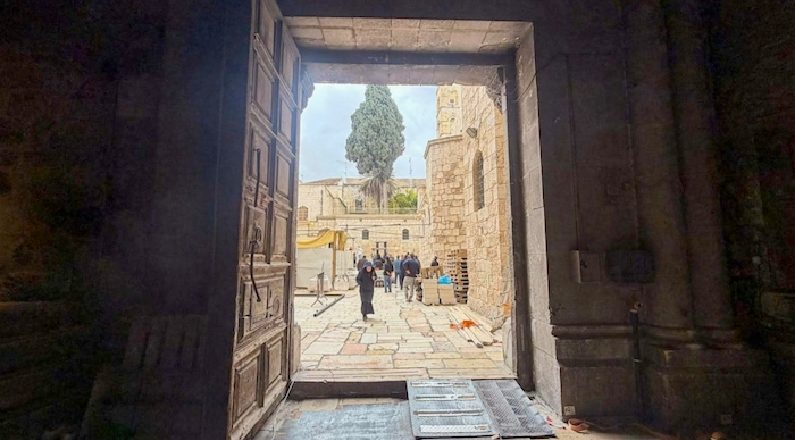
(ZENIT News – TerraSantaNet / Jerusalem, 03.01.2026).- On Thursday February 19, 2026, an exceptional scene was witnessed at the entrance to the Basilica of the Holy Sepulchre: the doors of the ancient portal of the Basilica were ripped off from their hinges. A team of workmen, assigned to the restoration project of the floor of the Basilica, removed them.
Taking advantage of the presence of the workers and their equipment, and observing that the doors showed signs of deterioration, the Churches responsible for the sacred building mutually agreed to proceed with the restoration (entrusted to Italian technicians and financed by funds from the Italian Agency for Development Cooperation — Editor’s note).
While awaiting the return of the 12th-century doors to their original position, the doors have been replaced with panels displaying photographic reproductions of the original doors, to maintain the illusion of their presence.
The last documented intervention on these doors dates back to 1810, during the restoration undertaken by the Greek Orthodox Church following the fire of the Basilica.
Most pilgrims don’t pay much attention to the Basilica’s main door and assume it’s open. Hardly anyone notices that next to the entrance there’s a double portal, but it’s walled up, as were all the doors of the Basilica of the Crusades after Saladin’s conquest of the city in 1187. To ensure that Christians didn’t enter the Basilica without paying the required tax, Saladin also bricked up the windows of the rotunda, plunging into darkness a place designed to receive light.
What today’s pilgrims, like most guides, don’t know is that Saladin entrusted the keys to Muslim families tasked with collecting this tax. Accounts from early pilgrims are replete with stories of standing before the tiled gate of the Basilica. After a long journey on foot and paying the tax to enter the city, they often found themselves without the means to open that gate as well. Furthermore, the gate opened only once a day –in the afternoon, around 3:00 p.m., and was closed behind the pilgrims, who were «released» the following morning.
For this very reason, at the beginning of the 14th century, clergymen of various denominations chose to shut themselves up in the Basilica: only in this way could they guarantee prayer in the most important church in Christendom. Trapdoors were carved into the wooden doors for them and their supplies.
Today, only one of these openings is still used daily for the famous closing ceremony of the doors, which was regularly attended by groups of pilgrims. Through this opening, on the right-hand door, there is a ladder used by a descendant of the Nusseibeh family to reach the upper lock and close the door, while a descendant of the Joudeh family retrieves the long, ancient metal key. These same two families have performed this task since 1246.
Mehemet Ali is credited with opening the doors during the day and abolishing the entrance tax (which is still levied on certain occasions when paid by the three main ecclesiastical communities), beginning in 1832.
In 2018, the Churches decided to close the Basilica of the Holy Sepulcher in protest against a tax attack against them. During those days, pilgrims who were prevented from entering touched and caressed the wooden door and prayed before it. The doors remained closed, by order of the civil authorities, also during the COVID-19 pandemic, and were disinfected by municipal services during that time.
To the great disappointment of the pilgrims, the Basilica remained closed for much of Holy Thursday, after the Pontifical Mass, until well into Good Friday morning, after the Liturgy of the Passion. Access was only permitted to those wishing to participate in the lengthy liturgical rites.
Over eight hundred years old, the Basilica’s wooden doors were in dire need of restoration. They were subsequently returned to their former splendour, preserving their charm and the enduring traces of history.