

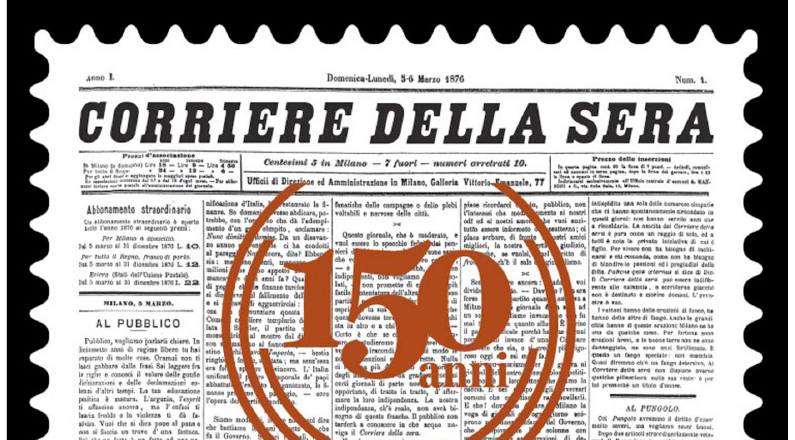
(ZENIT News / Rome, 03.06.2026).- When a newspaper reaches a century and a half of continuous publication, it inevitably becomes more than a chronicler of events. It becomes part of the story itself. That was the central theme of the message sent by Pope Leo XIV to the Italian daily Corriere della Sera on the occasion of the paper’s 150th anniversary, a milestone that highlights the long relationship between journalism, culture, and public life in Italy.
Founded in Milan in 1876, the newspaper has accompanied the country through some of the most dramatic chapters of modern European history. In a letter addressed to its editor, Luciano Fontana, the Pope congratulated the publication for its longevity while acknowledging the role it has played not merely as a vehicle for reporting events, but as a forum where ideas and cultural currents have circulated within Italian society.
According to the pontiff, the newspaper’s trajectory cannot be separated from that of the nation itself. Over the past 150 years, its pages have recorded Italy’s passage through the upheavals of the twentieth century and beyond: two world wars, the rise and collapse of fascism, the transformation from monarchy to republic, and the turbulent decades marked by domestic and international terrorism. The paper also reported on the geopolitical shifts that reshaped Europe, including the symbolic moment of the Fall of the Berlin Wall, which signaled the end of the Cold War order.
For Leo XIV, recalling these milestones was not simply an exercise in historical nostalgia. Instead, it provided a framework for reflecting on the present condition of journalism. Today, he noted, the communications landscape is being transformed by technological change at a pace unseen in previous eras.
The Pope pointed in particular to the impact of artificial intelligence, describing the current moment as a test that challenges both media institutions and society at large. While digital tools are reshaping how information is produced and distributed, he suggested that certain aspects of journalism remain irreplaceable.
Among these, he highlighted the authority that established newspapers derive from their history and professional standards. In the Pope’s view, the credibility of journalism depends on several principles: transparency about sources, respect for the professional vocation of reporters, and regard for the dignity of readers. These elements, he implied, are especially crucial in an age when information can circulate instantly and without verification across digital platforms.
Another dimension Leo XIV emphasized was the human element of storytelling. Technology may accelerate the flow of information, he observed, but experience and judgment remain essential for interpreting events and giving them meaning. The narrative craft developed by seasoned journalists—shaped by years of observing political, social, and cultural developments—cannot easily be replicated by automated systems.
Such reflections place the responsibility of the press in a broader civic context. Newspapers, particularly those with long traditions, serve as institutions that help societies understand themselves. In this sense, the Pope suggested, the legacy of a publication like Corriere della Sera carries obligations as well as prestige.
Closing his message, Leo XIV offered his good wishes for the anniversary, describing it as evidence of the deep bond between the newspaper and the country whose history it has documented for generations. That connection, he said, should encourage the publication not only to preserve its roots but also to continue shaping its future.
Thank you for reading our content. If you would like to receive ZENIT’s daily e-mail news, you can subscribe for free through this link.

Publicaciones relacionadas:
 [PHOTO GALLERY] First Marian shrine visited by the Pope: what is its dedication and where is it?
 Pope Leo XIV’s Coat of Ams Explained by Heraldic Expert
 Leader of Ukrainian Catholics visits the Pope and invites him to Ukraine: “his visit would contribute to stop the war”
 Leo XIV to separated Christians: “I consider the reestablishment of full and visible communion a priority”
