

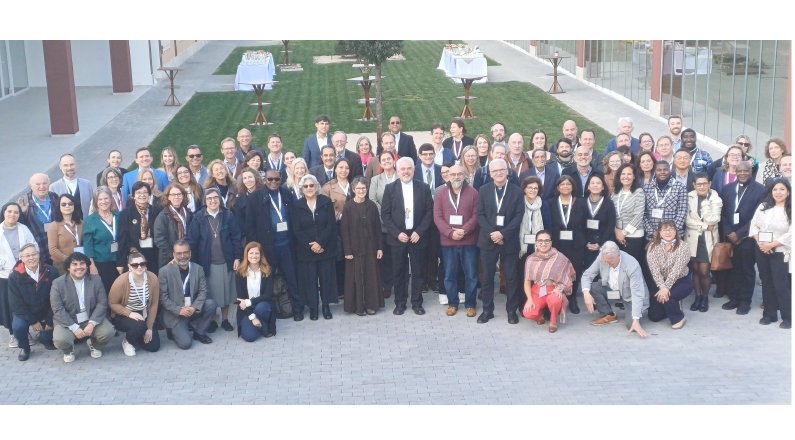
(ZENIT News / Castelgandolfo, 03.13.2026).- Two days of dialogue among researchers from more than 60 universities and 30 countries marked the launch of the Global Alliance, an international platform for academic and scientific collaboration aimed at developing a global agenda on awareness, research, education, and action on integral ecology, inspired by the principles of the encyclical Laudato Si’.
The initiative, led by the Laudato Si’ Higher Education Center and the University of Notre Dame, brought together scholars from a wide range of disciplines with the goal of strengthening cooperation among universities worldwide, and directing scientific research toward concrete processes of environmental, social, and economic transformation; in line with the vision of the care for our common home advanced in the teachings of Pope Francis and promoted by Pope Leo XIV.
The first day of discussions was devoted to presenting research activities already underway at participating universities and to identifying new opportunities for international collaboration. Speakers highlighted the central importance of an interdisciplinary approach capable of integrating the natural and applied sciences with philosophy, anthropology, the social sciences, and theology.
The discussions stemmed from several of the most significant passages of the encyclical Laudato Si’, contributing to a deeper exploration and development of its cultural, scientific, and social legacy. Academic work was understood as part of a broader process, aimed at fostering an authentic ecological conversion. This, through research networks capable of generating knowledge, supporting public debate, and contributing to the development of policies and strategies for sustainable development.
The dialogue gradually expanded beyond the strictly environmental dimension to address structural issues affecting global balances; including climate finances, public debt cancellation, and the dynamics of neocolonialism.
These themes reflect the vision of integral ecology proposed in Laudato Si’, which connects environmental protection with issues of social justice, the responsibility of financial systems, and the transformation of economic models. The ecological crisis, in fact, cannot be separated from economic inequality and the structural dynamics that shape the current global development system.
From this perspective, discussions among participants underscored the need for an integrated approach involving not only the research community and public institutions, but also the private sector, production systems, markets, and investors—individuals that are called upon to contribute to building economic models that are more sustainable, equitable, and oriented toward the common good.
Borgo Laudato Si’ provided both the symbolic and operational setting for the gathering, offering participants a concrete example of how the principles of the Encyclical can be put into practice through initiatives that integrate environmental, social, educational, and faith dimensions.
Conceived as a place for education, research, and experimentation, the Borgo serves as a laboratory for integral ecology, capable of translating the principles of Catholic Social Teaching into practices and models that can be replicated in other contexts. This space generated strong interest among participants, who emphasized the importance of promoting similar paths of transformation within universities and research centers around the world.
The second day of discussions marked a transition from reflection to the definition of operational tools. Participants established six interdisciplinary working groups, tasked with developing the main research lines of the Global Alliance in the coming years.
Their work will focus in particular on the following strategic priorities:
- Removing barriers that prevent access to clean water, energy, and food security.
- Transforming economic systems toward more sustainable and just models.
- Developing best practices and tools to promote collective action.
“The first day has been an extraordinary richness of content and shared reflection,” said Cardinal Fabio Baggio, General Director of the Laudato Si’ Center for Higher Education. “Universities and research centers presented studies and projects ranging from the applied sciences to philosophy, from anthropology to the human sciences and theology. This enthusiasm, born also from a shared desire to serve the good of humanity and to care for creation, is a sign of great hope. We are now called to transform it into concrete goals through working groups that will continue beyond the conference, initiating a lasting process of collaboration among research centers and institutions, in service of caring for our common home and promoting an authentic integral ecology.”
“We emerge from this first gathering of the Global Alliance with a renewed sense of purpose and hope,” said University of Notre Dame President Rev. Robert A. Dowd, C.S.C. “These interdisciplinary research and education initiatives reflect our commitment to an integral ecology that recognizes the deep connections between environmental sustainability and human dignity and flourishing. We look forward to the many ways this collaboration will serve the common good and advance the care for our common home in the days ahead.”
The conclusion of the gathering marks the beginning of a “synodal journey” intended to develop over time through research and educational processes with the potential for significant positive impact at the local, regional, and global level. The insights that emerged will contribute to the development of new educational programs dedicated to an integral ecology, the creation of new research lines on the impacts of environmental and social transformation, and the promotion of awareness initiatives directed toward civil society.
Thank you for reading our content. If you would like to receive ZENIT’s daily e-mail news, you can subscribe for free through this link.

