

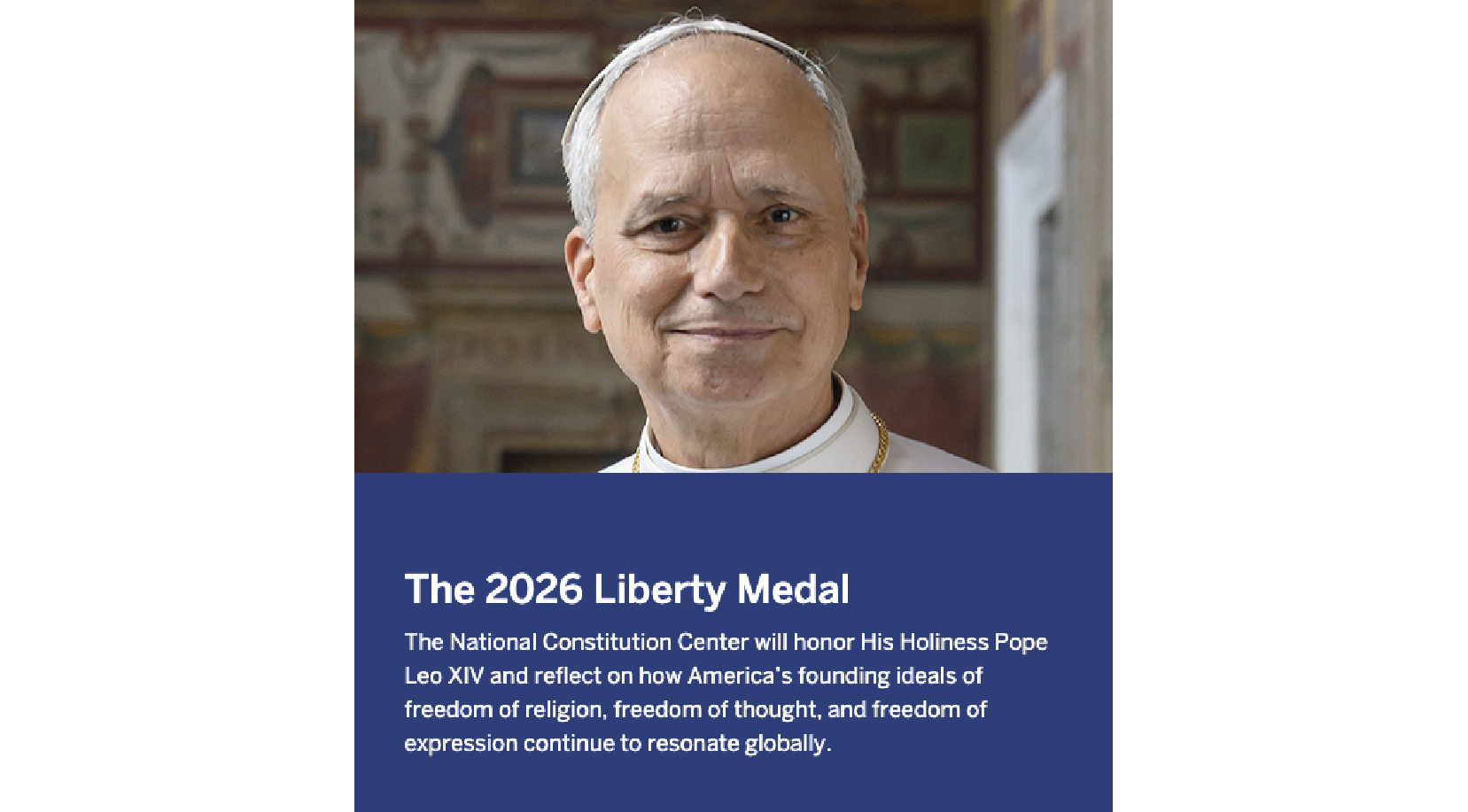
(ZENIT News / Washington, 03.17.2026).- On July 3: in the shadow of Independence Hall, where the country’s founding documents were signed, the nation will honor a pope—an event that would have seemed improbable, even paradoxical, to earlier generations.
The National Constitution Center has chosen Pope Leo XIV as the recipient of its 38th annual Liberty Medal, marking the first time a pontiff receives the distinction since its creation in 1988. The award recognizes his long-standing advocacy for religious freedom, freedom of conscience and expression—principles enshrined in the First Amendment and deeply embedded in the American constitutional tradition.
The ceremony, to be held on Independence Mall and broadcast nationally, will gather civic leaders, religious representatives and the public in a setting that is itself part of the message. It is not merely a commemorative act but a deliberate reflection on the evolution of freedom across centuries and cultures. Leo XIV will not be physically present; consistent with Vatican practice of avoiding politically sensitive contexts—especially in an election year—he will address the audience remotely from Rome.
That absence, however, is unlikely to diminish the symbolic weight of the moment. On the contrary, it underscores a broader narrative: the globalization of ideas once considered distinctly American, and their reinterpretation through a universal religious lens.
The choice of an American-born pope—elected in May 2025 following the death of Pope Francis—adds an additional layer of meaning. Born in Chicago and shaped by missionary work in Peru, Leo XIV embodies a convergence of cultural experiences that mirrors the pluralism the award seeks to celebrate. His pontificate has consistently emphasized interreligious dialogue and peaceful coexistence, engaging Jewish, Muslim and Christian leaders in an effort to frame religious freedom not simply as a legal guarantee but as a condition for human dignity.
Organizers have been explicit about this broader interpretation. For them, honoring the pope is not only about recognizing an individual, but about narrating a longer story—one that includes multiple faith traditions and acknowledges the complex path through which religious liberty became a foundational principle in the United States.
That path, historians note, was far from linear. The First Amendment’s protection of religious freedom emerged in the late eighteenth century as a radical departure from Europe’s legacy of confessional states and sectarian conflict. Yet, in the centuries that followed, American society itself struggled to fully embody that ideal. Waves of anti-Catholic sentiment in the nineteenth and early twentieth centuries targeted immigrants from Ireland, Italy and Poland, often portraying their allegiance to Rome as incompatible with democratic citizenship.
Against that historical backdrop, the image of a pope receiving a Liberty Medal on the eve of the nation’s semiquincentennial speaks to a significant cultural shift. It suggests not the absence of tension, but its transformation—what was once perceived as a threat is now framed as a contribution to the common good.
The decision also resonates with contemporary debates. In recent months, Leo XIV has entered into sensitive discussions on immigration policy in the United States, supporting statements by the country’s bishops that criticized mass deportations and raised concerns about detention conditions and limited pastoral access for migrants. In public remarks, he has called for the humane treatment of individuals who have lived for years in the country, insisting that legal enforcement must not come at the expense of dignity.
This tension between law and humanity is likely to form an implicit backdrop to the Philadelphia ceremony. Indeed, the very concept of freedom being celebrated—freedom of conscience—has increasingly intersected with questions of migration, identity and social cohesion, both in the United States and globally.
The Pope’s itinerary in the days surrounding the event reinforces this connection. On July 4, while Americans commemorate their independence, Leo XIV will travel to Lampedusa, one of the principal entry points for migrants crossing the Mediterranean from North Africa. The visit recalls the first papal journey of Pope Francis in 2013 and signals continuity in the Church’s attention to the humanitarian dimensions of migration.
Seen together, the two moments—Philadelphia and Lampedusa—form a coherent narrative. One celebrates a constitutional ideal forged in the eighteenth century; the other confronts a contemporary reality in which that ideal is tested at the borders of nations.
The Liberty Medal itself has long sought to bridge such divides. Previous recipients include figures as diverse as the Dalai Lama, Malala Yousafzai, Ruth Bader Ginsburg and Volodymyr Zelenskyy—individuals whose work has shaped global conversations on rights and dignity.
In awarding the medal to Leo XIV, the National Constitution Center appears to be making a broader claim: that religious freedom, far from being a relic of constitutional history, remains a living and contested principle. And that its defense today requires not only legal frameworks, but also moral leadership capable of navigating a world marked by diversity, conflict and displacement.
Two hundred and fifty years after the signing of the Declaration of Independence, the question is no longer simply how freedom was achieved, but how it is sustained. In that sense, the figure of a pope—speaking from Rome to an American audience, and then traveling to the edge of Europe—captures the paradox of the present moment: freedom is both rooted in history and constantly redefined by the challenges of a changing world.
Thank you for reading our content. If you would like to receive ZENIT’s daily e-mail news, you can subscribe for free through this link.

