

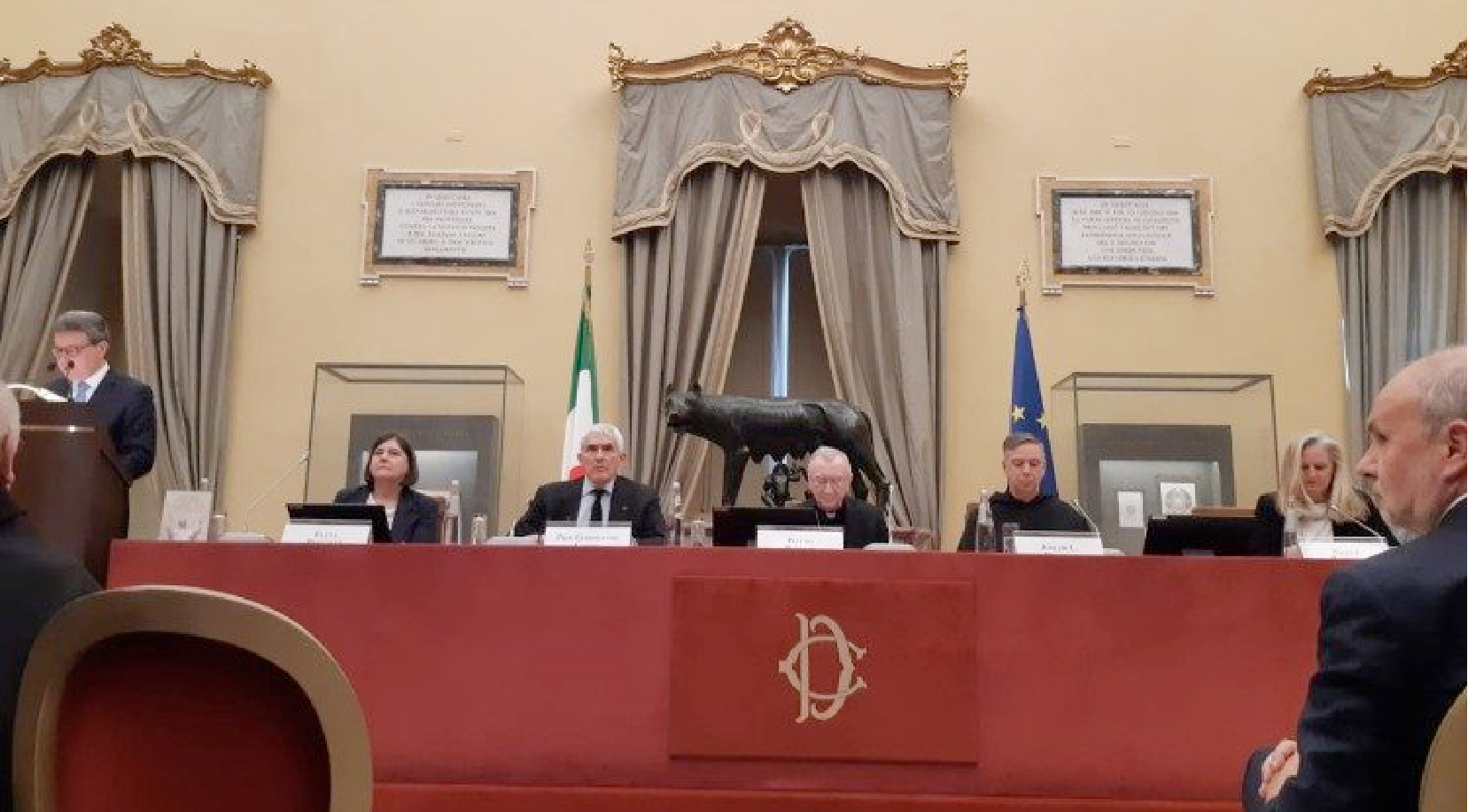
- (ZENIT News / Rome, 03.20.2026).- In the halls of Italy’s Chamber of Deputies, far from the sound of missiles and air raid sirens, the Holy See’s top diplomat issued a appeal. “Leave Lebanon in peace,” Cardinal Pietro Parolin urged, sketching in a few words the Vatican’s growing alarm over a conflict that is no longer regional in scope but systemic in its implications.
The appeal came as the war stretching from Iran to the Mediterranean intensifies, drawing in state and non-state actors and placing civilian populations—especially minorities—under mounting pressure. For the Vatican, the crisis is not merely geopolitical. It is existential, moral, and increasingly ecclesial.
Parolin, speaking on the sidelines of a book presentation dedicated to Pope Leo XIV, framed the current moment as one of dangerous escalation. His message was directed not only at Washington but also at Israel: conflicts must be resolved through diplomacy, not force. The risk, he suggested, is no longer hypothetical. It is imminent.
His remarks echo a broader Vatican line that has taken shape under the new pontificate. Leo XIV’s call for a “disarmed and disarming peace,” first articulated at the outset of his papacy, has become a leitmotif in Rome’s reading of global affairs. According to Parolin, this vision stands firmly within the continuity of 20th-century papal diplomacy—from Benedict XV’s condemnation of World War I as a “useless slaughter” to the social magisterium of Paul VI. Yet the current context, marked by rearmament and the normalization of force, gives that tradition a renewed urgency.
The Pope’s leadership style, described by his Secretary of State as deeply dialogical and marked by a preference for shared decision-making, is not incidental to this vision. It is structural. Listening, Parolin insisted, is not a soft skill but an ecclesial act—one that shapes governance, fosters unity, and resists the polarization that increasingly affects both Church and world. In a time when ideological fractures threaten to turn Catholicism either into a political actor or a defensive enclave, the insistence on unity through dialogue reflects a strategic as much as a spiritual choice.
Yet if Rome articulates principles, it is in the Middle East that those principles collide with reality.
From Jerusalem, Cardinal Pierbattista Pizzaballa has offered one of the starkest assessments of the ongoing war. His warning is theological as much as political: invoking God to justify violence, he argues, constitutes one of the gravest sins of the present moment. War, he insists, is driven by concrete interests, not divine mandates—and any attempt to frame it otherwise amounts to manipulation.
This critique was prompted in part by references to biblical texts used in political rhetoric surrounding military actions. But Pizzaballa’s concern runs deeper. In his view, the introduction of religious language into the conflict risks transforming it into something even more intractable, feeding absolutist narratives that leave no room for compromise.
“There are no new crusades,” he stated bluntly. If God is present in this war, he added, it is not on the side of those who wield power, but among the victims: the dead, the wounded, the displaced.
Those victims are increasingly concentrated in places like Gaza, where the humanitarian situation remains catastrophic despite diminishing international attention. According to figures cited by Church officials, around two million people are displaced, 80 percent of infrastructure is destroyed, and basic medical supplies—including antibiotics—are scarce. Thirty-six hospitals operate only partially. Reconstruction has not begun.
The deadlock is total. Hamas refuses to disarm without Israeli withdrawal; Israel refuses to withdraw without Hamas disarming. Meanwhile, civilians are trapped in what Pizzaballa describes as a “vicious circle” with no visible exit.
The situation in the West Bank is no less alarming. Daily attacks by settlers, severe restrictions on movement through nearly a thousand checkpoints, and new legislative measures affecting land ownership and education are compounding an already volatile environment. For Christian communities, the consequences are particularly acute: declining access to employment, education, and mobility is accelerating emigration trends that have been underway for years.
In Lebanon, the war has taken on a different but equally devastating form. Israeli airstrikes targeting Hezbollah infrastructure have triggered mass displacement on a scale that recalls previous conflicts. More than one million people—roughly a fifth of the population—have been forced from their homes. In the first wave alone, at least 30,000 fled within hours of overnight bombardments.
The social fabric of the country, already weakened by economic collapse, is under extreme strain. Public institutions are overwhelmed. Some 700 shelters, many of them schools, now host over 130,000 displaced individuals, while countless others rely on informal networks for survival.
Testimonies from the ground reveal a climate of pervasive fear. In Beirut, even areas once considered relatively safe are now exposed to strikes. In the Christian district of Gemmayzeh, a Franciscan monastery has become a refuge for around 150 people, despite lacking even a proper shelter. Children react to any loud noise as if it were an explosion. For many, the psychological toll rivals the physical danger.
Yet amid the chaos, ecclesial structures have become critical nodes of resilience. Parishes, monasteries, and Church-run organizations are providing food, shelter, and medical assistance, often stepping in where the state cannot. Humanitarian convoys, including those coordinated by Catholic networks, continue to reach some of the hardest-hit areas, though access remains precarious.
The Apostolic Nuncio to Lebanon, returning from a mission to the country’s southern villages, described landscapes emptied of life: rubble, silence, and the intermittent sound of shelling. His message to those he encountered—Christians, Muslims, and mixed communities alike—was one of proximity, peace, and hope. But even he acknowledged the obvious: this is war.
Overlaying these local crises is a broader geopolitical escalation. The confrontation between the United States, Israel, and Iran has extended into strategic domains such as the Strait of Hormuz, through which a fifth of the world’s oil supply typically passes. Disruptions there have driven crude prices above 100 dollars per barrel, raising fears of a global economic shock.
Casualty figures continue to climb: more than 1,300 dead in Iran, hundreds in Lebanon, and dozens in Israel and among U.S. forces. Thousands more have been injured. The scale and intensity of the conflict suggest that containment is becoming increasingly difficult.
For the Vatican, however, the most alarming trend may not be the military escalation itself, but its long-term demographic and cultural consequences. According to Aid to the Church in Need, the Christian presence in the Middle East—already diminished by decades of conflict—faces the risk of near disappearance. Migration, driven by insecurity and lack of prospects, is steadily eroding communities that trace their roots back two millennia.
The question, then, is no longer only how to end the war, but what will remain once it is over.
In this context, the Church’s insistence on dialogue, its rejection of religiously framed violence, and its emphasis on unity—both internal and external—appear less as abstract principles than as strategic imperatives. Whether they will be sufficient to counter the logic of war remains uncertain.
But as Parolin’s intervention in Rome makes clear, the Holy See is determined to continue articulating them—even as the space for listening grows ever narrower.
Thank you for reading our content. If you would like to receive ZENIT’s daily e-mail news, you can subscribe for free through this link.

Publicaciones relacionadas:
 Pope Leo XIV, the US-Iran war, and a forceful call in a Middle East on the brink of the abyss
 Vatican questions “preventive” war in Iran as Leo XIV intensifies diplomatic calls for peace
 From Castel Gandolfo, Pope Leo XIV Calls for Peace Amid Gaza’s Agony and UN Genocide Allegations
 The Middle East on the Brink of Collapse: Another Call for Peace from the Pope, the Death of a Member of the Order of Malta in Lebanon, and Bombings at Shepherds’ Fields in Bethlehem
