

(ZENIT News / London, 03.28.2026).- A exchange of letters—and an imminent meeting in Rome—signals a renewed moment in the long and delicate relationship between Anglicans and Catholics, as Sarah Mullally prepares for her first official encounter with Pope Leo XIV.
The newly installed Archbishop of Canterbury will travel to Rome from April 25 to 28, in what will be her first direct engagement with the Vatican since assuming office on March 25 at Canterbury Cathedral. The visit, confirmed by Lambeth Palace, comes at a moment rich in symbolism: the 60th anniversary of the first formal ecumenical declaration between the Anglican Communion and the Roman Catholic Church.
That milestone—the 1966 Common Declaration signed by Pope Paul VI and Michael Ramsey—marked a historic thaw after centuries of estrangement. It laid the groundwork for a sustained theological dialogue that continues today through bodies such as the Anglican–Roman Catholic International Commission (ARCIC).
A correspondence framed by unity
The forthcoming meeting was preceded by an exchange of letters that, while formal in tone, reveals a shared awareness of both progress and unfinished work. Writing to Mullally on the occasion of her installation, Pope Leo XIV assured her of his prayers and invoked the guidance of the Holy Spirit, encouraging her to draw inspiration from Mary as a model of faithful discipleship.
In her reply, Mullally reciprocated the gesture and placed her new ministry within a clearly ecumenical horizon. As Archbishop of Canterbury, she wrote, she is called not only to shepherd the Anglican Communion but to serve as an “instrument of communion,” working toward the “full and visible unity” to which all Christians are called—a reference to the prayer of Christ in the Gospel of John.
Her language echoes a long-standing aspiration: that Christian unity should not remain an abstract ideal but take visible, institutional form. That goal remains elusive, yet it continues to guide decades of dialogue.
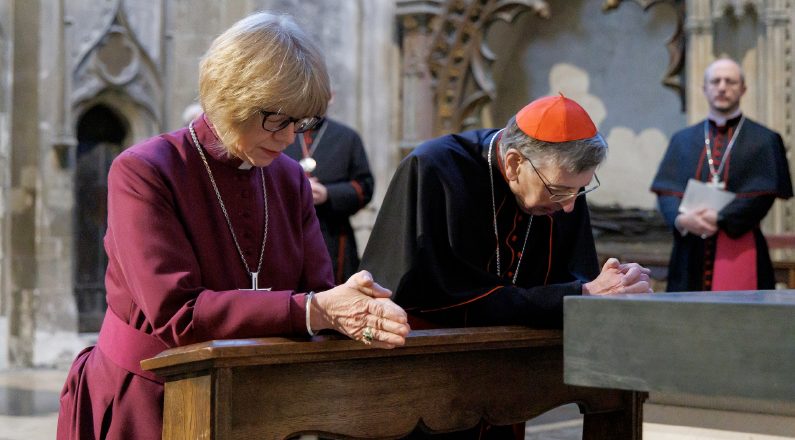
The symbolic dimension of this moment was underscored in Canterbury itself, where commemorations of the 1966 declaration unfolded alongside Mullally’s installation. In the presence of Kurt Koch, prefect of the Dicastery for Promoting Christian Unity, a joint prayer service recalled the breakthrough achieved six decades earlier.
Koch delivered the Pope’s message personally and joined Mullally in prayer at the site traditionally associated with the martyrdom of Thomas Becket—a gesture that consciously echoed earlier moments of rapprochement, including the 1982 visit of Pope John Paul II and Archbishop Robert Runcie.
Such acts of shared memory are not incidental. In ecumenical diplomacy, gestures often carry as much weight as documents, signaling continuity across generations of leadership even when doctrinal convergence remains partial.
A dialogue shaped by history—and limits
Since 1966, Anglican–Catholic relations have evolved through a series of theological agreements, pastoral collaborations, and symbolic encounters. Institutions like ARCIC and the International Anglican–Roman Catholic Commission for Unity and Mission (IARCCUM) have worked to bridge differences on issues ranging from authority and sacramental theology to ethics and ecclesiology.
Yet significant divergences persist, particularly in areas such as ordained ministry and moral teaching. These unresolved questions have, at times, slowed the momentum of dialogue, even as personal relationships between leaders have remained cordial.
In this context, recent remarks by Pope Francis—quoted approvingly by Leo XIV—offer a revealing lens. Addressing Anglican primates in 2024, Francis warned that it would be “a scandal” if Christian divisions prevented a common witness to the Gospel. Leo’s decision to echo those words suggests a continuity of emphasis: unity not as an optional aspiration, but as a missionary necessity.
A new phase, cautiously framed
Mullally’s upcoming visit to Rome will not, in itself, resolve theological disputes. But it represents the opening of a new personal chapter in a relationship that depends as much on trust as on doctrine.
Her remarks following the anniversary celebrations point to a dual awareness: gratitude for the progress already made, and realism about the distance still to travel. The relationship between Anglicans and Catholics, she noted, continues to bear fruit in “dialogue, friendship and common witness” across the world.
That triad—dialogue, friendship, witness—has become the operative grammar of modern ecumenism. It acknowledges that unity is not achieved solely through formal agreements, but also through shared action and mutual recognition.
As Sarah Mullally prepares to meet Pope Leo XIV in Rome, the encounter will be read less for immediate outcomes than for its tone and trajectory. In a landscape where historic divisions endure, even incremental steps carry significance.
Thank you for reading our content. If you would like to receive ZENIT’s daily e-mail news, you can subscribe for free through this link.

Publicaciones relacionadas:
 Faith, synodality and common date of Easter: 3 topics discussed by the Pope in meeting with Catholics and Orthodox
 This is how Leo XIV reintroduces the value of the Creed prayer
 [Pope in Turkey: Day 3] What does it mean to “be the Church”? Pope Leo XIV’s twofold answer
 The Pope’s ecumenical and interfaith message in Lebanon
