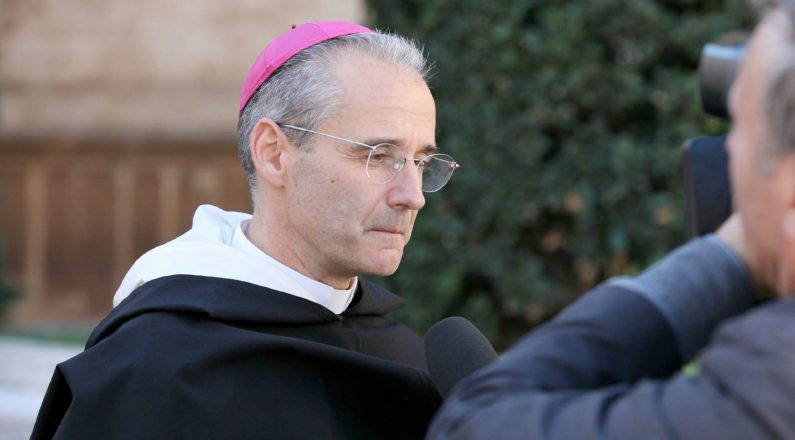
(ZENIT News / Algiers, 04.11. 2026) – Pope Leo XIV will arrive in Algeria on Monday, April 13, 2026. He will remain there for two days before continuing his trip to three other African countries: Cameroon, Angola, and Equatorial Guinea. To better understand the Catholic Church in Algeria and the implications of the Holy Father’s Apostolic Visit, ZENIT interviewed Cardinal Jean-Paul Vesco, Archbishop of Algiers, who has resided in the country for more than 22 years.
* * *
ZENIT: Pope Leo XIV’s visit to Algeria is very near. What reasons led him to choose Algeria for his first stop in Africa?
Cardinal Jean-Paul Vesco: To be honest, I myself invited the Pope to come to Algeria on the day of his election. He was elected on May 8, a date celebrated in the liturgy of the 19 Blesseds of Algeria. I told him: «No Pope has ever come to Algeria. You are a son of Saint Augustine, and it would be wonderful if you were the first Pope to visit us.» He replied that he would come with great pleasure, and then arranged for the Algerian Authorities to accept the invitation and formalize it. It was a great step for us and, above all, a wonderful opportunity!
The main objective of this trip is to get to know the Algerian people. I believe that Pope Leo XIV wishes to continue building bridges between the Muslim and Christian worlds, and that he comes, above all, to meet with contemporary Algeria. But he also comes for the 19 martyrs of Algeria, killed between 1994 and 1996 and beatified in December 2018. Among these Blesseds are the monks of Tibhirine, Bishop Pierre Claverie and his driver, as well as several monks and nuns, including two Augustinian Sisters, Esther and Charity.
These Beatifications were of great importance to him. Of course, Algeria is also important because Saint Augustine lived there. But the Pope is not coming to our country to make a personal pilgrimage following in the footsteps of Saint Augustine. He already visited Algeria twice when he was Superior General of the Augustinians; and if he really wanted to visit the tomb of Saint Augustine, he would go to Pavia, Italy, where he is buried.
ZENIT: After Turkey and Lebanon, the Pope has chosen another country where the Catholic Church is a minority. What is the dialogue like with Muslims in Algeria?
Cardinal Vesco: Indeed, apart from Monaco, the first countries he has visited since his election are predominantly Muslim. That a religious leader begins his travels in small Christian communities demonstrates the importance he attaches to the peripheries of the Church, just as Pope Francis did. He is following in the footsteps of his Predecessor.
I know Algeria well, having lived here for 22 years. Before becoming Bishop of Algiers, I was Bishop of Oran for 10 years. Therefore, I believe there is a genuine desire on the part of the Algerian Authorities to be a welcoming, attentive country, open to religious diversity. The Catholic Church’s relations with other religious communities are good — complex, but good. In any case, there are no conflicts or confrontations. As a Christian, I can form strong friendships with Muslims and have never personally experienced religious resentment. However, the delicate issue lies in conversion, which the Muslim world has difficulty accepting. Consequently, there is a significant difference in status between foreign Christians and Algerian Christians.
What I find extraordinary is that we collaborate with Muslims in many ways. The Church could not exist or be present without this collaboration. Every time we manage to do something beautiful and good together, I experience a special joy. I deeply feel the truth of these words of Jesus: “For where two or three are gathered in my name, I am there among them.” For me, the presence of God in those moments is undeniable. So, when someone on the street says to me, “You are my brother,” as often happens, they are really saying, “You are my friend.” By saying this, they overcome an obstacle and together we cross a border. This makes us aware of the fragile balance of religious difference: it can be an insurmountable barrier or it can disappear in an instant.
ZENIT: How does the life that Charles de Foucauld left in Algeria continue to bear fruit today, after his Canonization in 2022?
Cardinal Vesco: The fruits are primarily for the Catholic Church. Saint Charles de Foucauld is little known in Algeria; he is not a model like Saint Augustine or the martyred monks of Tibhirine. However, for our Church, he is an example of the presence of the Gospel and a powerful witness of conversion. Charles de Foucauld came to Algeria to convert, preach, proclaim the Gospel, and achieve results that he did not attain. He himself was converted when, afflicted with scurvy, he was saved by the poorest people of Tamanrasset. There he discovered a form of equality while immersing himself in a new culture. This Saint teaches us the true meaning of evangelization in the Church: a deep and passionate commitment to others This transforms us profoundly.
ZENIT: The Church is also commemorating this year the 30th anniversary of the martyrdom of the 19 Blesseds of Algeria. What is their influence today?
Cardinal Vesco: Algerian Authorities find it difficult to accept that the Catholic Church commemorates these 19 martyrs, as this rekindles the memory of the 200,000 deaths of the Civil War. But Algeria has decided to turn the page. Therefore, we do not commemorate these murders themselves, but rather the witness of life and fraternity of these people.
These men and women died alongside Muslims, but they were not killed by them. While there were 19 martyrs, more than 100 Imams were also killed. And this is something that no one seems to know! We often imagine Christian martyrs being killed by Islam, but this is a completely erroneous interpretation. The death of these blessed people only confirmed the truth of their existence, and their message is a call to brotherhood. My hope for Algeria, therefore, is that it will move forward despite the darkness. Deep down, there is much darkness in our world today, and also in Algeria. Let us move forward despite everything, but we must look to the star, which is there!

Publicaciones relacionadas:
 Walking in synodal style: Vatican accelerates “synodal” applications (in resistant dioceses?)
 How Did Cardinal Prevost React To Being Elected and What Did He Feel About Being a «Papabili»? Cardinal Tagle Responds
 What Is the Difference Between the Holy See, Vatican City, and the Roman Curia? Cardinal Ghirlanda Explains
 How Is the Jubilee Going and What Impressions Do Those Who Organized It Have? ZENIT’s Interview with Monsignor Rino Fisichella