

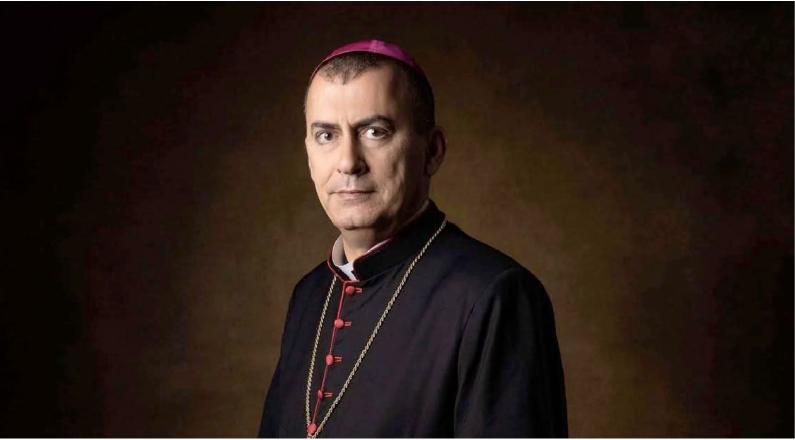
(ZENIT News / Vatican City, 04.12.2026).- In a moment charged with both continuity and urgency, the Chaldean Catholic Church has chosen a new patriarch, entrusting its future to a pastor shaped by exile, diaspora, and ecclesial resilience. The election of Bishop Emil Shimoun Nona as Patriarch—now Mar Paul III Nona—concludes a decisive synodal gathering in Rome held from April 9 to 12, 2026, and opens a new chapter for one of Christianity’s most ancient communities.
Presided over by Archbishop Habib Hormiz of Basra in his role as Patriarchal Administrator, the synod brought together Chaldean bishops from across the world at a time when their Church faces both internal transition and external pressures of historic magnitude. The election followed the resignation, accepted in March, of Cardinal Louis Raphael Sako, whose long patriarchate had guided the Church through years of upheaval.
Mar Paul III Nona, 58, is not an unfamiliar figure to these trials. His episcopal ministry has been marked by some of the most dramatic episodes in recent Middle Eastern history. As Archbishop of Mosul, he led his community until 2014, when the advance of the Islamic State forced the mass displacement of Christians and compelled him into exile. That experience—shared by thousands of Chaldean faithful—has become a defining element of his pastoral identity. Later appointed by Pope Francis to serve the Chaldean diaspora in Australia and New Zealand, and currently based in Sydney, Nona has come to embody a Church that increasingly lives beyond its ancestral lands.
His election, therefore, carries a dual significance. It signals not only a generational transition in leadership but also a recognition that the Chaldean Church today is both rooted in the Middle East and profoundly shaped by its global dispersion. Estimates place the worldwide Chaldean population at around one million faithful, many of whom now reside outside Iraq. Meanwhile, the Christian presence in Iraq itself has undergone a dramatic collapse, shrinking from more than 1.5 million in 2003 to roughly 300,000 today, with some estimates suggesting even lower figures. War, instability, and the rise of extremist violence have accelerated this demographic transformation, leaving the Church to grapple with questions of survival, identity, and mission.
The synod’s deliberations took place in close proximity to the Holy See, and included a meeting with Pope Leo XIV on April 10. In his address to the bishops, the Pope outlined a demanding vision of ecclesial leadership, emphasizing transparency in governance, prudence in public communication, and a renewed commitment to priestly formation. His words reflected a broader concern: that the credibility and unity of the Church depend not only on doctrinal fidelity but also on the integrity of its witness.
At the same time, Leo XIV situated the Chaldean Church within a wider theological and historical horizon. He recalled the irreplaceable role of Middle Eastern Christians as living witnesses in the lands where Christianity was born—described evocatively as “stars in the sky.” His appeal was both pastoral and geopolitical: that these communities should not be reduced to symbolic remnants, but be ensured full citizenship, religious freedom, and dignity in their homelands.
This tension—between rootedness and dispersion—will likely define the patriarchate of Mar Paul III. On one hand, there is the imperative to sustain Christian life in Iraq and the broader region, despite insecurity and emigration. On the other, there is the pastoral responsibility toward a diaspora that is not merely provisional but increasingly permanent. The new patriarch’s own biography suggests an awareness of both dimensions.
Thank you for reading our content. If you would like to receive ZENIT’s daily e-mail news, you can subscribe for free through this link.

Publicaciones relacionadas:
 Bishop Barron announces founding of new congregation dedicated to digital evangelization
 This is how the inauguration of the new Catholic Archbishop of Westminster went
 Heiner Wilmer takes the helm of the German Bishops’ Conference: he will present the controversial Synodal Conference to the Vatican
 A new papal nuncio to manage the Holy See’s relations with the progressive German episcopate
