

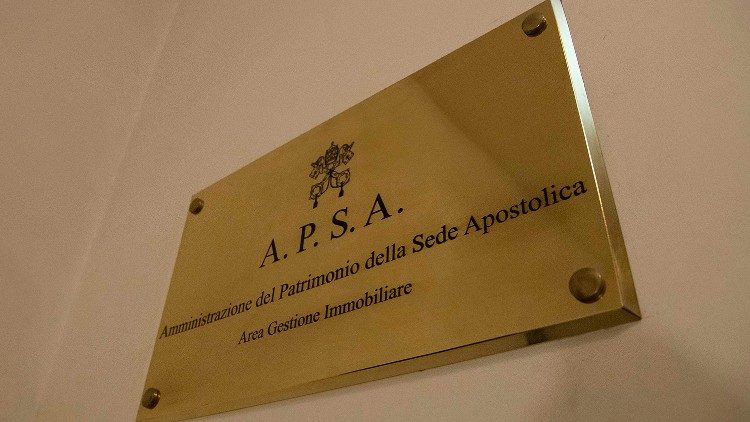
(ZENIT News / Rome, 08.07.2026).- The Vatican’s financial administration has ended 2025 with more assets, a larger net worth and a remarkably different story from the one suggested by the headline profit figure. Yet behind the improved balance sheet lies a question that will matter far more to Pope Leo XIV’s administration: can the Holy See turn the wealth it owns into the recurring income it needs to sustain its mission? The answer, for now, is not entirely clear.
The Administration of the Patrimony of the Apostolic See, or APSA, reported net assets of €2.686 billion at the end of 2025, an increase of approximately €89 million from the previous year. The result comes during a particularly significant transition for the Vatican, following the death of Pope Francis and the election of Leo XIV, while APSA continued its ordinary institutional responsibilities.
At first sight, however, the figures appear less impressive. APSA’s management result fell to €22.8 million, compared with €62.2 million in 2024. That comparison can easily mislead.
The previous year was exceptional, largely because of gains generated by a major restructuring of the investment portfolio. According to the information provided to ZENIT by APSA, around €30 million in trading gains were generated in 2024, compared with less than €500,000 in 2025. The sharp fall therefore says as much about the extraordinary nature of 2024 as it does about the underlying performance of the following year.
More revealing is what happened to the assets themselves.
APSA recorded approximately €16 million in positive investment performance in 2025, but new accounting rules meant that changes in the value of managed investments were recorded directly in net assets rather than in the income statement. The investment portfolio consequently showed an accounting loss of €3.7 million, while its effective performance remained positive by approximately €12.6 million.
In other words, part of the apparent deterioration is accounting presentation rather than vanished wealth.
This distinction is important because APSA is not a conventional commercial investment company. Its stated objective, according to Archbishop Giordano Piccinotti, its president, is not to maximize annual profit but to preserve and strengthen the patrimony entrusted to the Holy See.
And by that measure, 2025 was a solid year.
Gold, property and the limits of wealth on paper
The €89 million increase in net assets was driven principally by three factors: a €40.8 million revaluation of physical gold, a €39.2 million increase in the recorded value of real estate and a €16.3 million positive contribution from securities valuation.
Those numbers make the Vatican’s financial position look considerably stronger.
But balance-sheet strength and financial liquidity are not the same thing.
An increase in the market value of gold held in reserve does not, by itself, pay salaries, finance diplomatic activity or cover the running costs of the Roman Curia. Nor does a higher valuation for a building automatically generate cash.
This distinction becomes particularly important when looking at APSA’s enormous real-estate portfolio.
The administration manages 4,281 properties in Italy and approximately another 1,200 abroad, including holdings in London, Paris, Geneva and Lausanne. Its property business produced €44.5 million in results in 2025, an improvement of €9.4 million, attributed to more efficient management, higher operating revenues and tighter maintenance costs.
Yet the portfolio has a very different purpose from an ordinary commercial property company.
According to the material supplied, 61 percent of the total surface directly owned by APSA, covering 475,453 square metres, produces no income relative to its maintenance costs. Another 16 percent is devoted to subsidized or discounted rents. Only 23 percent of the property surface is rented at market rates.
This is partly explained by the nature of Church property: churches and other buildings serving ecclesial purposes cannot simply be evaluated according to the same commercial criteria as an office tower or shopping centre.
That reality, however, also illustrates the fundamental financial dilemma facing APSA. The Vatican may possess considerable wealth without being able to convert all of it into dependable annual revenue.
The number that matters most to Leo XIV
For the Holy See’s operating finances, one figure deserves particular attention: APSA’s contribution to the Roman Curia. In 2025, APSA provided €22.7 million toward the Curia’s needs. In 2024, the contribution had been €46 million. The difference is substantial.
APSA argues, with considerable justification, that the 2024 figure was exceptional and should not be treated as the new annual standard. Nevertheless, the reduction exposes the tension between two legitimate objectives.
One is preservation: protect the patrimony so that it can continue supporting the Church for generations.
The other is sustainability: generate enough recurring income to pay for the institutions through which the Holy See carries out its worldwide mission.
The two objectives normally reinforce each other. But when operating expenditure consistently exceeds recurring income, the pressure to monetize assets can become increasingly difficult to resist.
That is why the next overall Vatican budget will be more revealing than APSA’s balance sheet alone.
The supplied material notes that the Holy See’s 2024 budget recorded a €44 million operating deficit after operating expenditure increased by €40 million. Previous improvements in the deficit had also benefited from extraordinary, non-recurring income. If the underlying structural gap remains in the tens of millions, a rising asset valuation cannot by itself solve the problem.
A Vatican with €2.686 billion in net assets can therefore still face a difficult cash-flow problem.
A financial institution that does much more than invest
There is another side of the APSA story that conventional financial analysis can easily miss.
Around 40 percent of APSA’s personnel work for other Holy See institutions, including dicasteries, organizations and foundations, often without generating corresponding revenue. In 2025, APSA processed 4,417 purchasing requests, only about one quarter of them for its own needs. It also handled accounting for 77 entities and made more than 50,000 payments.
These activities reveal APSA as something closer to the Vatican’s financial and administrative infrastructure than simply its investment arm.
That makes the institution’s performance harder to measure through profit alone.
Its investment portfolio itself was deliberately conservative in 2025: approximately 17 percent equities, 32 percent bonds, 29 percent physical gold, alongside liquidity reserves. The overall return on the proprietary portfolio was 14.37 percent.
The strategy reflects a preference for preservation and prudence rather than aggressive speculation.
That may be particularly significant for a Church institution entrusted with assets accumulated over generations and intended to support religious, charitable, diplomatic and administrative purposes. Maximizing short-term returns would not necessarily be compatible with that responsibility.
The challenge awaiting Pope Leo
The real test for the Vatican’s financial reform agenda will therefore come when the extraordinary gains disappear from the picture.
APSA’s 2025 accounts suggest that the institution strengthened its patrimonial position while returning to more normal operating conditions. Its three-year real-estate strategy, launched in 2025, seeks to sell non-strategic properties, regularize property records and redirect capital toward more productive assets. Further projects are planned, including an agrivoltaic development at Santa Maria di Galeria and the redevelopment of the Domus Paolo VI.
These measures point toward a more disciplined approach to the Vatican’s wealth.
But they also underline the central dilemma of Pope Leo XIV’s financial inheritance. The Holy See does not merely need to be wealthier on paper. It needs sufficient predictable income to sustain its institutions without repeatedly relying on exceptional transactions or the liquidation of patrimony.
That is why the next Vatican-wide budget will be decisive.
If APSA’s stronger balance sheet is accompanied by a reduction in the Curia’s structural deficit, 2025 may prove to have been an important step toward durable financial stability. If the deficit remains entrenched, the €89 million increase in net assets will look less like a solution than a reminder of the difference between possessing wealth and generating the income required to use it.
For Leo XIV, that distinction may become one of the defining financial questions of his pontificate.
Thank you for reading our content. If you would like to receive ZENIT’s daily e-mail news, you can subscribe for free through this link.

Publicaciones relacionadas:
 Biden Administration Calls Upon UN to Stop Pro-Life Conservatives
 How many Catholic radio stations are there in the U.S., and how many listeners tune in via streaming? Major study on religious radio released
 Trump and Vance prolong the conflict with Leon XIV as Russia and Brazil join the controversy
 The Impact of the Bible in 2026: Openness to the Bible’s message is on the rise, while its use and reading are declining. Findings from a study by the American Bible Society
