

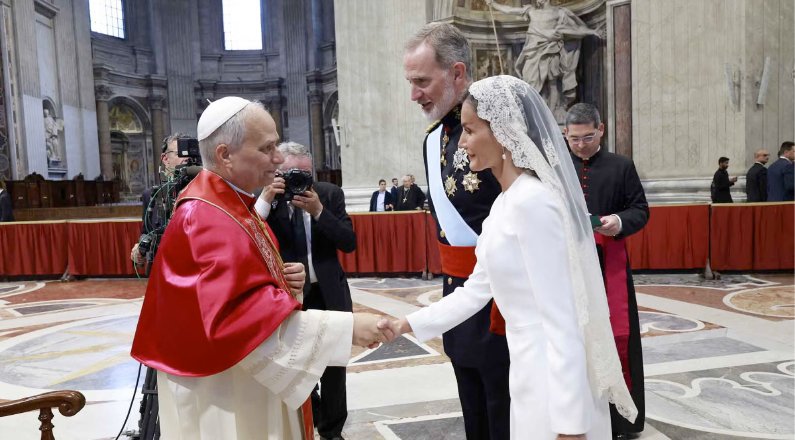
(ZENIT News / Madrid, 02.28.2026).- When Pope León XIV takes the floor of Spain’s Parliament on June 8, it will not simply be another stop on a papal itinerary. It will mark a first in the country’s democratic history and crystallize the dual nature of a visit that is at once pastoral and unmistakably institutional.
According to converging confirmations from parliamentary and ecclesial sources, the Vatican and the Spanish Congress have agreed to convene a joint session of both chambers of the Cortes Generales so that the Pope may address deputies and senators gathered in the hemicycle. The initiative, proposed by the Holy See to the Presidency of the Congress and formally requested in writing by the Spanish bishops on February 26, has received full political assent. The date has been carefully chosen: a Monday, when no ordinary plenary sessions are scheduled, thus avoiding any disruption to the parliamentary calendar.
A precedent without precedent
Although Spain has hosted several papal visits in recent decades, none has included an address to Parliament itself. Neither Saint John Paul II nor Benedict XVI ever spoke directly before the representatives of Spanish popular sovereignty in their institutional seat. By contrast, the Congress has welcomed foreign heads of state in recent years, among them the Ukrainian president Volodymyr Zelensky and leaders from France, Portugal and Latin America. On June 8, for the first time, a Pope will join that list, speaking explicitly in his capacity as head of state of the Holy See.
The format will be sober and tightly choreographed. Only two speeches are foreseen: one by Pope León XIV and one by the president of the Congress, Francina Armengol. No parliamentary debate will follow. The symbolism, however, will be hard to miss: a pontiff addressing a secular legislature in a country whose constitutional order is founded on the principle of aconfesionalidad, while still recognizing cooperation with religious communities.
A journey with two registers
The parliamentary appearance is embedded in a broader papal visit to Spain scheduled from June 6 to 12, the first by León XIV since his election. As repeatedly stressed by the secretary general and spokesperson of the Spanish bishops, Francisco César García Magán, the journey has a “double register.” On the one hand, it is a pastoral visit aimed at strengthening faith, hope and communion with the See of Peter. On the other, it is an official trip by a sovereign, complete with protocol, institutional encounters and state-level implications.
That duality explains why the Pope’s intervention in Parliament is not seen merely as a courtesy call. In García Magán’s words, the official dimension of the visit is expected to “intensify” relations between the Holy See and the Spanish state and, by extension, to have an impact on the common good of society as a whole.
The pastoral map, though still provisional, is already taking shape. Four dioceses have been confirmed: Madrid, Barcelona, Gran Canaria and Tenerife. Each stop is expected to highlight a distinct theme. In Madrid, evangelization will be central; in Barcelona, the Pope is set to inaugurate the tower dedicated to Jesus Christ at the basilica of the Sagrada Familia, a milestone in the long construction of Antoni Gaudí’s masterpiece. In the Canary Islands, attention will turn to irregular migration, an issue that places the archipelago at the crossroads of humanitarian urgency and European border policy.
A demanding operation
Beyond symbolism and messaging, the visit poses a substantial logistical challenge. Spain’s Ministry of Defence has publicly acknowledged that the Pope’s presence will draw thousands into the streets and require complex coordination in terms of security, transport and mobility. The issue was discussed on February 26 in a meeting between Defence Minister Margarita Robles and the apostolic nuncio to Spain, Piero Pioppo, as part of the preparations already under way.
Government sources underline that the country is accustomed to managing large-scale international events, but the combination of pastoral gatherings and state ceremonies over a full seven days will test coordination across multiple levels of administration. A Vatican advance commission is expected to arrive in Spain shortly to refine the program, after which details such as the official motto and hymn of the visit will be announced.
More than a visit
For the Spanish bishops, the significance of the journey goes beyond logistics or protocol. García Magán has described it as a moment of “joy, hope and renewal,” even likening it — despite its timing in Lent — to a kind of Advent. The underlying message is ecclesiological as much as social: communion with the Bishop of Rome, he insisted, is not an accessory but constitutive of Catholic identity.
Seen in that light, the Pope’s appearance in the Congress acquires an added layer of meaning. It is not only an unprecedented gesture toward Spain’s democratic institutions, but also a reminder that the Holy See continues to operate at the intersection of faith and diplomacy.
Thank you for reading our content. If you would like to receive ZENIT’s daily e-mail news, you can subscribe for free through this link.

Publicaciones relacionadas:
 7 out of 10 Spanish citizens believe that Leo XIV’s papacy will be good or better than that of Pope Francis
 Pope Leo XVI to visit Spain: here’s everything we know so far
 Pope Leo XIV to Equatorial Guinea: video captures the Holy Father’s travel coordinator visiting the country ahead of a papal trip
 Confirmed: The 4th Mediterranean Meeting will take place in Barcelona with the Pope in attendance
