

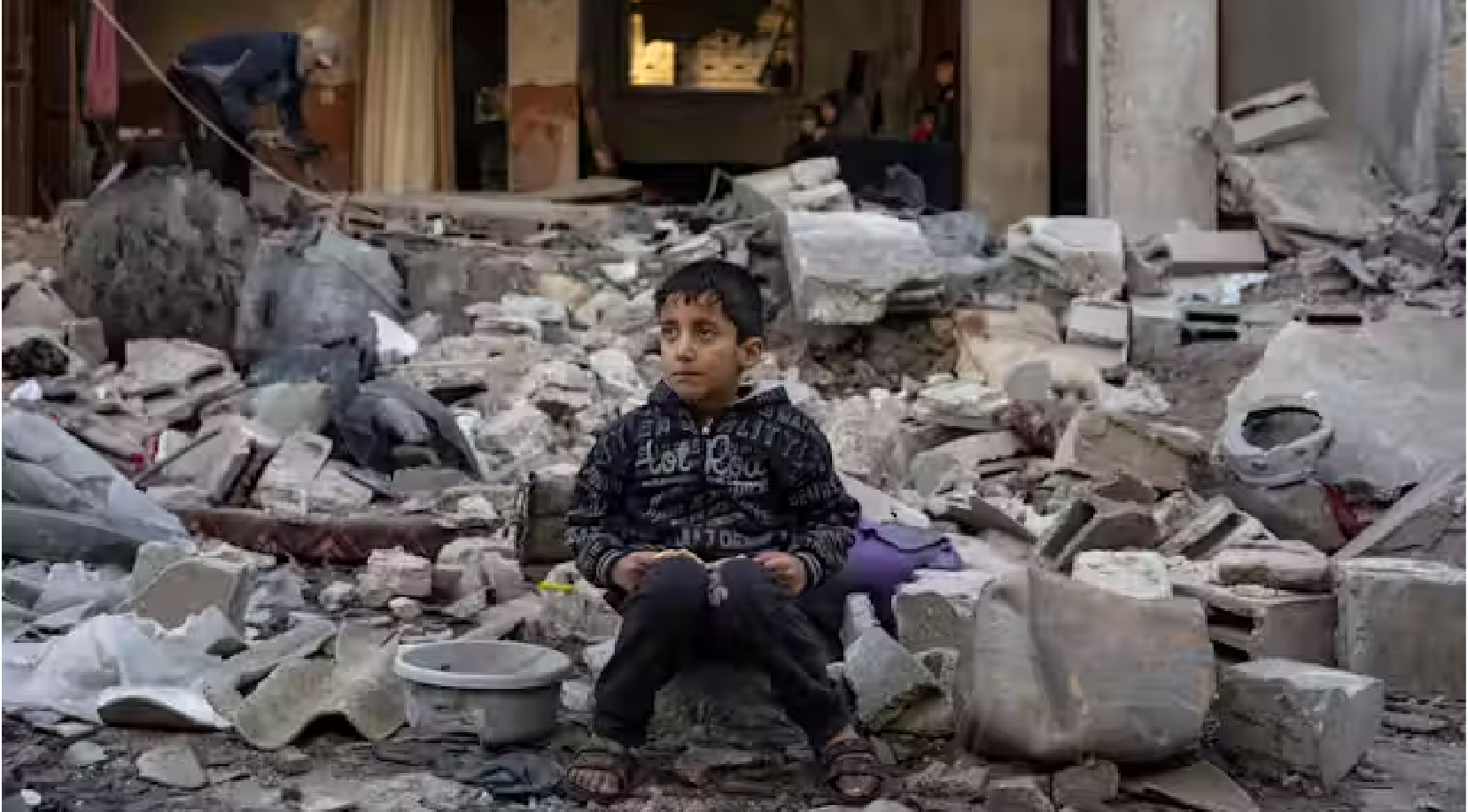
(ZENIT News / Jerusalem, 11.25.2025).- The international community may have celebrated the recent UN-backed “Comprehensive Plan to End the Gaza Conflict” as a diplomatic victory, but on the ground the landscape remains stubbornly unchanged. From Gaza’s still-ruined neighborhoods to the increasingly besieged villages of the West Bank, the region’s Christian leaders and civil society voices warn that political breakthroughs on paper risk becoming hollow gestures if daily reality continues to deteriorate.
Cardinal Pierbattista Pizzaballa, Latin Patriarch of Jerusalem, has watched the situation evolve through cycles of hope and exhaustion. Speaking after the Security Council endorsed Washington’s proposal for a temporary stabilization force in Gaza, he described the vote as symbolically powerful but practically fragile. International alignment, he noted, matters in theory — yet in Gaza City and Rafah, little has shifted aside from the cessation of constant bombardments.
What has changed is simply the absence of airstrikes. Humanitarian trucks arrive with greater regularity, but the Patriarch warns that the gap between supply and need remains crushing. Hospitals function only in fragments, winter advances toward families living in tents, and even something as basic as water often arrives in the form of mud. Reconstruction has not begun; before rebuilding, Gaza is still exhuming bodies buried under the rubble.
The ceasefire that followed President Donald Trump’s October 2025 hostage-exchange agreement brought global attention, but, according to Pizzaballa, both Hamas and Israel accepted the arrangement out of necessity, not conviction. He doubts Hamas intends to relinquish arms, and he does not foresee Israel withdrawing fully from the Strip. Progress, he argues, will require not only goodwill but political courage — and an endurance that the population, particularly the young, increasingly struggles to sustain.
Yet Gaza’s limbo is only one chapter in a wider, worsening story. Across the West Bank, especially in rural areas under full Israeli control, a very different crisis is unfolding: a sustained, aggressive campaign of pressure by extremist settlers. Violence has risen sharply since late 2023, taking forms that blend intimidation with economic sabotage — burned groves, armed raids, vandalized homes, and roadblocks that suffocate daily life.
The Christian village of Taybeh, long regarded as a symbol of the region’s ancient faith heritage, has endured repeated assaults. Parish buildings have been destroyed, vehicles smashed, and public spaces vandalized. Father Bashar Fawadleh, its parish priest, describes an atmosphere of persistent fear and fatigue. Residents have reached what he calls “the threshold of despair,” with many quietly considering emigration.
In July, church leaders and diplomats made a high-profile visit to Taybeh, affirming both solidarity and alarm. Their presence was a reminder that the Christian population — though a tiny minority — remains deeply embedded in the land’s story. But gestures of support cannot substitute for protection. Attacks continue, often during the olive harvest, the backbone of local agricultural life. For the third year, many families cannot reach their own groves.
Elsewhere, the pattern repeats. In villages like Aboud or around Ramallah and Nablus, residents report a collapse of legal order. Windows smashed, crops destroyed, night-time raids — each incident remains small enough to escape headlines abroad, yet together they form a daily architecture of coercion. The aim, many Palestinians believe, is not merely harassment but gradual displacement.
Palestinian religious leaders and academics have issued their own stark assessment. In a recent joint statement, they argued that the UN resolution’s vision for a Peace Board, chaired by the U.S. president, represents a new form of external administration rather than a path to self-determination. By conditioning Palestinian political autonomy on undefined “reforms,” they fear the plan reinforces rather than dismantles decades-long power imbalances.
The document points to deeper historical currents — from the Balfour Declaration to the post-war partition — that shaped an unequal reality. While affirming that Jewish attachment to the land is real and ancient, the signatories insist that such belonging cannot justify dispossession. The way forward, they argue, lies not in perpetual segregation but in imagining a shared society rooted in equal rights.
From within the Church, Monsignor William Shomali, patriarchal vicar for Jerusalem and Palestine, describes the present moment as one of both humanitarian crisis and political suffocation. Area C of the West Bank, he notes, is especially vulnerable: hamlets without protection, shepherding communities hemmed in by expanding settlements, and youth facing unemployment rates around fifty percent. Under such pressures, emigration becomes not an escape but a rational calculation for survival.
This exodus is particularly acute among Christians, who maintain strong networks abroad and perceive diminishing prospects at home. Diaspora communities in Chile, the United States, and Australia offer the stability and security that seem increasingly out of reach in the Holy Land.
The situation has drawn rare criticism from Israeli leadership as well. Prime Minister Benjamin Netanyahu recently convened senior security officials to address the surge in settler violence, after allegations of stone-throwing and arson in the town of Huwara. His description of the perpetrators as “a handful of extremists” has been met with skepticism by human-rights groups, who point to a far broader pattern of impunity.
For many residents, such statements are too little, too late. The destruction of a scrapyard in Huwara, allegedly ignited by settlers shortly after an attack on passing Palestinian cars, underscores a worrying trend: acts that escalate quickly, unfold in full view of soldiers, and leave Palestinians with little recourse. Investigators may collect evidence, but residents are unconvinced any accountability will follow.
Against this complex backdrop, church leaders continue to insist on hope — not as a naïve sentiment but as a form of resistance. Father Fawadleh in Taybeh calls prayer a force capable of transforming hardened hearts, yet he also urges practical support: job programs, housing projects, and international accompaniment for vulnerable communities. Hope, he insists, must take the shape of structures that allow people to remain on their land.
Whether such structures will emerge depends in large part on outside powers. Several local leaders have urged targeted sanctions on violent settlers and their networks, arguing that financial pressure would be more effective than diplomatic statements. Others call for greater international monitoring on the ground, documenting abuses in real time.
What unites these voices — from Gaza’s overwhelmed clinics to the frail villages of the West Bank — is the sense that the future cannot be built on ceasefires alone. Stability requires justice, and justice requires confronting realities long ignored. Until then, the region’s fragile calm risks becoming merely another pause between storms.
Thank you for reading our content. If you would like to receive ZENIT’s daily e-mail news, you can subscribe for free through this link.

Publicaciones relacionadas:
 Palestinian and Israeli leaders present Pope with peace plan for Holy Land (includes status for Jerusalem)
 New report shows systematic abuse in Israeli prisons
 The Middle East on the Brink of Collapse: Another Call for Peace from the Pope, the Death of a Member of the Order of Malta in Lebanon, and Bombings at Shepherds’ Fields in Bethlehem
 A Church Against the Logic of War: Vatican Voices, Middle East Realities, and the Risk of a Vanishing Christianity
