

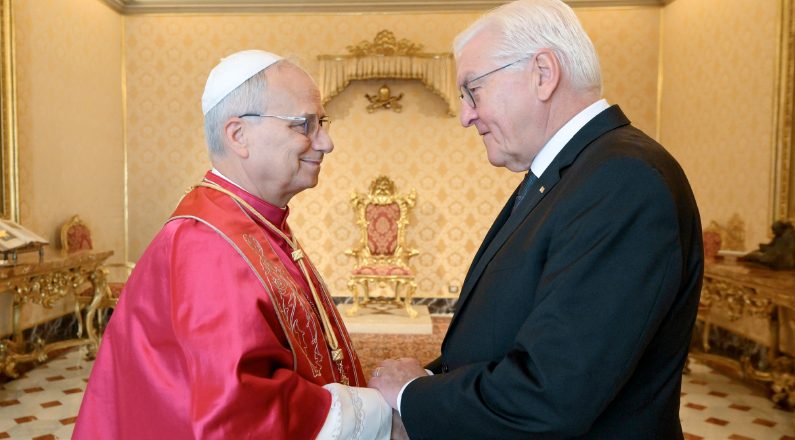
(ZENIT News / Vatican City, 09.23.2025).- German President Frank-Walter Steinmeier met Pope Leo XIV in Rome on September 22, marking their first encounter since the new pontiff’s election. The meeting, held in the Apostolic Palace, carried both a European and a global resonance: concern over the decline of Christianity on the continent, alongside appeals for the Vatican’s diplomatic voice in international crises.

For Steinmeier, the question of religion is not confined to theology but tied to the social fabric of Europe. “Churches can and should play a constructive role in keeping our society cohesive,” he told reporters after the audience. The president, himself a Protestant, emphasized that the German state still values the moral presence of Christianity, noting that “the voice of Rome remains important for us.” His remarks came with a formal invitation for the Pope to visit Germany.
Pope Leo XIV, for his part, was candid in expressing his deep concern over the dwindling numbers in Catholic congregations across Europe. The president echoed that anxiety, acknowledging that scandals—particularly clerical sexual abuse—had weakened trust in church institutions, but also citing secularization and increasing religious pluralism as driving forces. “This is not a burden for the Pope and the Vatican alone,” Steinmeier stressed. “It must be our concern as well.”

The German head of state also urged the pontiff to assume a larger role in global diplomacy, pointing specifically to conflicts in the Middle East. In a time when mediators are scarce, he said, “we simply cannot do without the help of the Pope and the Vatican.” He noted the Holy See’s ongoing readiness to assist in the search for peace in Ukraine as an example of its enduring diplomatic weight.
The symbolism of the visit extended to its gifts: three bottles of Riesling from the centuries-old episcopal winery in Rüdesheim and a facsimile of Bach’s Well-Tempered Clavier, a nod to Germany’s cultural and religious heritage.
Steinmeier’s itinerary in Rome also included a strong defense of multilateralism. Speaking at the United Nations’ Rome-based agencies—the World Food Programme, the Food and Agriculture Organization, and the International Fund for Agricultural Development—he warned against the “erosion” of international law and institutions. “We need strong institutions and rules,” he declared, criticizing governments that cut funding or retreat from engagement. Germany, now the largest donor to the WFP after the United States scaled back, he said, cannot sustain that role indefinitely. He called for renewed commitment to trade norms and financial stability in an era of mounting economic strain.

The president also stopped at the Sant’Egidio Community, the Catholic lay movement known for its outreach to refugees and its discreet role in peace negotiations. His visit underscored a theme running through the day: the need for faith-based actors to bridge divides both within Europe and in wider global conflicts.
Steinmeier, accompanied by his Catholic wife Elke Büdenbender, has long embodied Germany’s religious diversity at the highest political level. Both had attended the funeral of Pope Francis earlier this year, an event that symbolized the continuity of the papal office and its enduring diplomatic relevance.
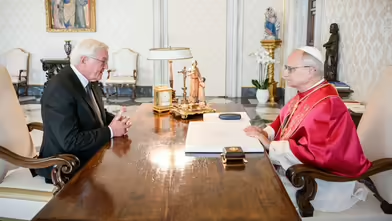
The Rome visit, though diplomatic in form, had a clear pastoral subtext: the search for a renewed role for churches in secular Europe, and the recognition that the Vatican remains one of the few moral actors still capable of opening doors in a fractured world.
Thank you for reading our content. If you would like to receive ZENIT’s daily e-mail news, you can subscribe for free through this link.

Publicaciones relacionadas:
 Pope Leo XIV receives Zelensky: open doors to Russia and Ukraine for negotiations and invitation to visit Ukraine
 Nicolás Maduro asks the Pope for diplomatic mediation in conflict with Trump and the United States
 The Middle East, the spread of war, and the position of the Pope and the Catholic Church
 A Phone Call in Times of War: Pope Leo XIV Answers a Call from the President of Palestine
