

(ZENIT News / Rome, 02.03.2026).- At a time when political authority increasingly breeds division rather than confidence, a surprising constant has emerged from the world’s longest-running global opinion survey: the Bishop of Rome.
According to Gallup International’s End of Year (EOY) Survey, Pope Leo XIV stands apart as the only contemporary global leader with a net positive reputation worldwide—an extraordinary result in an era defined by polarization, war, and ideological fatigue.
The annual study, conducted since 1977 by the Gallup International Association (GIA), is widely regarded as the most comprehensive synchronized snapshot of global public opinion. Founded in 1947 by George Gallup, the pioneer of modern survey science, GIA today brings together more than 65 independent polling organizations across every continent.
This latest edition draws on interviews with 64,097 adults in 61 countries, carried out between October and December 2025. Roughly 1,000 respondents were surveyed per country, using a mix of online questionnaires, telephone interviews, and face-to-face polling—an approach designed to capture opinion simultaneously across vastly different political and cultural contexts.
A singular global consensus
The headline result is striking.
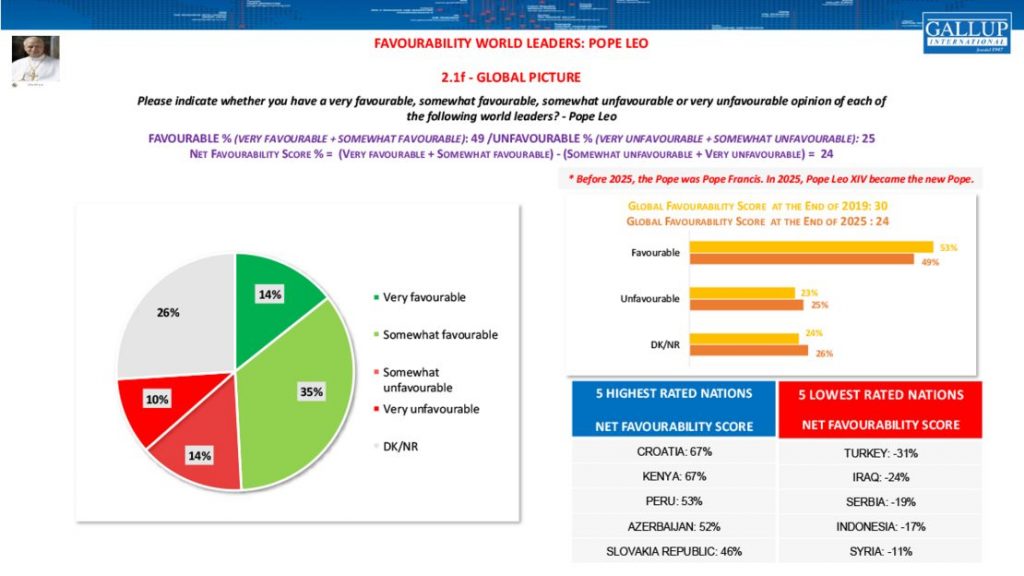
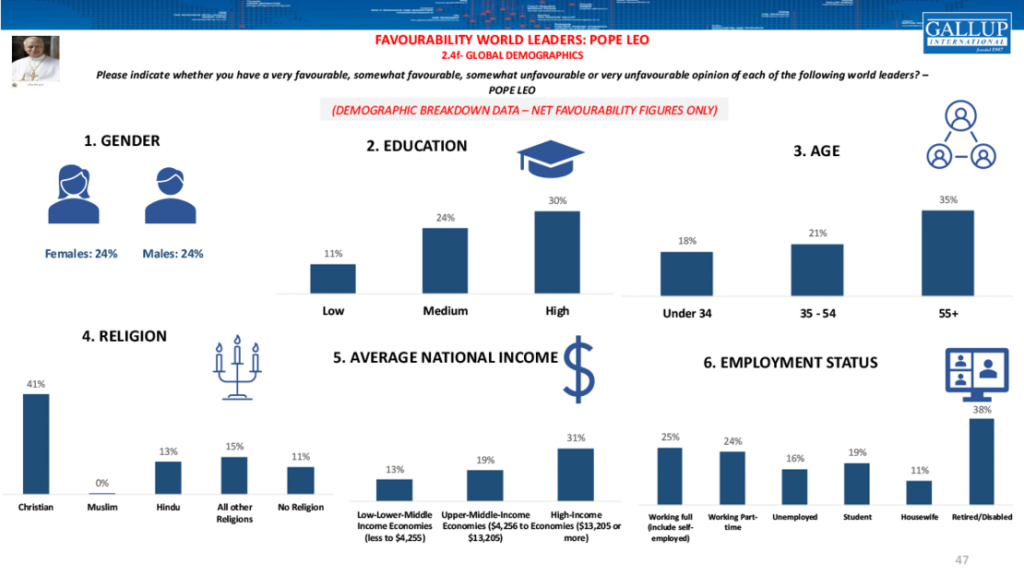
Pope Leo enjoys a 49 percent favorable rating worldwide, against 25 percent unfavorable, with 26 percent undecided—yielding a net favorability score of +24. No other leader measured comes close. In fact, he is the only figure with a positive global net score.
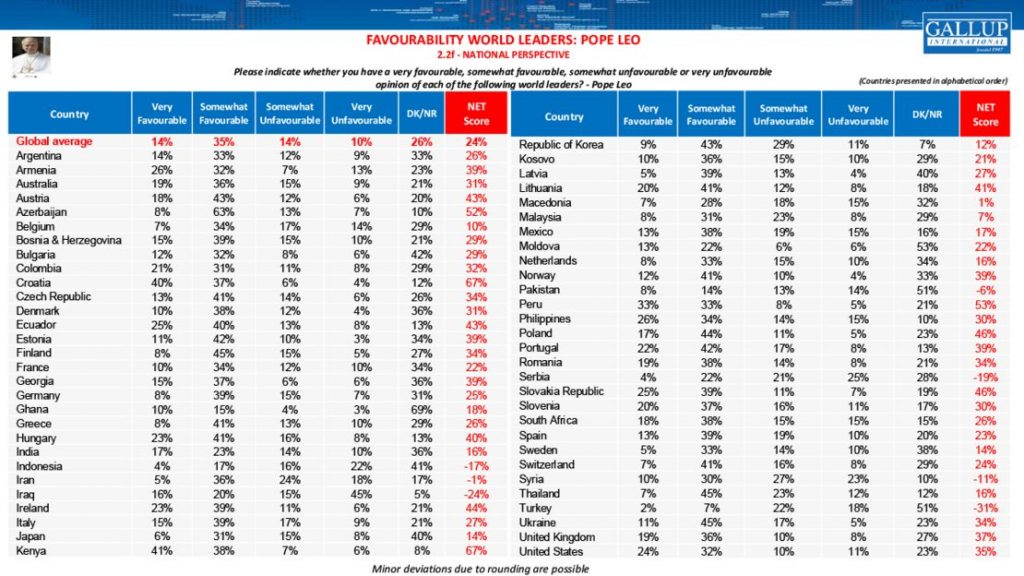
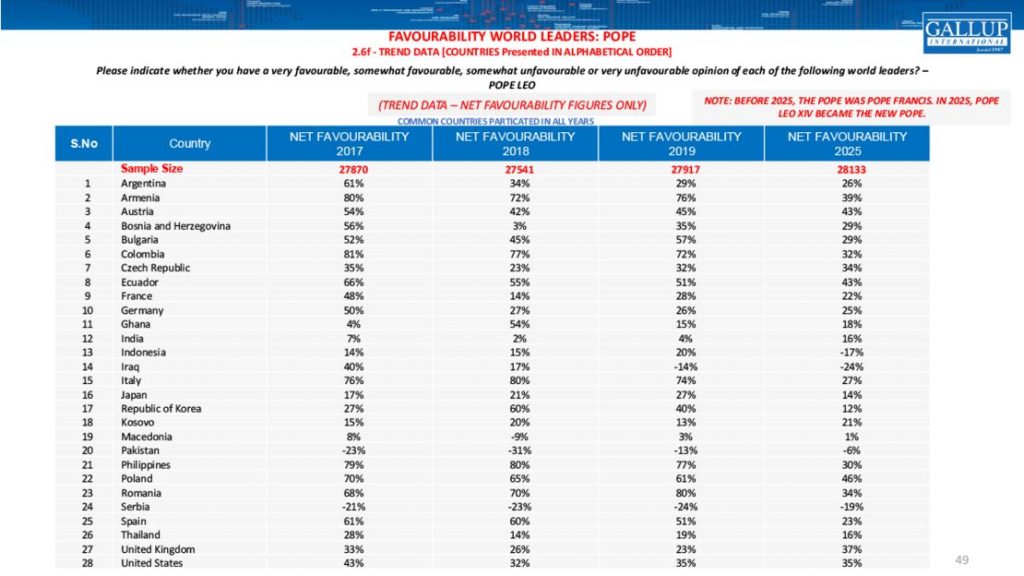
His strongest support appears in Croatia, Kenya, and Peru, while his weakest relative standings are found in Turkey, Iraq, and Serbia.
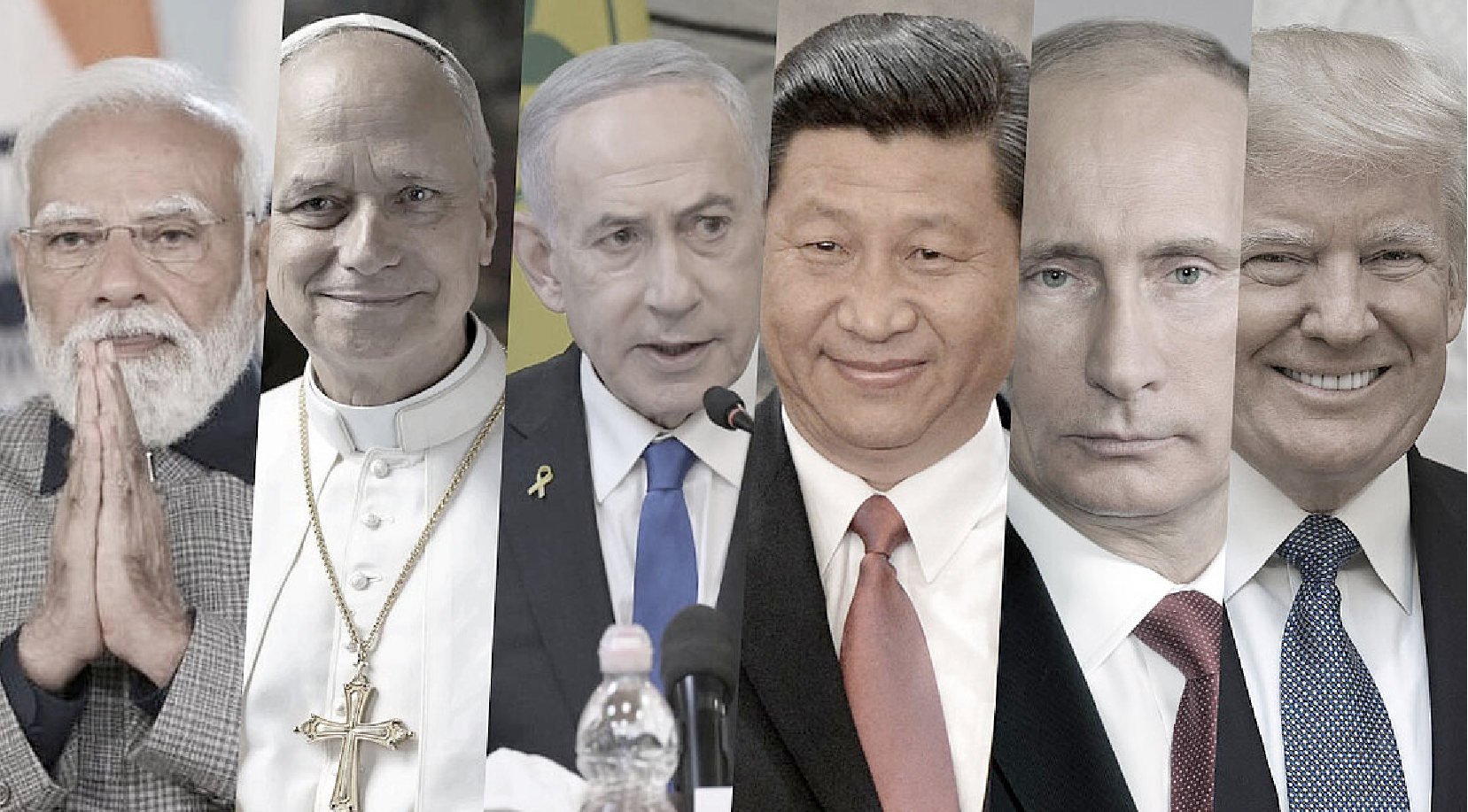
Equally telling is his geographic reach. When analysts examined how many countries view each leader positively overall, Pope Leo again led decisively: he registers a net positive image in 51 of the 61 countries surveyed. By comparison, China’s President Xi Jinping reaches that threshold in 18 countries; Donald Trump and Vladimir Putin in 13 each; India’s Narendra Modi in 11; and Israeli Prime Minister Benjamin Netanyahu in just five.
This measure of “national reach” arguably reveals more than global averages alone. It suggests that the Pope’s moral authority travels across borders in a way political power simply does not.
Politics versus the papacy
Among political leaders, Donald Trump posts the highest global favorability at 30 percent, narrowly ahead of Xi Jinping at 29 percent. Vladimir Putin and Narendra Modi follow at 25 percent each, while Benjamin Netanyahu ranks last with just 19 percent favorable views worldwide.
Yet none of these figures escapes widespread rejection. Netanyahu carries the heaviest global burden, with a deeply negative net score of –42. Putin follows closely at –41, while Trump stands at –31, Xi at –23, and Modi at –12.
The long-term trend is even more revealing.
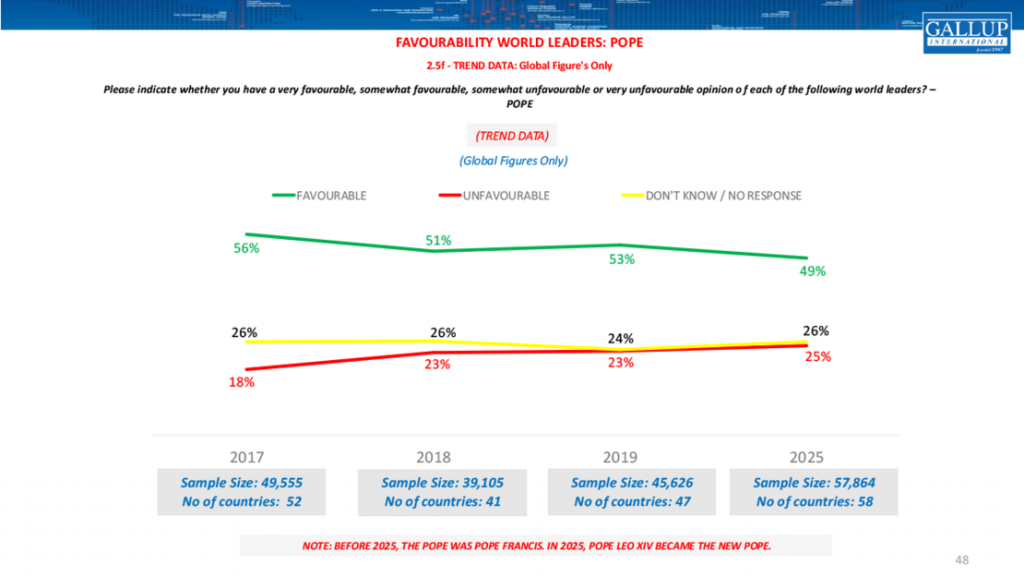
In 2017, Pope Francis recorded a remarkable +38 net favorability. Under Pope Leo in 2025, that figure remains firmly positive at +24—confirming that the papacy continues to function as the world’s most trusted leadership institution.
Over the same period, every major political figure has seen a dramatic erosion of global standing. Putin fell from +3 in 2017 to –41 today. Xi Jinping slipped from +6 to –23. Modi dropped from +8 to –12. Netanyahu declined from –8 to –42. Trump, already highly polarizing in 2017 at –27, has become even more negative globally, now at –31.
Regional contrasts sharpen the picture
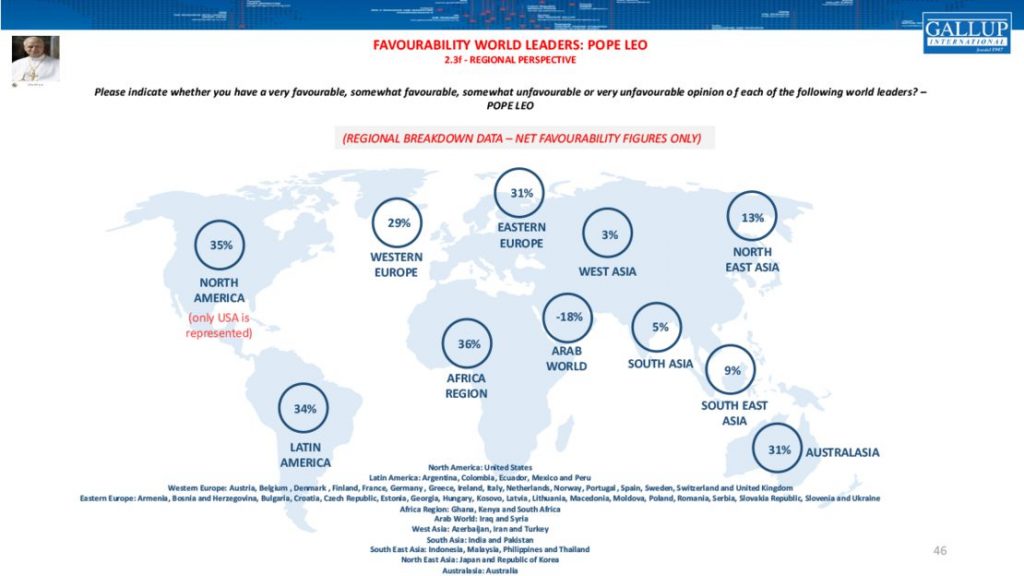
Region by region, Pope Leo dominates much of the globe: Africa (+36), North America (+35), Latin America (+34), Eastern Europe and Australasia (both +31), and Western Europe (+29). Only in West Asia (+3) does his rating approach neutrality, and in the Arab world he registers a negative –18.
By contrast, Trump posts marginal positives only in South Asia (+3), Africa (+2), and North America (+1), while suffering severe rejection in Western Europe and Northeast Asia (both –59). Xi Jinping performs well in Africa (+29), Latin America (+10), and West Asia (+9), but collapses in Northeast Asia (–82), Western Europe (–50), and North America (–37).
Modi retains support in Africa (+26) and South Asia (+17) but remains negative across much of the rest of the world. Putin faces near-universal resistance, especially in Northeast Asia (–81) and Western Europe (–73). Netanyahu encounters the harshest regional backlash of all, plunging to –79 in the Arab world.
Why the Pope still matters
For observers of Vatican diplomacy, these results reinforce a long-standing reality: the papacy operates on a different plane from nation-states. While presidents and prime ministers are judged through the lens of conflict, economics, and ideology, the Pope is perceived primarily as a moral and spiritual figure—one who speaks across cultures about peace, human dignity, and the common good.
That distinction appears to matter.
Even as geopolitical leaders struggle to command trust beyond their borders, Pope Leo’s voice continues to resonate globally, sustaining a level of credibility unmatched by any political counterpart.
Methodologically, the survey’s scale adds weight to its conclusions: 57 countries used nationally representative samples, four focused on urban populations, and respondents were selected through a combination of probability sampling, quota methods, and limited non-probability approaches. Data collection relied on web interviews in 38 countries, telephone surveys in 10, and in-person polling in 13.
A verdict on global leadership
In a world increasingly weary of power politics, Gallup’s findings suggest a subtle but profound shift: people may no longer look to politicians for unity or moral direction.
Instead, they appear to be placing their trust—however cautiously—in a spiritual leader whose influence rests not on armies or economies, but on conscience.
For the Vatican, it is a reminder that soft power, when rooted in credibility and consistency, still carries remarkable weight. And for the rest of the world, it offers a rare data-driven insight into where genuine global confidence now resides.
Thank you for reading our content. If you would like to receive ZENIT’s daily e-mail news, you can subscribe for free through this link.

Publicaciones relacionadas:
 Pope asks to define principles, norms, and guidelines for Latin rite priests accompanying Eastern rite Catholics arriving in the West
 How God makes us into his dwelling places: a reflection of Pope Leo XIV
 Leo XIV to Personally Bestow Palliums in Return to Historic Ritual: A Subtle but Symbolic Shift in Papal Style
 Pope Leo XIV summons bishops to Rome to discuss the reimplementation of the controversial Amoris Laetitia
