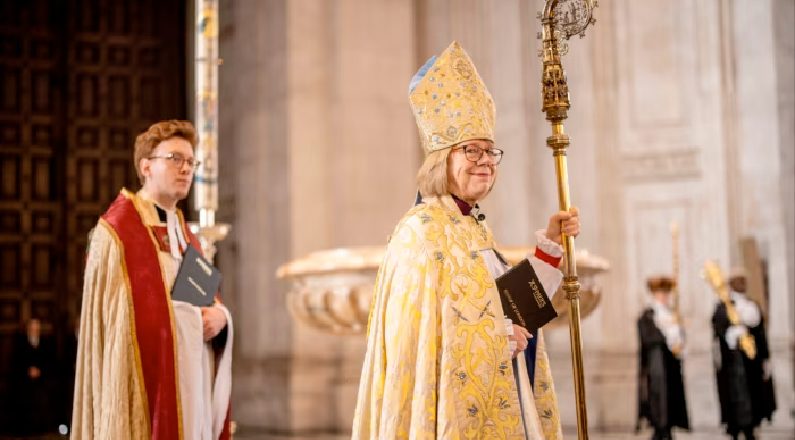
(ZENIT News / London, 10.03.2025).- For the first time in its centuries-long history, the Church of England will be led by a woman. Sarah Mullally, currently Bishop of London and a former nurse turned priest, has been named the 106th Archbishop of Canterbury. Her installation, set for March 2026, will mark an unprecedented moment for the Anglican Communion — one welcomed by many, yet regarded with apprehension by others.
The announcement, formally confirmed by King Charles III after the Crown Nominations Commission’s selection, has been met with both celebration and unease. Supporters point to Mullally’s decades of pastoral service, her reputation for compassion, and her unusual trajectory — from chief nursing officer of England to parish priest and then bishop. Critics, however, see her appointment as deepening the rifts within global Anglicanism, already strained over doctrine, gender, and sexuality.
In her first remarks, Mullally reflected on the image that has guided her vocation: washing feet. “As a nurse, as a priest, as a bishop, it has always been about service. In a world of uncertainty, healing begins with simple acts of kindness and love,” she said at Canterbury Cathedral. Her words captured both the humility of her personal faith and the scale of the challenge before her: to serve as primus inter pares, first among equals, in a communion of some 85 million Anglicans worldwide.
Catholic leaders offered cordial congratulations. Cardinal Vincent Nichols of Westminster welcomed Mullally’s appointment, noting hopes of closer cooperation between the Catholic Church and the Church of England. In Rome, Cardinal Kurt Koch of the Dicastery for Promoting Christian Unity echoed those sentiments, acknowledging the “considerable challenges” facing Anglicanism but praying Mullally might become an “instrument of communion.” The Catholic Church does not recognize Anglican orders as valid and firmly rejects the ordination of women, leaving formal unity an ever-distant hope.
If Rome’s reaction was cautious, the strongest opposition came from within Anglicanism itself. Archbishop Laurent Mbanda of Rwanda, chair of the Gafcon primates’ council — a conservative movement representing the overwhelming majority of active Anglicans — declared the Canterbury role “no longer credible” as a spiritual center. In a letter, Mbanda accused the Church of England of abandoning biblical teaching and warned that Mullally’s leadership would entrench division rather than heal it. He announced plans for a major Gafcon assembly in Nigeria in 2026, intended to consolidate an alternative pole of authority in global Anglicanism.
These reactions underscore the paradox of Mullally’s appointment. For many in England and beyond, she embodies the inclusivity and pastoral care the Church seeks in the 21st century. For others, her very election symbolizes what they see as theological compromise and Western revisionism. Analysts warn that her tenure may accelerate a realignment: defections of Anglo-Catholics to Rome on one side, and the growing assertion of Gafcon as the true guardian of Anglican orthodoxy on the other.
Behind the ceremonies to come, then, lies a fundamental question: can Canterbury still serve as a point of unity for a communion that increasingly lives its life elsewhere — in Africa, Asia, and Latin America? Sarah Mullally steps into office with history on her shoulders, but also with a communion looking past her chair to other centers of gravity.
Her leadership may well define whether the title “Archbishop of Canterbury” continues to mean what it once did, or whether the global Anglican family is already shaping a future beyond Canterbury’s shadow.
Thank you for reading our content. If you would like to receive ZENIT’s daily e-mail news, you can subscribe for free through this link.