

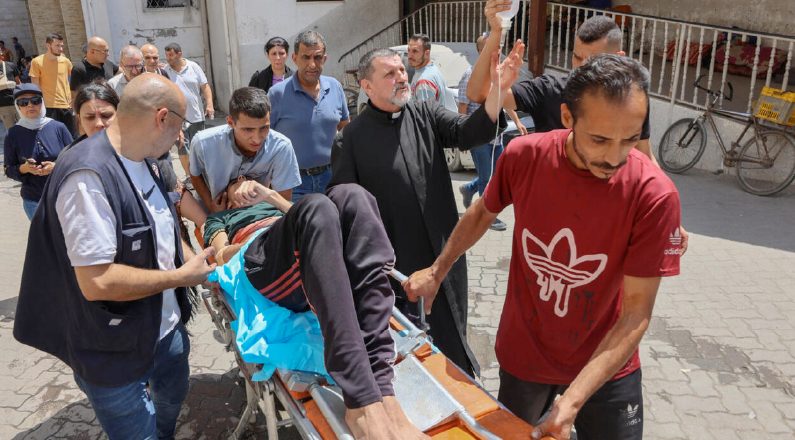
(ZENIT News / Washington, 07.18.2025).- The recent Israeli military strike that hit the Holy Family Catholic Church compound in Gaza has ignited international concern, as the death toll rises and questions swirl over whether the attack was a tragic misfire or something more deliberate. In Washington, President Donald Trump’s response was described as sharply critical, prompting a direct call to Israeli Prime Minister Benjamin Netanyahu on the morning of July 17.
According to the Latin Patriarchate of Jerusalem, the strike occurred at approximately 10:20 a.m. local time, resulting in the deaths of at least three civilians and injuries to nine others—three of them in serious or critical condition. The church, Gaza’s only Catholic sanctuary, has long been a place of refuge for displaced families in times of crisis.
In a press briefing later that day, White House Press Secretary Karoline Leavitt told reporters that President Trump was “not pleased” upon learning of the incident. “His reaction was not a positive one,” she said. “He spoke directly with Prime Minister Netanyahu to address the strike on the Catholic church in Gaza. I understand the prime minister has agreed to issue a formal statement.”
Leavitt added that Israeli leadership had acknowledged a mistake. “The prime minister communicated to the president that it was an error on their part,” she noted. “That’s what we’ve been told, and we encourage everyone to read the statement Israel is preparing on the matter.”
🇺🇸🇮🇱⛪️Trump habló con Netanyahu tras ataque a la única parroquia católica en Gaza
Según declaraciones de la portavoz de la Casa Blanca, la reacción de Trump al ataque a iglesia católica no fue positivo. Trump pidió a Netanyahu la publicación de un comunicado. pic.twitter.com/cnSG8pxm4E
— P. Jorge Enrique Mújica, LC (@web_pastor) July 19, 2025
But voices within the Church have cast doubt on the idea of a mere accident. Latin Patriarch Cardinal Pierbattista Pizzaballa acknowledged the chaos of Gaza but hinted at darker possibilities. “We don’t have the full picture of what happened,” he said, “because communication in Gaza is extremely limited. But the Israeli army has said a tank shell hit the church compound—by mistake, they say. We are not entirely convinced.”
Church officials privately suspect that the strike may have been intentional, potentially a response to the Church’s recent condemnation of settler violence in the Christian town of Taybeh, located in the West Bank. On July 14, just days before the church compound was shelled, Catholic leaders had denounced what they called “terrorist actions” by Israeli settlers against Taybeh’s population.
Sources close to the Patriarchate’s diplomatic office confirmed that Church authorities are weighing the possibility that the attack was retaliatory. “It is one thing to claim a mistake,” one official said, “but it is another when the incident occurs so soon after Church leaders speak out publicly against state-linked violence.”
So far, the Israeli Defense Forces have not released detailed footage or documentation of the strike, though initial statements suggest the shelling was part of broader operations in northern Gaza. For many, the lack of transparency and the sensitivity of the target—a Christian place of worship during ongoing hostilities—raise pressing questions.
The Holy Family Church, part of the Latin Patriarchate of Jerusalem, has served Gaza’s tiny Catholic community for generations. In recent months, it has also been a haven for civilians fleeing bombardments, particularly women and children with no other safe place to go.
With diplomatic lines now wide open between Washington and Jerusalem, and the Vatican closely monitoring the situation, pressure is building for a more thorough investigation. Human rights advocates and religious leaders alike have called for an independent inquiry, arguing that the sanctity of religious spaces must be protected—even in war.
For President Trump, who rarely addresses foreign religious matters with such urgency, the phone call to Netanyahu may signal a growing discomfort with the handling of the Gaza campaign. Whether it leads to a shift in U.S.-Israeli dialogue or merely serves as a symbolic gesture remains to be seen.
Meanwhile, in Gaza, the survivors of the strike on Holy Family Church are left to grieve their dead, patch their wounds, and await answers from a world that too often looks away.
Thank you for reading our content. If you would like to receive ZENIT’s daily e-mail news, you can subscribe for free through this link.

Publicaciones relacionadas:
 Palestinian and Israeli leaders present Pope with peace plan for Holy Land (includes status for Jerusalem)
 Israeli Prime Minister Calls Pope After Military Attack on Catholic Parish in Gaza
 Vatican Secretary of State reiterates Holy See’s position on total invasion of Gaza
 A Church Against the Logic of War: Vatican Voices, Middle East Realities, and the Risk of a Vanishing Christianity
