

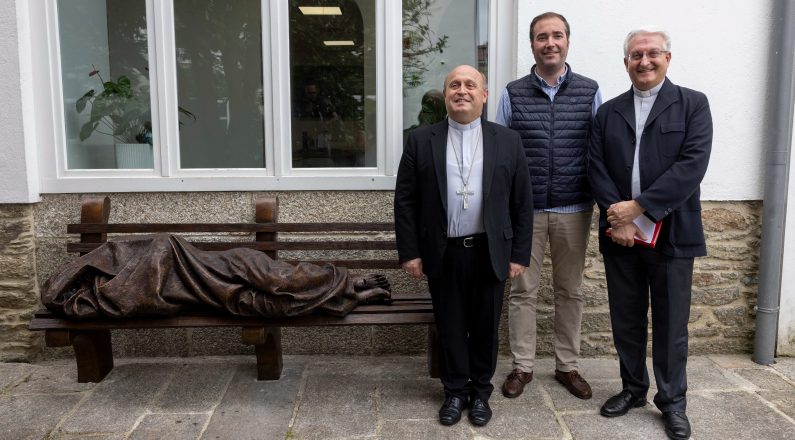
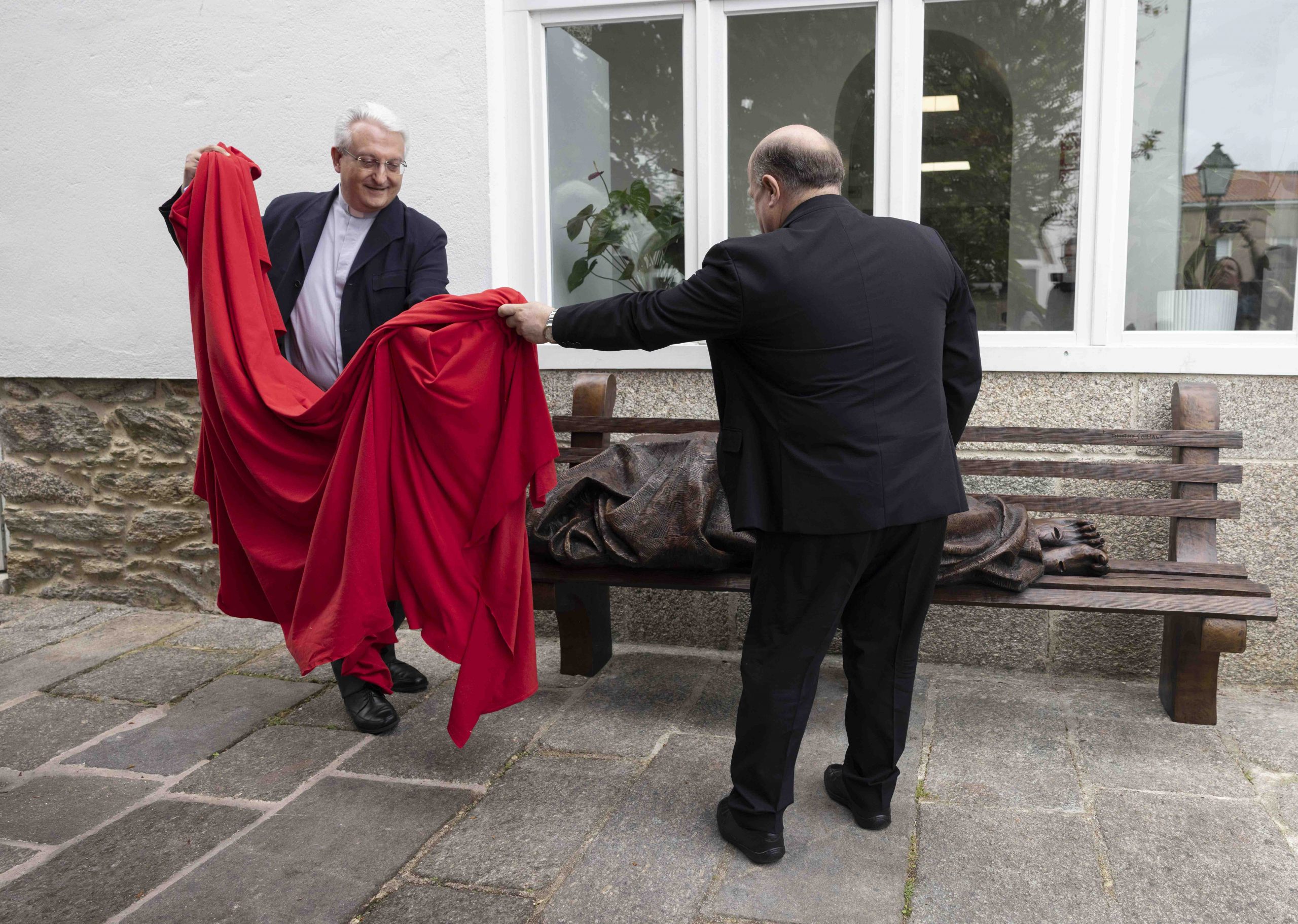
(ZENIT News / Santiago de Compostela, 07.23.2025).- A bench in the city, a body covered by a blanket, and wounds on bare feet. Homeless Jesus, the new sculpture by artist Timothy Schmalz, was blessed 22 July at the Pilgrim’s Reception Office of the Cathedral of Santiago de Compostela, as part of the week of celebrations in honor of St. James the Apostle.
There, where the Camino de Santiago culminates and the “Compostella” is received, pilgrims arriving in the city will be able to encounter a stirring and challenging installation. The sculpture depicts Jesus wrapped in a blanket, lying on a public bench with his face hidden. The only sign of his identity is the visible wounds on his feet.
After the blessing, Archbishop Francisco José Prieto Fernández of Santiago de Compostela reflected: “Memories like these — such as the one from Matthew 25 or the bronze sculpture in St. Peter’s Square, Angels Unawares — are timely. We are especially grateful that the sculptor, Timothy Schmalz, and his patrons wanted it to be present here, and so it has been welcomed into this Pilgrim’s Office. The pilgrim who arrives in Santiago follows a path and has a destination. But this also reminds us of so many who walk the roads without knowing what goal or horizon awaits them. Some may not even have walls to shelter them or a roof to cover them. That is why I believe it is important that we value this work and what it represents — not just for believers. In the face of this reality, we should all have a shared sense of awareness and a commitment that recognizes our common humanity.”
A Christ Who Lives on the Street
Homeless Jesus is a visual representation of the passage from Matthew 25: “I was a stranger and you welcomed me. I was homeless and you gave me shelter.” For the sculptor, the piece invites us “to see Christ where we least expect him, on a bench, exposed to the cold.”
“Overlooking others is part of the message too. How often do we ignore those sleeping in doorways, on benches, or under bridges? They are truly invisible in our society,” reflects Schmalz, who is also the artist behind Angels Unawares and Let the Oppressed Go Free.
During the blessing, representatives of the Archdiocese of Santiago, ecclesiastical authorities, leaders of the Pilgrim Office, local officials, and numerous faithful gathered to witness the unveiling. “This bench not only holds a sculpture; it is an invitation to sit next to Christ. It’s a spiritual space that calls us to action, confronting us with our responsibility toward humanity,” said Schmalz.
A Transformative Experience
“After creating this piece, I never looked at a homeless person the same way again. Now I see Jesus,” the sculptor confessed. Homeless Jesus has been installed in over 100 cities around the world — including New York, London, Madrid, and Rome — and leaves a profound impact in each one. “That’s the magic of art: its power to crystallize the Gospel and bring it to the streets as an eternal reminder,” affirms the artist.
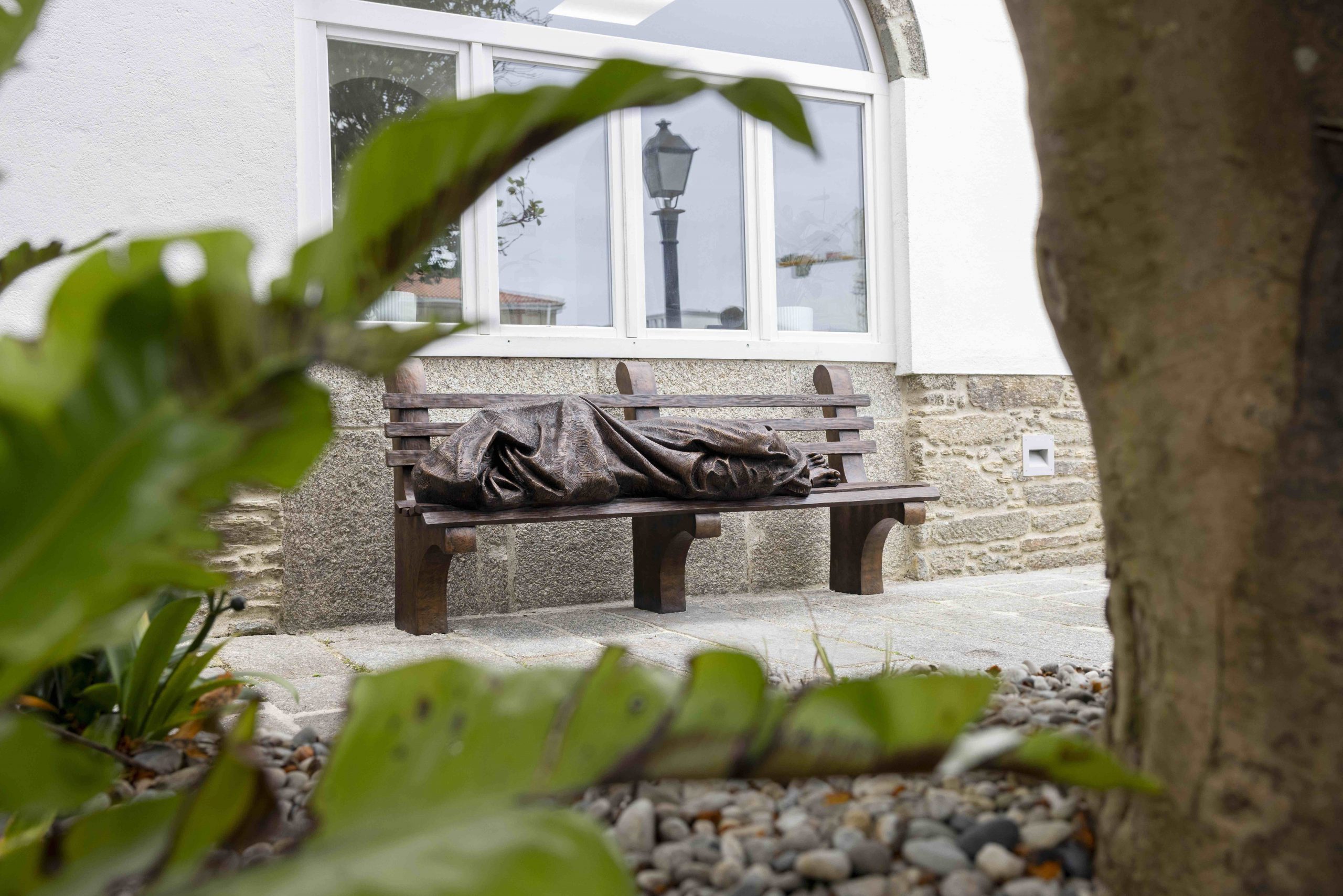
The chosen location, the Pilgrim’s Office, is one of the Camino’s most symbolic sites. There, thousands of pilgrims are received who, after traveling hundreds of kilometers, find an unexpected image: that of a humble, suffering Christ, close to the most forgotten.
The sculpture’s installation was made possible through the generosity of Diane and Tim Needles from Cleveland, Ohio, who have dedicated their lives to helping the less fortunate and spreading the Good News of Jesus.
Homeless Jesus is not the artist’s only work along the Camino de Santiago. Be Welcoming is located in the town of Melide, in the Diocese of Lugo, Spain. That sculpture depicts a pilgrim transforming into an angel, with an outstretched hand and a place to rest. Schmalz’s work speaks of hospitality, the pilgrim’s journey, and the importance of not turning our gaze away from those we meet.
A Work That Challenges and Accompanies the Pilgrim
More than a static piece, Homeless Jesus is an experience: a shared bench, a direct message, a call to the heart. Starting July 22, at the final stop of the Camino de Santiago, a new bench awaits. One in which not only to rest, but also to pray and decide not to turn our backs on others.
Thank you for reading our content. If you would like to receive ZENIT’s daily e-mail news, you can subscribe for free through this link.

Publicaciones relacionadas:
 Opus Dei Convokes An Extraordinary General Congress Following the Pope’s Request for Reform
 A Lesson on Ecclesiology: Benedict XVI’s Full Letter to Franciscan University in Ohio
 USA: Archbishop Broglio Urges Funding of Lifesaving Programs and an End to Federal Government Shutdown
 Basilica of the Holy Family Becomes the Tallest Church in Europe
