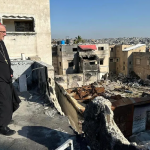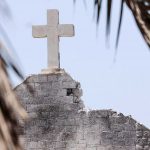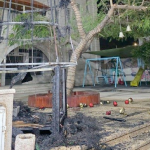
(ZENIT News / Taibeh, 07.28.2025).- The quiet streets of Taibeh, the only fully Christian village in the West Bank, were again broken by violence in the early hours of July 28. Around 2:20 a.m., a group of Jewish settlers launched yet another attack on the small Palestinian community, setting fire to vehicles, hurling stones at homes, and scrawling threats in Hebrew across residential walls. One house was reportedly targeted for arson. By the time Israeli forces arrived—more than an hour later—the assailants had already vanished into the surrounding hills.
Despite recent high-profile visits, including that of senior Christian leaders and former U.S. politician Mike Huckabee, the threats against Taibeh have not only persisted but escalated. What began months ago as attacks on crops and livestock now appears increasingly aimed at people, homes, and the very presence of Christians on the land.
This latest act of intimidation, part of a broader campaign of settler violence attributed to extremist groups such as the so-called “Hilltop Youth,” is believed to be orchestrated by radical rabbi Neria ben Pazi. His followers claim divine justification, but their tactics speak less of religion than of calculated aggression. And while the Christian identity of Taibeh gives the attack a particular resonance, the violence is not uniquely anti-Christian. Muslim Palestinian communities in the region have faced similar assaults.
Still, the symbolism of Taibeh—its isolation, its resilience, and its peaceful witness—has made it a lightning rod. Most Christians in the Holy Land are Palestinian, and Taibeh has become something of a microcosm of their vulnerability. As acts of intimidation mount, the fear is not simply of individual harm but of gradual erasure: pressure to abandon ancestral land and allow demographic reshaping by force.

A recent police report, which controversially absolved the settlers from responsibility in a prior attack, only deepened mistrust. The report not only failed to identify any perpetrators but claimed that settlers may have helped extinguish the flames—an assertion dismissed by locals as implausible. No explanation was offered as to who did set the fires.
The timing of this latest attack is no less telling. In the days prior, U.S. diplomats had issued sharp condemnations of settler aggression. Some observers interpret the violence in Taibeh as a retaliatory message: a defiance of external scrutiny and an assertion of impunity.
German Ambassador Steffen Seibert did not mince words. “Whether the victims are Christian or Muslim, these extremists may invoke divine mandate,” he said, “but their actions are criminal and betray every authentic religious tradition.”
What continues to set Taibeh apart is its refusal to respond in kind. Even as they endure violence that is often met with indifference—or worse, silence—from the Israeli military, the villagers have consistently chosen restraint. Their call is not for vengeance, but for accountability: independent investigations led by credible third parties, not by institutions entangled in the very dynamics that enable the attacks.
The credibility of such investigations, or lack thereof, is no longer just a local concern. It is becoming a measure of whether rule of law, religious freedom, and human dignity can still be upheld in a region where all three are under increasing strain.
Thank you for reading our content. If you would like to receive ZENIT’s daily e-mail news, you can subscribe for free through this link.