

(ZENIT News / Jerusalem, 12.08.2025).- I have been teaching the Bible in Palestine/Israel for twenty-five years, primarily to Arabic-speaking Catholic seminarians, men and women religious, and religion teachers. I have also taught the Bible in Hebrew d to Jews in Israel, to Rabbinical students, to tourist guides, and to ordinary people eager to deepen their formation. It is a mission for which I feel particularly grateful and which still fills me with fear and trembling. Although I am very grateful to live in a time when the Church is more aware, more sensitive, and more prudent regarding how the Bible should be used in Christian teaching –deeply repentant for the way it has been used as a weapon against Judaism and Jews –, I know that there is still much work to be done regarding those who suffer the consequences of distorted biblical readings.
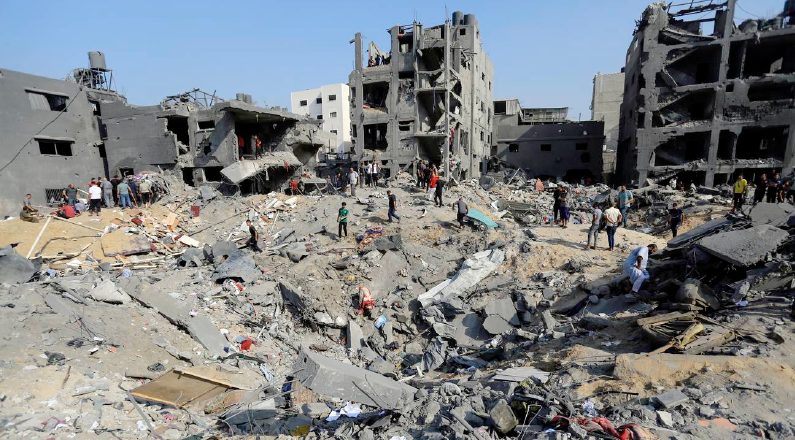
The most urgent thing for me, in the midst of a conflict that pits Israel against Palestine in a bloody war that has left Gaza in ruins and reduced its population to starvation, is: How should I approach God’s loving plan for humanity in the Bible, a plan that includes the election of Israel, the gift of the land, and the annihilation of the peoples who inhabit the earth? How can I read the word that Christians acclaim as the Word of God: “But in the cities of these peoples that the Lord your God gives you for an inheritance, you shall save alive nothing that breathes, but you shall utterly destroy them, the Hittites and the Amorites, the Canaanites and the Perizzites, the Hivites and the Jebusites, as the Lord your God has commanded” (Deuteronomy 20:16-17)? Wouldn’t it be better to put the Bible in a closet and find other resources for developing spiritual life, moral conduct, and religious leadership? Or, at the very least, shouldn’t the most problematic parts of the Bible be censored? It can be, and has been, a dangerous book, not only for many in the Middle East today, but also for many others throughout centuries of history.
On January 7, 1937, David Ben-Gurion, head of the Jewish Agency in British-Mandated Palestine (a shadow government that prefigured the creation of the State of Israel), spoke before the Peel Commission, which sought to resolve the problems of the British Mandate in Palestine, which was mired in conflict between Jews and Arabs. Questioning the very concept of a «British Mandate for Palestine» established in the aftermath of World War I, Ben-Gurion declared: «In the name of the Jews, I say that the Bible is our Mandate, the Bible that was written for us, in our language, in Hebrew, right in this country. This is our Mandate. Our right is as old as the Jewish people». In 1958, ten years after the creation of the State of Israel, Ben-Gurion, then Prime Minister, inaugurated the first World Bible Competition in Jerusalem. Shortly afterward, he established a regular Bible study circle, which he frequently attended. The group began its work with Ben-Gurion’s favourite Bible book, Joshua, which he considered absolutely factual. For him, it was the historical model of the conquest of the Land of the Bible by the People of the Bible, then and now.
Ben-Gurion was not a religious Jew, and his faith in God was overshadowed by his faith in the «Jewish» nation, a concept derived from his avid reading of the Bible. Moreover, he explicitly rejected the religious betrayals of the Jewish people that had developed over the centuries in the Rabbinic writings collected in the Talmud. As a «Jewish» nationalist, he viewed the Bible as the ultimate and eternal literary and spiritual apex of the Jews in their homeland, while considering the Rabbinic writings — the Talmud — as a secondary collection, created in exile and destined to disappear over time. Ben-Gurion’s biblicism (a secular reading of the Bible used as a treasure house of nationalist terminology and mythology) was instrumental in the early history of Zionist activity in Palestine. Although harshly criticized by religious Jewish intellectuals in Israel, such as Martin Buber and Yeshayahu, Leibowitz — both deeply aware of the troubling issues raised by Israel’s military conquests, the ethnic cleansing of Palestinians from Israeli territories and the entrenched discrimination against Arab citizens in the State of Israel — Ben-Gurion’s version of Zionism dominated.
The current Israeli Prime Minister Benjamin Netanyahu is heir to Ben-Gurion’s legacy of using the Bible to further legitimize and consolidate the Occupation. At the beginning of the Gaza war on October 8, 2023, Netanyahu described Israeli soldiers as «eager to take revenge on the murderers for the horrific acts perpetrated against our children, our wives, our parents, and our friends. They are committed to eradicating this evil from the world, for our existence and, I add, for the sake of all humanity. All the people and their leaders embrace them and believe in them. ‘Remember what Amalek did to you.'» His citation of Deuteronomy 25:17 was a chilling reminder of how the Bible can be used to promote war and hatred. Amalek, described in Exodus 17, is the archetypal enemy of the Israelites, and they are ordered to exterminate him and his descendants. Netanyahu, his allies, the Israeli settler movement, and those who commit acts of violence against Palestinians constantly resort to biblical vocabulary to justify their acts of death and destruction.
There is nothing new in the ideological abuse of sacred texts. «Mobilizing» an idea of God and sacred narratives that speak of God adds authority to human ideologies of dominion and exclusion. This causes the Bible to be frowned upon by those who fight for freedom, equality, and fraternity. However, for Christians, the Bible provides the words to speak of God, the human person, and the relationship between the two. It offers a vocabulary, a grammar, and a syntax through which Christians can attempt to express God. The biblical narrative traces a story of origins, relevance, and hope that situates believers in a long history of humanity, in which they can find meaning, vocation, and mission in a world seeking redemption. And, like all treasure, appropriating it carries risks.
In 1994, the Latin Patriarch of Jerusalem, Michel Sabbah, published a key tool for Bible readers in this time of conflict in Palestine/Israel: Reading and Living the Bible Today in the Land of the Bible (Michel Sabbah, Latin Patriarchate, Jerusalem, 1993). The Introduction to this Pastoral Letter is a verse that constitutes a Christian hermeneutical key for reading the Bible: «For He is our peace, who has made us both one, and has broken down the dividing wall of hostility, by abolishing it in His flesh […] that He might create in Himself one man in place of the two, so making peace, and might reconcile us both to God» (Ephesians 2:14-16). In this Letter, Sabbah poses a poignant question to those who read the Bible in Palestine today: «Should we be victims of our own history of salvation, which seems to privilege the Jewish people and condemn us? Is this really the will of God, to which we should submit inexorably, without appeal or discussion, and which would not ask us to leave everything for another people?» (n. 7c).
Addressing those who have rejected the Bible because of the way it is read to justify the Occupation and discrimination, Sabbah says: «By this rejection of the Word of God, dear faithful, you make yourselves accomplices and victims of those you accuse and, having been robbed of the land, you allow yourselves to be robbed also of your Sacred Scripture and of the light it contains to help you emerge from the darkness and overcome every difficulty» (n. 56). Towards the end of the Letter, Sabbah concludes: «To read and live the Bible, today in the land of the Bible, is a grace and a challenge. A grace because every day we walk with Jesus Himself along the same paths that He walked with His disciples, as a partner and friend. A challenge because today, in this war of conflict, we experience sufferings that are at the heart of our dialogue with the Lord. And the Lord, who sets our hearts on fire when He speaks to us (cf. Luke 24:32) along our pilgrim’s journey, «opens our hearts to an understanding of the Scriptures» and helps us to understand, through an understanding of our history, the Will of the Father» (n. 64).
Christians must be aware that concepts such as «Chosen People» and «Promised Land» have very concrete existential and moral consequences for the peoples of the Middle East, and are not merely speculative and theological exercises. In line with these concerns, the Holy See has emphasized the importance of international law, rather than biblical discourse, in understanding the conflict in Palestine and Israel. Christians are invited to understand the conflict — the Jewish religious link with the land of Israel — which has its roots in the biblical tradition, although no particular religious interpretation of that relationship should be adopted. Regarding the existence of the State of Israel and its political decisions, it must be seen in a perspective that is not religious in itself, but refers to the common principles of international law” (Dicastery for the Promotion of Christian Unity, Sussidi per una corretta pesentazione degli ebrei e dell’ebraismo nella pedicazione e nella catechesi della Chiesa cattolica, 1985, VI, 1).
Ultimately, the Bible read with faith, love, and charity reveals itself as the living Word of God. In Palestine today, the Bible is used to legitimize and justify wars, Occupation, and discrimination. Along with the Bible, the Koran, the scripture favoured by Muslims, is «mobilized» in political struggles over the fate of the Holy Land and who should govern it. However, Dei Verbum, the Dogmatic Constitution of Vatican Council II on divine revelation, emphasizes that «Sacred Scripture [must] be read and interpreted in the light of the same Spirit by which it was written» (no. 12). Discerning this Spirit, also according to the authentic interpretation entrusted to the Magisterium (no. 10), is therefore an essential part of reading the Bible. In essence, the Bible read as the Word of God teaches equality, justice and peace, values that are in harmony with the God we learn to know in the Church’s reading of the Bible.
David Mark Neuhaus, SJ, born in South Africa in 1962 to German-Jewish parents who fled Nazism, served as Superior of the Jesuit Community at the Pontifical Biblical Institute of Jerusalem. Professor of Sacred Scripture at the Seminary of the Latin Patriarchate of Jerusalem, from 2009 to 2017, he was Patriarchal Vicar for Hebrew-speaking Catholics in the Latin Patriarchate.
Translation of the Italian original into Spanish by ZENIT’s Editorial
Director and, into English, by Virginia M. Forrester.

Publicaciones relacionadas:
 Israel’s crisis and divisions reflected in the Gaza war
 Analysis: The Gaza War and the Economic Impact on Palestinians
 One year of Israeli attacks on Palestinians in the West Bank under the pretext of Gaza and Lebanon
 Vatican questions “preventive” war in Iran as Leo XIV intensifies diplomatic calls for peace
