

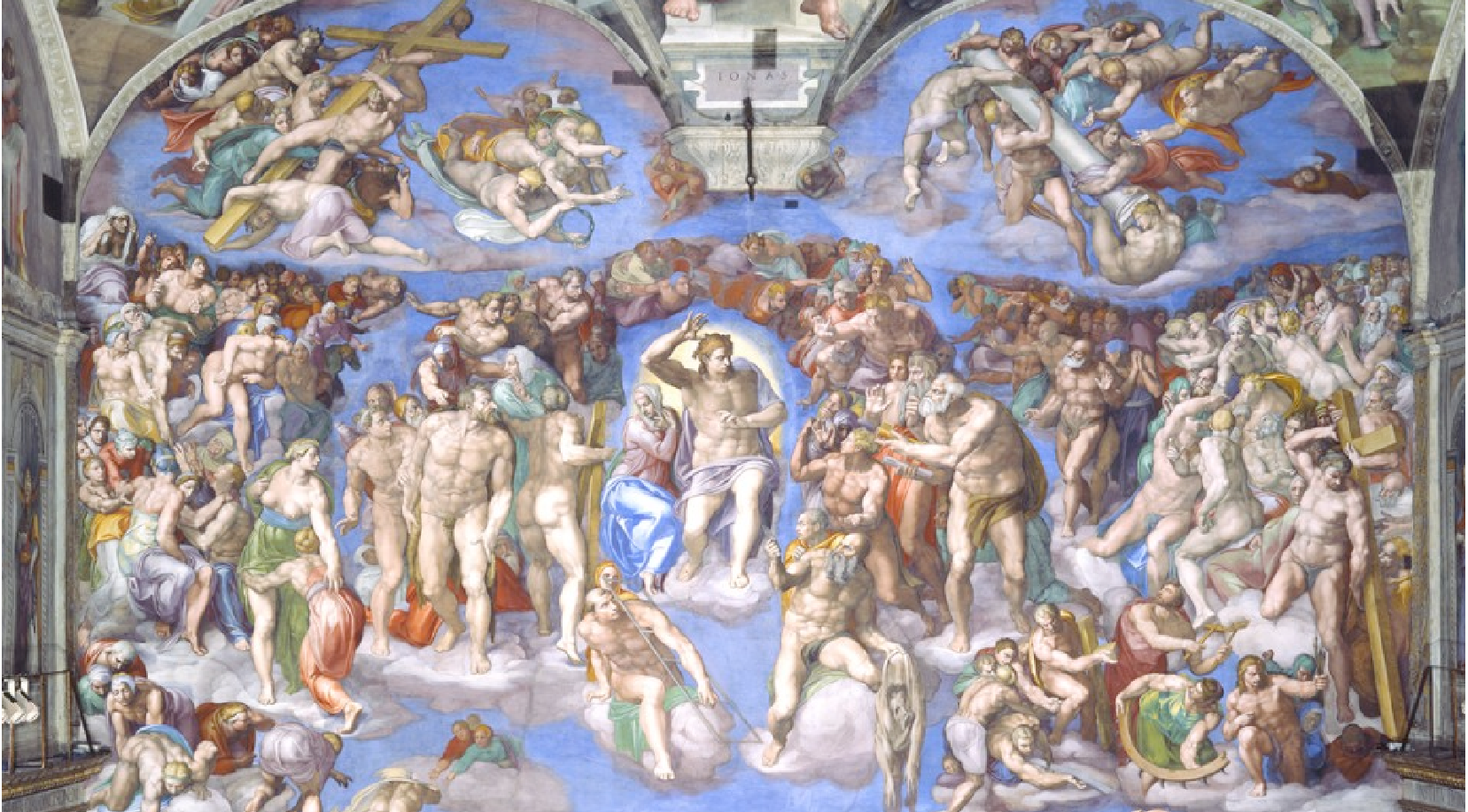
(ZENIT News / Rome, 08.15.2025).- When Michelangelo’s monumental “Last Judgment” in the Sistine Chapel undergoes extraordinary maintenance in early 2026, it will not merely be an intervention on pigment and plaster. It will be a decisive act of stewardship, carried out in the same spirit that has guided Vatican conservation for over a century: preserving not only the material beauty of sacred art but also the spiritual legacy it conveys.
At the helm of this effort stands Paolo Violini, newly appointed director of the Vatican Museums’ Laboratory for the Restoration of Paintings and Wooden Materials. He succeeds Francesca Persegati from the beginning of August 2025 and inherits one of the most prestigious and demanding positions in the art world. His appointment crowns decades of experience within the papal collections, where he has worked since 1988 on projects ranging from Raphael’s Stanza della Segnatura to the Stanza di Eliodoro.
The coming years promise to test both his technical acumen and his vision. The five-year restoration of Raphael’s Loggia is already underway, reviving the intricate stuccoes and frescoes conceived by Giovanni da Udine and his contemporaries—a decorative cycle that reshaped Renaissance interiors and reintroduced the ancient Roman grotesque to European art. Violini regards it as “a heritage of humanity” whose preservation demands the highest care.
Yet it is the January 2026 operation on the «Last Judgment» that will draw the world’s eyes. While the fresco undergoes regular annual cleaning with a mechanical lift, the forthcoming work will be more ambitious. For three months, scaffolding will cover the entire altar wall of the Sistine Chapel, supporting a dozen platforms where up to twelve specialists can work simultaneously. “The aim,” Violini explains, “is to confront the effects of millions of visitors on the most famous fresco in the world, and to do so without compromising its accessibility once Easter approaches.”
His leadership style is rooted in a principle the Vatican restoration team holds as almost a creed: continuity. The laboratory, founded in 1923 by Biagio Biagetti, carries forward methods and values shaped by 19th-century artists of the Academy of Saint Luke, when papal art was already seen as a trust to be guarded for posterity. The passage of knowledge from one generation of restorers to the next, Violini says, is the quiet strength behind their public successes.
That ethos sets Vatican restoration apart. Here, the work goes beyond preserving paint and surface integrity; it involves safeguarding the intangible dimension—the faith, theology, and historical memory embedded in every image. “It is more akin to medicine than craftsmanship,” Violini reflects. “You are not only repairing what is visible; you are ensuring the work continues to speak with its original voice.”
With a team of 26 in-house specialists and occasional outside collaborators, the Vatican’s restorers oversee a seven-kilometer exhibition circuit, Rome’s basilicas, and other papal sites beyond the city walls. Their mission is as vast as it is meticulous, requiring the kind of patience that accepts projects spanning decades. For Violini, the completion of Raphael’s «Fire in the Borgo» remains a personal ambition, not just to close a professional circle but to deepen understanding of the transition between the master and his workshop—an understanding that informs the interpretation of the «Aula of Constantine», recently restored and reopened.
Thank you for reading our content. If you would like to receive ZENIT’s daily e-mail news, you can subscribe for free through this link.

Publicaciones relacionadas:
 Priest Is Arrested Who Sought to Enter the Vatican with Weapons
 Complete List of Mexican, Spanish, American and Argentine Comedians That The Pope Will Meet in The Vatican
 Becciu case: Vatican appeal trial enters uncharted waters amid questions about the role of the prosecution
 Leo XIV overturns Pope Francis’ decision and restructures Vatican finances under one principle: shared responsibility
