

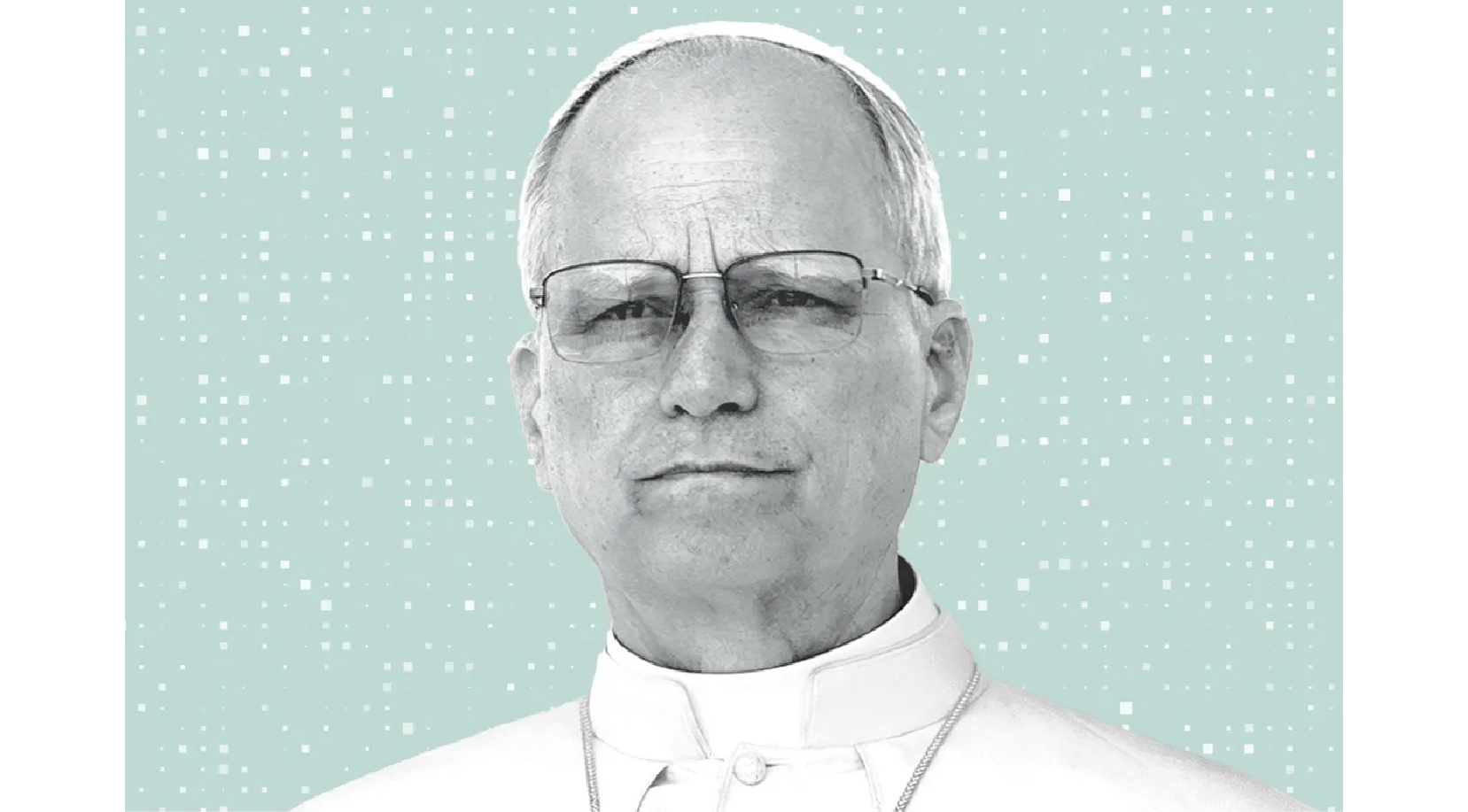
(ZENIT News / Roma, 09.02.2025).- When Time magazine unveiled its 2025 ranking of the world’s most influential voices in artificial intelligence, readers expected to see the usual constellation of Silicon Valley titans and political heavyweights. What they did not expect was the presence of a man dressed in white: Pope Leo XIV.
The new pontiff, elected just this May, appeared in the “Thinkers” category alongside leading engineers from Google and OpenAI. His inclusion, unusual though it may seem, points to a growing recognition that the ethical dilemmas posed by artificial intelligence are not merely technical puzzles but moral crossroads. And few global figures command as much moral authority as the bishop of Rome.
Leo XIV, born Robert Francis Prevost in the United States and seasoned by decades of ministry in Latin America, has quickly distinguished himself as a pope who wants to grapple with technology head-on. He has compared artificial intelligence to a “new industrial revolution” and insists it must be shaped by human dignity rather than profit or power. For him, the reference point is not abstract philosophy but the historic precedent of Pope Leo XIII, who responded to the first Industrial Revolution with the landmark social encyclical «Rerum Novarum» in 1891. Just as his predecessor defended exploited factory workers from becoming disposable cogs, Leo XIV warns against treating human beings as data points in the age of algorithms.
That vision came into sharper focus in June, when the Vatican hosted a global summit on AI governance. There, Leo praised the technology’s potential to advance medical research and relieve human suffering but sounded an alarm over its risks: systems that could warp humanity’s search for truth, manipulate democratic societies, or deepen social inequalities. The Pope’s insistence that AI be subject to ethical oversight echoes calls by his predecessor, Francis, who urged governments to negotiate a global treaty on the issue. But in Leo’s voice, the urgency feels renewed.
What makes his stance particularly notable is the pastoral lens through which he views the debate. Having lived and worked among farmers and laborers in Peru, he brings to the digital table the memory of people who bear the costs of economic upheaval most acutely. For him, conversations about automation are not theoretical—they are about livelihoods, families, and communities. In this sense, his presence on Time’s list is less about inserting religion into tech and more about ensuring that the people usually forgotten in boardrooms are not left behind in the algorithmic age.
That perspective places him in dialogue—sometimes in tension—with figures such as Elon Musk, Mark Zuckerberg, and Jensen Huang, who also appear on Time’s list. Where they speak the language of innovation, scaling, and market share, Leo XIV speaks of justice, solidarity, and the primacy of the human person. His contribution to the conversation is not a blueprint for machine learning but a reminder that technology without a moral compass can become as dehumanizing as the factories of the 19th century.
By naming a pope as one of the world’s most influential AI thinkers, Time has acknowledged that the debate over artificial intelligence transcends the laboratories and boardrooms where code is written. It belongs equally in the realm of ethics, culture, and spirituality. Leo XIV’s message is clear: progress must be measured not by how smart our machines become, but by whether they help us remain more fully human.
Link to Time magazine article on Leo XIV.
Thank you for reading our content. If you would like to receive ZENIT’s daily e-mail news, you can subscribe for free through this link.

Publicaciones relacionadas:
 Pope asks to define principles, norms, and guidelines for Latin rite priests accompanying Eastern rite Catholics arriving in the West
 How God makes us into his dwelling places: a reflection of Pope Leo XIV
 Leo XIV to Personally Bestow Palliums in Return to Historic Ritual: A Subtle but Symbolic Shift in Papal Style
 Pope Leo XIV summons bishops to Rome to discuss the reimplementation of the controversial Amoris Laetitia
