

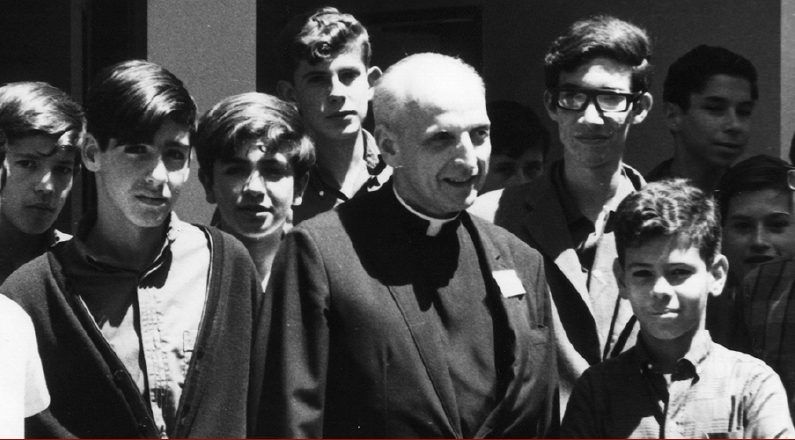
(ZENIT News / Rome, 09.21.2025).- The name of Pedro Arrupe, the charismatic Jesuit superior general who guided his order through the turbulent decades after the Second Vatican Council, has long inspired devotion. From his work among the survivors of Hiroshima to his vision of a missionary Church that serves the marginalized, Arrupe’s story has been invoked as a model of holiness since his death in 1991. His cause for canonization, opened in 2019, continues to advance in Rome.
Yet today, the legacy of the Spanish Jesuit is facing fresh scrutiny, not for his spirituality or leadership in global mission, but because of a newly reopened wound in the history of clerical sexual abuse. A civil lawsuit in Louisiana has unearthed decades-old correspondence in which Arrupe was consulted about the ordination of Donald Dickerson, a Jesuit seminarian later revealed as a serial abuser.
The documents, made public in U.S. court filings this summer, include two letters: one sent to Arrupe in 1977 and another signed by him the following year. The exchange reflects a tense dispute within the New Orleans province over whether Dickerson should ever have been ordained. Provincial superior Thomas Stahel strongly resisted ordaining him, citing disturbing reports of misconduct, while his deputy for formation, Louis Lambert, argued in favor. Arrupe, writing from Rome, seemed to defer to local leadership, a style consistent with his aversion to authoritarian governance. Dickerson’s ordination was postponed—but not prevented. In June 1980, he became a priest.
In hindsight, the decision is seen as catastrophic. Court filings describe at least six victims abused by Dickerson before and after ordination. His trajectory—from assignments at Jesuit schools to parish work and eventually to Loyola University New Orleans—left behind a trail of trauma, litigation, and settlements that continue to surface.
For Arrupe, whose reputation rests on moral courage and prophetic vision, the Louisiana case has become a stumbling block. Lawyers representing victims argue that he failed to act decisively and accuse him of complicity in covering up crimes. Three of them now openly insist his sainthood cause should be closed.
Others caution against collapsing history into accusation. Canon lawyer Dawn Eden Goldstein notes that Jesuit superiors of the 1970s often relied on psychological assessments that minimized the risks of reoffending and embraced therapies that have since been discredited. “The procedures followed then were inadequate,” she says, “but whether that equates to a deliberate cover-up is far less clear.”
Psychologists back this view. Thomas Plante of Santa Clara University recalls that, in those years, clinicians often believed offenders could be rehabilitated through behavioral therapy. David Finkelhor, a leading researcher on child protection, adds that the scientific understanding of how to prevent recidivism was still in its infancy. What today appears as negligence, they argue, was once considered accepted practice.
The debate underscores a broader tension: how should the Church weigh the heroic sanctity of figures like Arrupe against their entanglement—however indirect—in systemic failures? The Spanish Jesuit, remembered for urging his order to form men and women “who live not for themselves but for God and Christ,” was also the head of an institution that, like much of the Church, stumbled gravely in protecting children.
Arrupe’s defenders stress that it would have been highly unusual for a superior general in Rome to override the judgment of provincials overseas. His critics counter that sainthood requires not simply fidelity to the norms of an era but an extraordinary clarity of conscience, especially when human lives are at stake.
For now, the cause for Arrupe’s canonization continues, while the Louisiana lawsuit moves forward in civil court. As testimonies and documents surface, they are unlikely to leave either the Jesuits or the Vatican untouched.
The paradox remains: a man revered for his compassion and leadership at Hiroshima, in Latin America, and across the post-conciliar Church now finds his memory intertwined with one of Catholicism’s most devastating crises. Whether this complicates his path to sainthood—or even reshapes it—will depend on how the Church, and history, chooses to judge both his vision and his silences.
Thank you for reading our content. If you would like to receive ZENIT’s daily e-mail news, you can subscribe for free through this link.

Publicaciones relacionadas:
 Case of mismanagement of abuse allegations could halt canonization of Jesuit Pedro Arrupe
 Dicastery for the Doctrine of the Faith Clarifies the Term “Vulnerable Adult” in Cases of Abuse and Its Competence in This Regard
 Jesuits report that Father Arrupe’s cause for beatification is moving forward
 Cardinals Decide to Suspend Beatifications Until Election of the New Pope
