

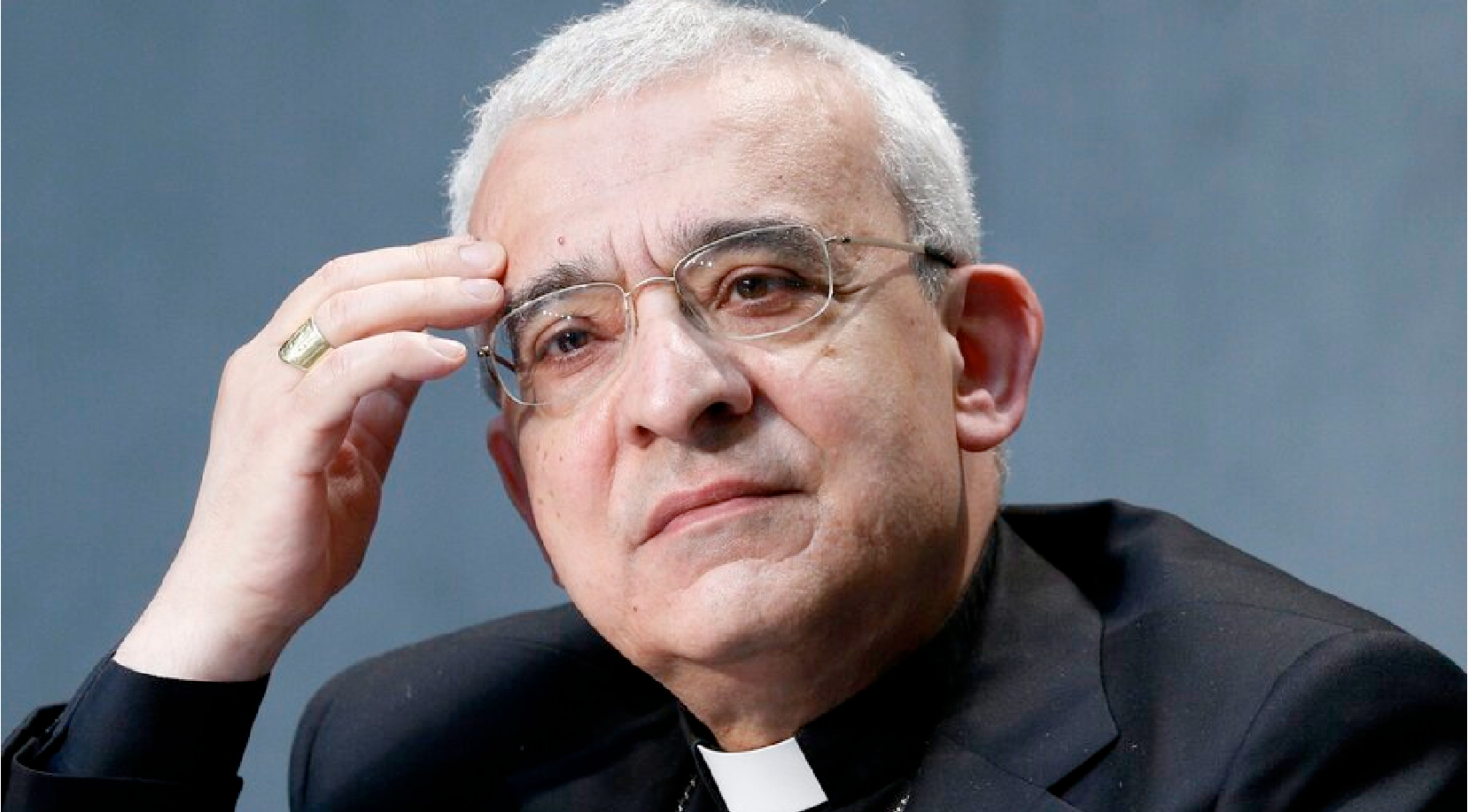
(ZENIT News / Rome, 10.22.2025).- A Vatican initiative to define and codify “spiritual abuse” within canon law has taken a decisive step forward, as Pope Leo XIV confirmed Archbishop Filippo Iannone will remain at the helm of the specialized working group despite his recent transfer to lead another Vatican department.
The task force, jointly overseen by the Dicastery for the Doctrine of the Faith (DDF) and the Dicastery for Legislative Texts, was first established by Pope Francis in November 2024 to address what Church jurists have described as one of the most urgent legal gaps in canon law. The group’s mandate is to determine how spiritual abuse—often linked to manipulation, coercion, and the misuse of authority within religious settings—should be formally classified as a canonical crime.
Archbishop Iannone, a Carmelite and seasoned canon lawyer, was originally appointed to chair the group in his capacity as prefect of the Dicastery for Legislative Texts. When Pope Leo transferred him in September 2025 to head the Dicastery for Bishops, some observers feared the change might stall the delicate process of drafting legal norms. But a decision announced ensures continuity.
In a communiqué dated October 14, Cardinal Víctor Manuel Fernández, prefect of the DDF, reported that the group “has been working fruitfully” and requested that Iannone be confirmed as its leader “in order to maintain the consistency and momentum of the effort.” The Pope accepted the proposal four days earlier during a private audience with Fernández, effectively securing the project’s stability at a critical stage.
The continuity of leadership was welcomed quietly by those following the Vatican’s internal reforms. Iannone’s steady hand, they note, had been instrumental in implementing Francis’s wider curial reorganization, which sought to simplify structures and strengthen oversight of canonical matters. His new post at the Dicastery for Bishops—traditionally one of the Holy See’s most influential departments—was viewed as both a promotion and a sign of confidence from the new pontificate.
The timing of Fernández’s request was not incidental. It came just a day after a five-judge Vatican tribunal was appointed to hear the case of Father Marko Rupnik, the Slovenian Jesuit artist accused of sexually and psychologically abusing multiple adult women. The scandal surrounding Rupnik has been one of the most painful for the Church in recent memory, in part because it exposed how certain patterns of coercion and spiritual manipulation—though not explicitly defined in canon law—can devastate victims while remaining difficult to prosecute.
Currently, canon law does not clearly delineate “spiritual abuse” as a distinct offense. Instead, such behavior often falls into ambiguous categories, leaving investigators and tribunals with limited tools for accountability. The new working group aims to close that gap by identifying and codifying what constitutes spiritual abuse, its canonical penalties, and the forms of authority under which it can occur.
Legal and theological experts have long pressed for such a reform. They argue that the Church must recognize not only physical or sexual violations but also the abuses of conscience and faith that can emerge in relationships of pastoral dependence—where obedience, trust, and spiritual direction can be weaponized.
If the working group completes its task before the conclusion of Rupnik’s trial, the case could become the first in which the newly defined canonical crime is invoked. Such a development would mark a milestone in the Church’s ongoing struggle to confront abuse in all its dimensions—physical, psychological, and now, explicitly, spiritual.
Behind the technical legal language lies a deeper cultural shift. The Vatican’s decision to systematize the concept of spiritual abuse signals a growing awareness that the Church’s internal justice system must evolve to reflect the complexities of modern ecclesial life. For many, it represents the slow but tangible maturation of the Church’s response to authority gone awry.
As one canon lawyer in Rome observed, “The challenge is not only to punish wrongdoing, but to protect what is sacred in the relationship between the faithful and their pastors. Defining spiritual abuse is a way of defending spiritual trust itself.”
Thank you for reading our content. If you would like to receive ZENIT’s daily e-mail news, you can subscribe for free through this link.

Publicaciones relacionadas:
 Pope’s Commission on Guardianship of Minors gives green light to study group on vulnerable adult issue
 Abuse Is Not Related to Celibacy: Vatican Publishes First Annual Report on Policies for Protection of Minors
 Vatican institutes task force against spiritual abuse and false mysticism
 Vatican announces date of its second report on protection against abuse
