

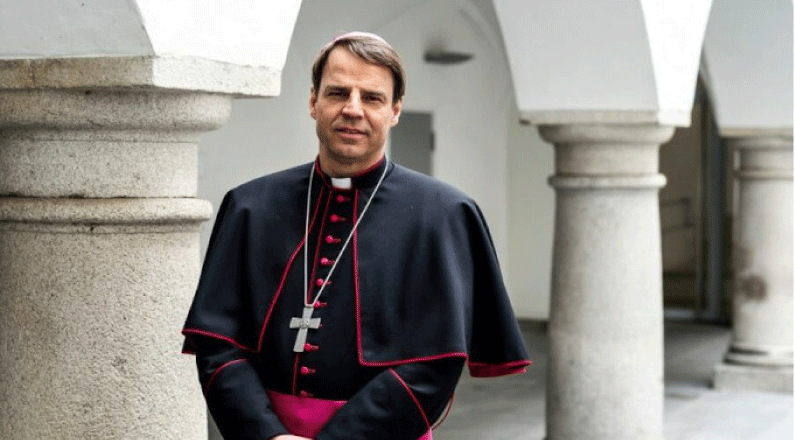
(ZENIT News / Passau, 11.12.2025).- In Germany, a sharp rift has erupted within the Catholic hierarchy over how the Church should engage questions of sexuality, identity, and education in a changing cultural landscape. The spark was the late-October release of an educational document by the German Bishops’ Conference (DBK), titled Created, Redeemed, and Loved: Visibility and Recognition of Sexual Diversity in Schools. What was intended as a pastoral guide for Catholic educators has instead revealed deep fractures over the Church’s understanding of human nature itself.
Among the first and most vocal dissenters is Bishop Stefan Oster of Passau, who publicly distanced himself from the document this week. “Even though the cover says ‘The German Bishops,’ the text does not speak in my name,” he wrote in a personal statement. His words carried a note of sadness as much as alarm. To Oster, the issue is not one of tone or pastoral sensitivity, but of theological coherence. “What is at stake,” he wrote, “is the very Christian concept of humanity—of who we are before God.”
The DBK’s document calls on Catholic schools to cultivate openness and respect toward students of all sexual orientations and gender identities, promoting an atmosphere free of discrimination. It encourages teachers of religion to present Church teaching in a “nuanced” way, while facilitating dialogue rather than confrontation. Its tone is inclusive, its vocabulary contemporary, and its central theme clear: every person, in their diversity, is loved by God.
Yet for Oster, that emphasis—while pastoral on the surface—betrays what he calls “a desacralized anthropology,” one that risks replacing theology with sociology. He argues that the document treats diversity as inherently divine and therefore beyond moral discernment. “Almost every line suggests: less moral theology, and certainly no claim to truth,” he writes, describing what he sees as a “super-dogma” of unconditional affirmation—an emotional substitute for doctrine.
Oster’s critique goes beyond linguistic quibbles. He contends that the document’s use of terms such as “gender identity” and “sexuality” lacks clarity and depth, failing to explain how these concepts relate to Christian anthropology, sin, grace, and salvation. He warns that if the Church accepts a view of human identity detached from creation and revelation, it risks altering not only its moral teaching but its very understanding of the sacraments and of God Himself.
In perhaps his most pointed passage, Oster targets the treatment of transgender identity in the document, which he says uncritically extends the phrase “God made and loved them as they are” to those seeking to alter their biological sex. For the bishop, such a claim ignores both theological and scientific complexities. He notes that several Western countries, including the UK, Sweden, and the United States, have begun re-evaluating their policies on gender-transition treatments for minors, citing medical and ethical concerns. “If this document was meant to be in step with the times,” he writes, “then it is already behind them.”
Other theologians have echoed his unease. Franz-Josef Bormann, a moral theologian from Tübingen, said the DBK guidelines rely on “a rhetoric of acceptance and well-being” while neglecting serious medical and psychological questions surrounding young people who identify as transgender or queer. He criticized the document for blurring the distinction between compassion and relativism and for failing to affirm clearly that humanity exists as male and female—a foundation, he argues, of both reason and revelation.
The controversy reveals a deeper tension running through the German Church’s current path: the attempt to reconcile the universal claims of Catholic doctrine with the fluid language of the modern age. Many German bishops have pushed for a more inclusive approach in matters of sexuality, arguing that credibility and pastoral effectiveness require dialogue with contemporary science and social reality. But their critics, like Oster, see such efforts as edging toward a theology of accommodation that empties faith of its transformative power.
Behind this dispute lies a broader question: can a Church that seeks to meet people “where they are” still speak meaningfully about what God calls them to become? Oster’s answer, implicit but unmistakable, is that a Church that forgets its anthropology forgets its mission.
Thank you for reading our content. If you would like to receive ZENIT’s daily e-mail news, you can subscribe for free through this link.

Publicaciones relacionadas:
 Cardinal Ambongo: statements on the new colonialisms and Fiducia Supplicans
 Bishop Accepts and Backs First Transgender “Man” (Biologically a Woman) in Catholic Hermitic Life
 Woman Wins Lawsuit Against Two Bishops in Belgium for Refusing to Accept Her for Diaconal Formation
 Capuchin Bishop Who Supported a Transgender Hermit Is Recognized by LGBT Activist Group in the USA
