

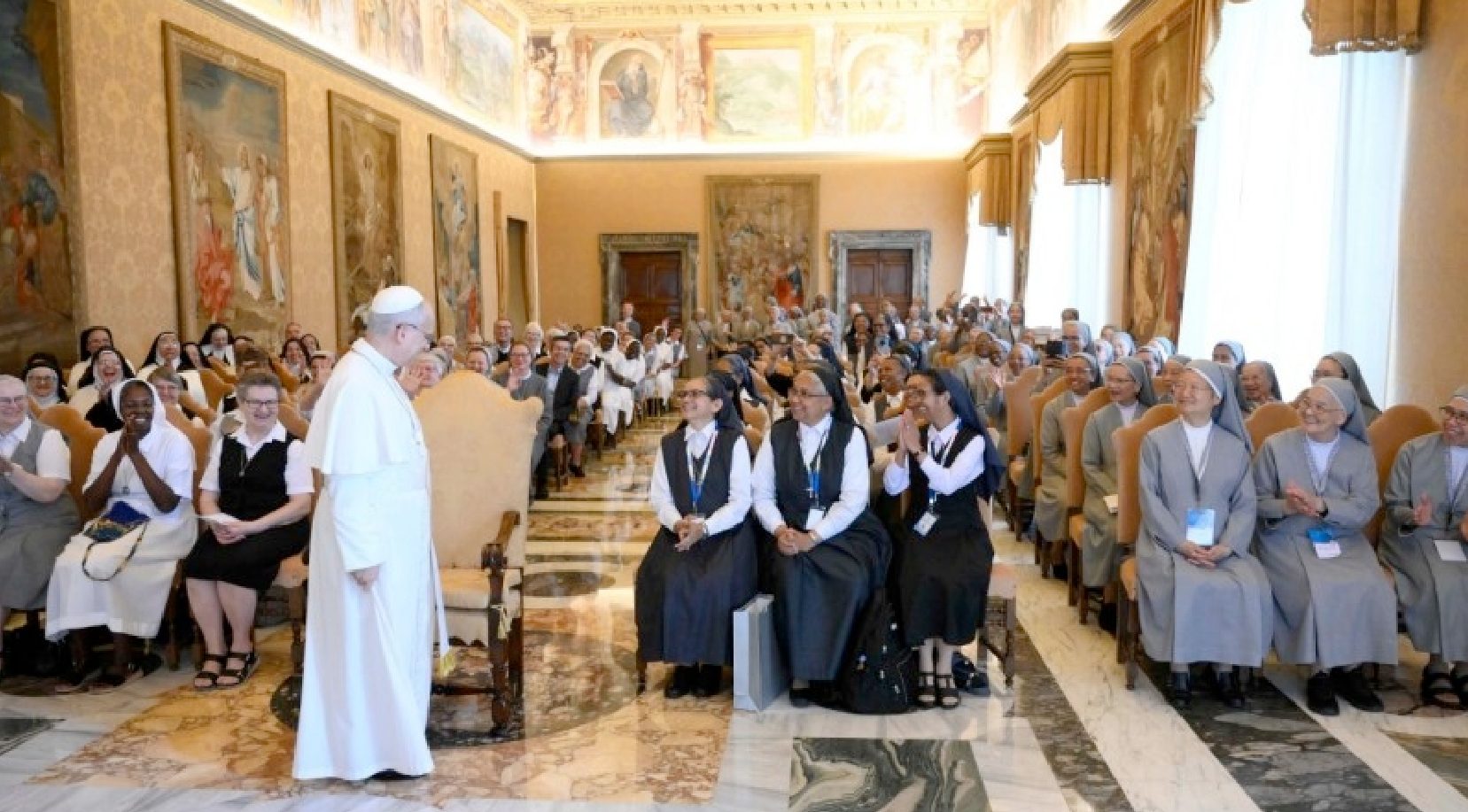
(ZENIT News / Rome, 11.17.2025).- For decades, the question of whether Catholic women might one day serve as deacons has hovered at the edge of ecclesial debate, alternately resurfacing and receding as popes, theologians, and bishops revisited the issue. Now, the discussion is returning to the foreground with unusual momentum. The General Secretariat of the Synod of Bishops has disclosed that a Vatican commission dedicated to the topic is nearing the conclusion of its work, raising expectations that concrete findings may soon be placed before the Holy See.
The revelation came in mid-November, embedded in a broader update on the progress of several sensitive research projects launched during the final years of Pope Francis’s pontificate. What emerged from the report is a portrait of a Church carefully but deliberately probing its own internal boundaries.
Two separate study bodies are now working in parallel. One is tasked with evaluating how women participate in the life, mission, and governance of the Church writ large. The other, more narrowly focused, is examining the historical, theological, and pastoral dimensions of a possible female diaconate. In both cases, the mandate is to sift through centuries of tradition and contemporary pastoral realities without succumbing to ideological pressures from either side of the debate.
Many Catholic reform groups have spent years urging an expansion of ministerial roles for women, arguing that the credibility of the Church’s mission in modern society depends on it. Others, including a majority of bishops across regions, have warned that certain proposals risk unsettling doctrinal foundations or creating expectations that exceed what Catholic theology can sustain. The study groups now find themselves navigating this tension, aware that their conclusions will be scrutinized by the global Catholic community.
The timeline is unusually concrete. Before the close of 2025, the commissions must deliver their full analyses and recommendations to Pope Leo XIV, whose pontificate began following the death of Francis. One of his first acts was to extend the deadline for these reports by six months and to establish two additional committees focused on other pastoral questions—including the training of priests, the identity and responsibilities of bishops, ecumenical engagement, and pastoral responses to poverty and polygamy in regions where those issues hold particular urgency.
The renewed examination of the female diaconate is not occurring in a vacuum. Since the Second Vatican Council, the Church has periodically returned to the historical evidence for women described as “deaconesses” in early Christian communities. Scholars disagree on whether these figures exercised a sacramental ministry equivalent to that of male deacons or fulfilled distinct roles shaped by the needs of their time. Francis reopened the discussion twice during his pontificate, convening study groups in 2016 and again in 2020, though neither produced a decisive judgment.
What distinguishes the current stage is less the novelty of the questions and more the institutional weight behind them. As the Synod’s global process pushes the Church to reexamine its own structures, initiatives that once seemed peripheral have been brought into the center of ecclesial reflection. The possibility—still distant, still uncertain—of formally restoring women to the diaconal ministry has become a symbolic test of how the Church understands participation, authority, and tradition in the twenty-first century.
For now, anticipation is tempered by caution. No one close to the process expects swift or dramatic shifts, and sources within the Vatican emphasize that the commissions’ conclusions will be consultative rather than binding. Still, the very fact that the Church’s highest advisory bodies have been asked to treat these questions with seriousness reflects a new phase of institutional introspection.
Thank you for reading our content. If you would like to receive ZENIT’s daily e-mail news, you can subscribe for free through this link.

Publicaciones relacionadas:
 Group of Women Headed by A Princess Pray Over Pope Francis Who Gives Them Three Characteristics of Mary to Imitate
 For the first time in 500 years, two women in team of sanpietrini of Vatican basilica
 Cardinal Prefect of Dicastery for the Doctrine of the Faith Repeats That Female Diaconate Is Not Mature and Explains Absence of Synodal Group
 Pope Leo XIV corrects Pope Francis’ canonical error: now any woman (or lay person) can be governor of the Vatican
