

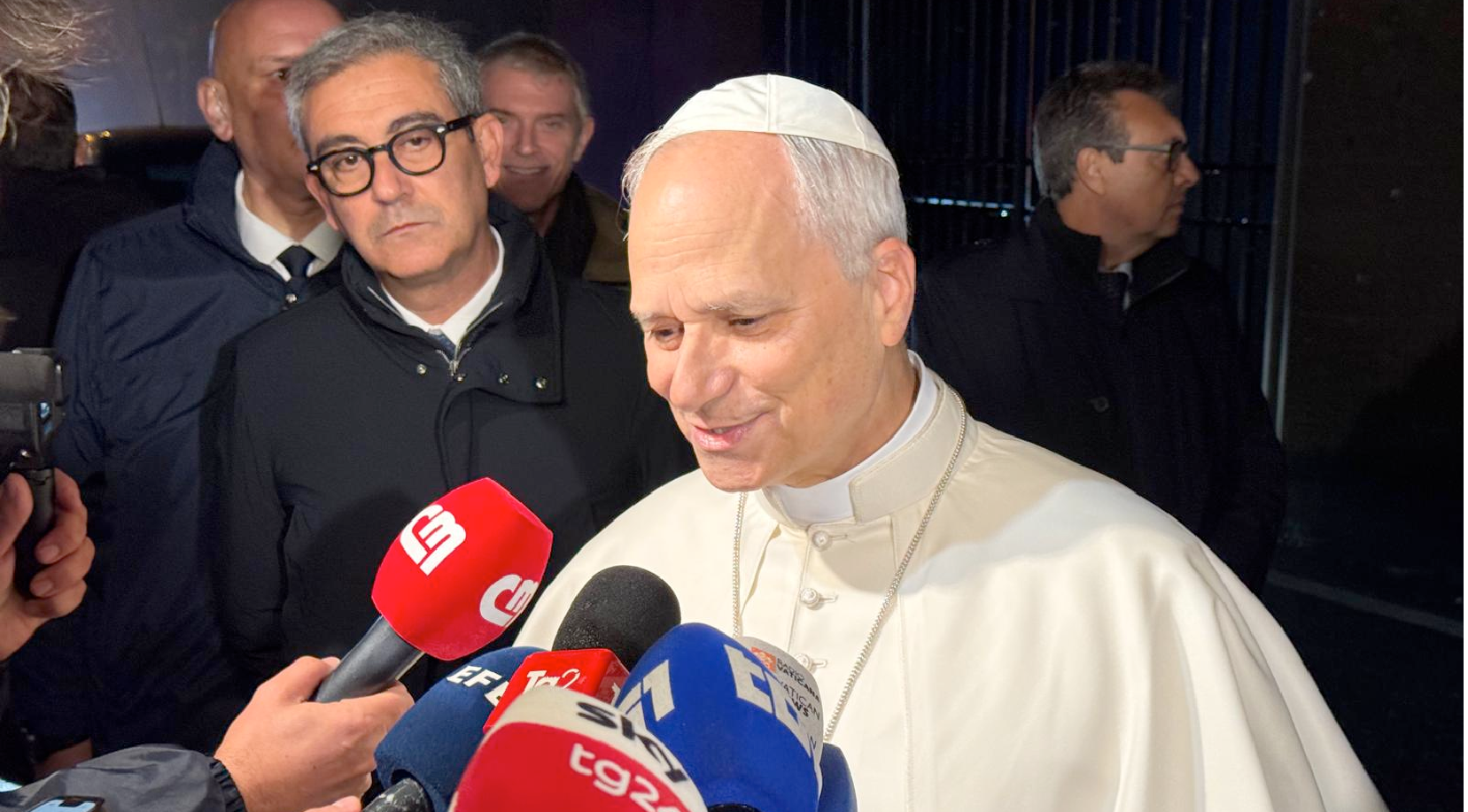
(ZENIT News / Castelgandolfo, 11.19.2025).- When Pope Leo XIV stepped out of Villa Barberini on a crisp November afternoon, the small crowd gathered along the narrow road in Castel Gandolfo greeted him with a mixture of warmth and curiosity. Tuesdays have quietly become his weekly retreat from the unrelenting pace of Rome, but the pause in the papal rhythm opened into a conversation with reporters — a dialogue that spanned war, migration, terrorism, and even tennis.
The encounter unfolded on November 18. Journalists from various countries had been waiting, aware that the pontiff’s informal Tuesday exchanges often reveal more of his thinking than formal speeches ever could.
Asked first about Ukraine — still battered by heavy Russian strikes — Pope Leo refused to endorse the idea, floated recently in geopolitical circles and echoed publicly by U.S. president Donald Trump, that territorial concessions might be the price of peace. “Their constitution is very clear,” he noted, placing the responsibility squarely on the Ukrainian people. His concern was not theoretical. “People are dying every day. What is missing is a ceasefire. Only from that point can dialogue begin.”
The Pope’s insistence on a ceasefire echoed the Vatican’s repeated calls for negotiations, yet Leo XIV spoke with a bluntness that suggested frustration: the war has become a grinding stalemate, and humanitarian suffering has long passed the threshold of moral urgency.
Soon the discussion turned to another political flashpoint: the United States. A pastoral letter issued November 13 by the U.S. bishops, rejecting proposals for mass deportations of undocumented migrants, has rippled through American public debate. Leo XIV welcomed the bishops’ intervention as “very important,” and urged Catholics — and anyone “of good will” — to take their words seriously.
He described the tension between border regulation and human dignity not as an ideological impasse but as a practical challenge. Nations, he said, hold the right to determine their borders. But he added a caution: people who have lived in the country for a decade or more should not be treated in ways that are “extremely disrespectful” or violent. The Pope’s remarks were a quiet but pointed critique of recent enforcement operations that have unsettled long-established communities.
As global questions multiplied, Leo XIV directed attention to a region often overshadowed until tragedy strikes: Nigeria. Violence there, he warned, is ravaging not just Christians but Muslims as well. “There is a danger for everyone,” he said, describing a landscape where terrorism converges with conflicts over land and resources. The Pope urged Nigerian authorities and local communities to work toward genuine religious freedom — not merely as a legal guarantee, but as a lived reality capable of defusing spirals of hatred.
Reporters, aware of his two decades as a missionary in Peru, asked whether he intends to return to Latin America. The Pope smiled. Travel, he said, has always been something he enjoys, though the complexity of papal commitments makes planning difficult. Still, he sketched a tentative itinerary for 2026: Fatima, Guadalupe, Uruguay, Argentina, and, “of course,” Peru. The Jubilee Year has left little space for detailed preparation, but the desire is unmistakable.
Between global crises and pastoral diplomacy, the conversation shifted to something more intimate: how a Pope spends his day off. Leo XIV described a rhythm surprisingly ordinary — and intentionally so. He reads, he swims, he answers correspondence, he plays tennis. The mixture of exercise and quiet work, he explained, is essential. “A person must take care of body and soul together,” he said. For him, this weekly pause “helps a great deal.”
But the respite did not prevent reporters from raising a sensitive issue: the investigation involving Bishop Rafael Zornoza of Cádiz and Ceuta, accused of sexual abuse dating back to the 1990s. The Pope, careful not to interfere with the judicial process, said that established protocols must guide the case. Zornoza maintains his innocence, the Pope noted, and an inquiry is underway. Leo XIV expressed hope that victims find secure spaces to speak, emphasizing that the Church must allow the investigative steps to unfold thoroughly, even if they take time.
The exchange at Castel Gandolfo captured a pontificate balancing expansive global awareness with pastoral immediacy and human vulnerability. Leo XIV’s responses did not offer dramatic surprises, yet they revealed a leader who prefers clarity over spectacle, and who carries into even the most charged issues a commitment to patient dialogue — grounded, perhaps, in the quiet Tuesday hours he spends between a tennis court and a pile of correspondence.
Thank you for reading our content. If you would like to receive ZENIT’s daily e-mail news, you can subscribe for free through this link.

Publicaciones relacionadas:
 The Pope’s Complete Agenda: Mass for the Inauguration of the Pontificate, Possession of Rome Cathedrals, and First General Audience
 Pope Leo XIV Reopens Papal Apartment
 Former Swiss Guard’s Thoughts on Election of Pope Leo XIV
 Pope Leo XIV: attention to current events and the ministerial and missionary dimension of teaching
