

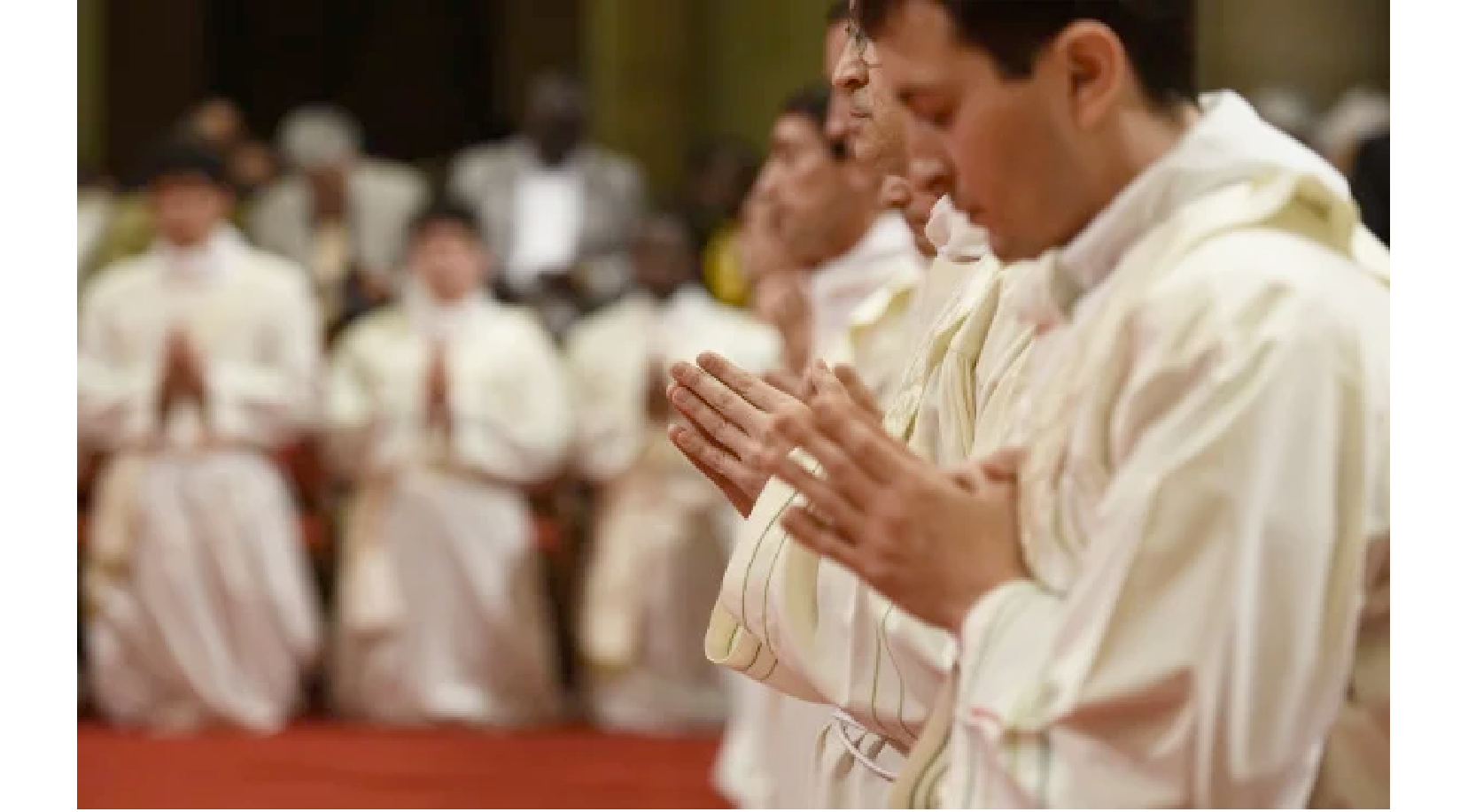
(ZENIT News / Rome, 11.19.2025).- For years, observers of Catholic life in Western Europe and North America have spoken vaguely of a “shift” within the clergy—something sensed in seminaries, noticed in parish assignments, whispered about in chancery conversations. Now two new studies, one from France and another from the United States, give shape and numbers to that intuition: the younger the priest, the more deeply he aligns with the Church’s traditional moral and theological frameworks. And this pattern is not marginal. It is becoming the dominant profile of the new generations entering—and shaping—the priesthood.
The French data, gathered by the Observatoire français du catholicisme with the help of IFOP and several Catholic media outlets, offer an unusually close look at the lives and convictions of hundreds of priests between the ages of 35 and 64. Though the sample—766 respondents out of 5,000 surveys sent—cannot claim perfect representativeness, it paints a remarkably consistent picture of generational divergence. The contrast between older and younger clergy appears across nearly every area of ecclesial life examined.
The finding that startled analysts most was not about liturgy, governance, or parish structures, but about moral teaching. Nearly half of priests over 75 expressed a desire for significant shifts in the Church’s sexual and family ethics. Among the 35–49 cohort, that share fell to just 10 percent. For priests under 35, it dropped again to 7 percent. A similar pattern emerges in attitudes toward priestly celibacy and women’s ordination: almost 30 percent of priests over 65 are open to change in these areas, compared with only 4 percent among priests under 50.
In short, the dream of a more progressive Catholicism—long expected by many aging clergy and theologians—has not been inherited by the men now taking responsibility for parishes, vocations ministries, schools, and diocesan leadership.
The new study also reveals something more human and perhaps more urgent. Roughly one in five priests says he does not feel supported by his bishop. Half worry about future assignments or the stability of their pastoral mission. And nearly 60 percent hope for stronger backing from the episcopal authority that guides their ministry. Their concerns are practical rather than ideological: they want predictable support, transparent leadership, and a sense that they will not be left alone in the overwhelming demands of modern parish life.
Despite these misgivings, French priests express a striking clarity about what their vocation means. Three out of four describe their mission in classical terms—to celebrate the sacraments, to teach the faith, and to shepherd the faithful entrusted to them. They do not ask for reinvention but for the freedom to carry out the ministry the Church has always given them. They see catechesis and education as central to the future of French Catholicism, and more than half call for concrete efforts to encourage new vocations.
Above all, they are happy. Media coverage in France has highlighted this point: priests report a deep interior joy in witnessing God’s work in people’s lives and in feeling placed exactly where they are meant to serve. Their optimism is not naïve; it coexists with anxiety, exhaustion, and the complex pressures of living in a profoundly secularized culture. Yet the joy remains, stubborn and luminous.
The generational divide documented in France closely parallels what researchers are observing across the Atlantic. A widely discussed study of American priests, found that more than 70 percent of priests ordained before 1975 identified as theologically progressive. Among priests ordained since 2010, only 8 percent did so. The overwhelming majority of younger clergy described themselves as orthodox or strongly orthodox. A few decades ago, priests with such views were seen as outliers. Today they form a growing majority.
Demographers note that part of the explanation is simple arithmetic: the “progressive” clerical generation that came to prominence after the Second Vatican Council is now aging rapidly, with many retired and others no longer active in ministry. But numbers do not tell the entire story. Younger priests have come of age in a Church marked by scandal, institutional fragility, and cultural decline. Their instinct is not to reform doctrine but to anchor themselves in forms of Catholic life they perceive as stable, coherent, and generative.
This trend does not imply uniformity. Younger priests do not constitute a single ideological bloc, nor do they share identical pastoral strategies. But the sociological picture emerging from both France and the United States suggests that the future of the Catholic clergy will be marked less by the reform-driven optimism of the post-conciliar decades and more by a desire for rootedness—rootedness in tradition, in sacramental life, and in a clear ecclesial identity.
Two studies cannot reveal the full future of the Church. Yet they do illuminate an unmistakable direction: as older generations retire, younger clergy are stepping forward with a notably different vision of what it means to serve. Their approach is not louder, nor more militant. It is quieter, more focused, and often more demanding of themselves.
The Church that emerges from this transition will not resemble the one many expected 50 years ago. It will be shaped by priests who, far from seeking to remake Catholicism, aim simply to live it with fidelity—and to help others do the same.
Thank you for reading our content. If you would like to receive ZENIT’s daily e-mail news, you can subscribe for free through this link.

Publicaciones relacionadas:
 Germany: research reveals that young clergy are conservative and opposed to ecclesiastical progressivism
 1 in 20 new priests by 2025 in the U.S. come from the military. Research reveals surprising facts
 Germany: Study Shows That Young Muslims Believe More in God Than Catholics
 Which U.S. dioceses have vocational replacement, which do not and why? Study answers
