

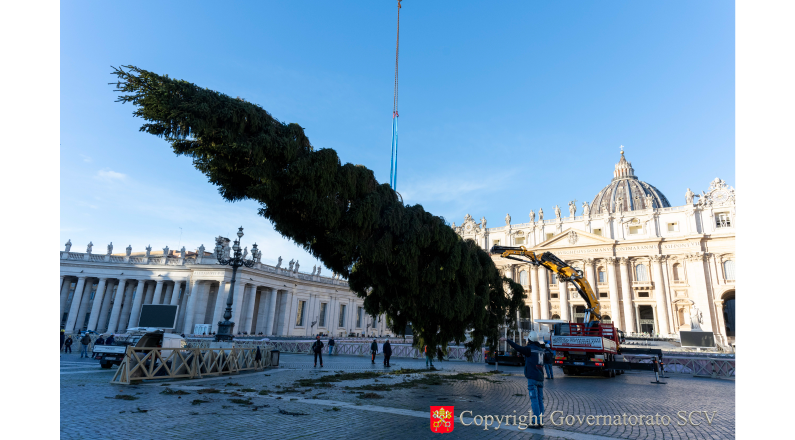
(ZENIT News / Vatican City, 11.27.2025).- Every winter, St Peter’s Square becomes a meeting point of tradition, craftsmanship and symbolism. Yet the tree that will stand at the heart of the Vatican’s Christmas celebrations in 2025 has a story that begins far from Rome, in the deep silence of the Val d’Ultimo forests of South Tyrol. Before dawn on 24 November, foresters cut a towering Norway spruce that had risen for decades among mountain farms, streams and pastures. Now it is on its way to Rome, ready to take up its once-in-a-lifetime role as the Vatican’s Christmas sentinel.
At twenty-five meters high and weighing around eight tons, the spruce is a gift from two neighbouring municipalities, Lagundo and Val d’Ultimo, whose landscapes are often described as among the most harmonious in the Alps. These communities, shaped for centuries by pastoral life and careful agricultural rhythms, consider the donation not simply an act of generosity but an offering of their natural heritage to a global gathering place of faith.
Forty smaller trees accompany the main one, destined for offices and institutions across Vatican City. Their presence is quieter, perhaps, but together they form a network of Alpine greens meant to bring a sense of mountain serenity into the daily work of the Holy See.
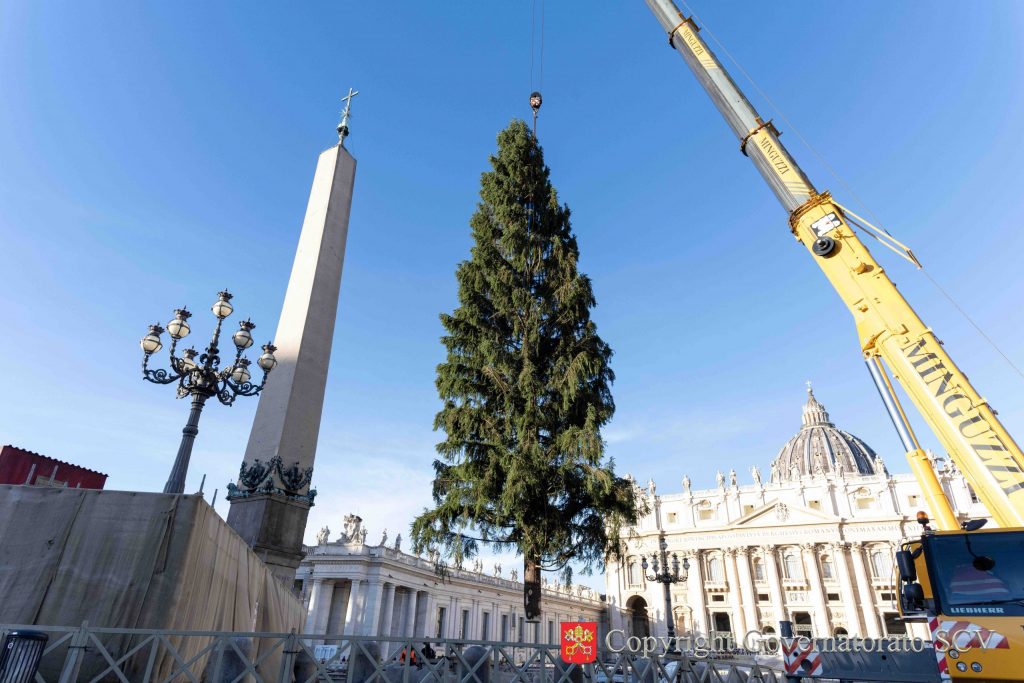
The choice of the trees was not random. Forest stewards conducted a meticulous selection process, prioritising sustainability and the life cycle of the woodland. Mature trees, whose removal aids overall forest health, were identified for harvest. This approach has long been central to the forestry philosophy of the region: intervention not as intrusion, but as a measure of protection.
Bishop Ivo Muser of Bolzano-Bressanone has been one of the most articulate voices explaining the meaning behind this annual gesture. In an interview given to the Vatican City State’s website, he emphasised that harvesting a tree is not a violation of the forest’s integrity. It is, he said, the result of responsible care, where attentive management prevents overcrowding and supports the thriving of the entire ecosystem. In South Tyrol, he added, reforestation is not an idealistic slogan but a daily practice. Every tree cut is one part of a cycle that includes the planting of new trees, securing healthy woodlands for future generations.
Once installed in St Peter’s Square, the spruce will remain on display throughout the Christmas season, its lights and decorations drawing pilgrims, families, and tourists into the festive atmosphere that ripples through Rome during the holidays. Yet the tree’s journey will not end when the last visitors leave. After the season concludes, its green branches will be transformed into essential oils by an Austrian company specialised in natural products, while the remaining wood will be entrusted to a charitable organisation focused on environmental stewardship.
The life of this Alpine giant, shaped by the slow patience of mountain winters, will thus continue in new forms. It will offer fragrance, warmth and utility long after the Christmas lights dim. In a world often tempted to treat nature as disposable, the Vatican’s 2025 tree brings with it a quiet lesson from the high valleys that nurtured it: that beauty, when cared for responsibly, can be both shared and renewed.
Thank you for reading our content. If you would like to receive ZENIT’s daily e-mail news, you can subscribe for free through this link.

