

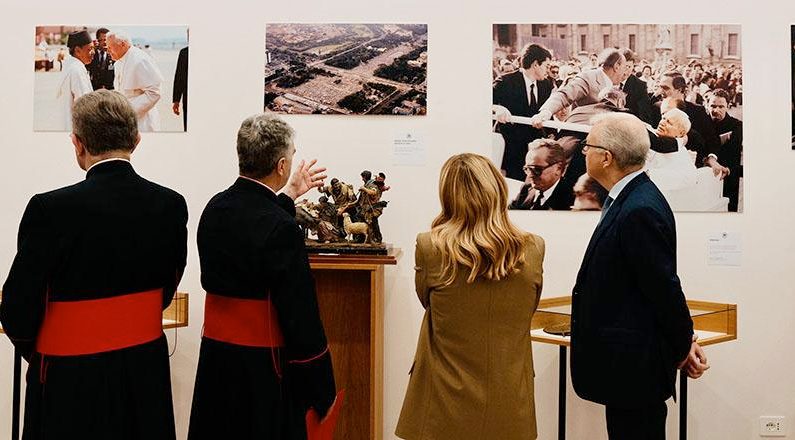
(ZENIT News / Rome, 12.29.2025).- In the heart of Rome, within the historic walls of the Pontifical Polish College, a new chapter in the remembrance of Pope John Paul II has begun. The John Paul II House Museum officially opened its doors to the public, offering free access in a gesture that aligns with the ongoing Jubilee initiatives and reflects a commitment to preserving both spiritual and cultural heritage. The project was made possible in part thanks to the support of Italy’s Presidency of the Council of Ministers.
The timing of the museum’s inauguration was marked by the visit of Italian Prime Minister Giorgia Meloni on 22 December. The Prime Minister toured the College’s historic rooms, spaces intimately linked to Karol Wojtyła’s time in Rome as Archbishop of Krakow and particularly the eve of the 1978 conclave that would see his election as Pope. It was from this very residence that Wojtyła embarked on the journey to the Vatican, unaware that his life—and the course of modern Catholicism—would change forever.
The museum preserves the tangible traces of John Paul II’s daily life and spiritual practices during his Roman sojourns. Visitors encounter his private study, filled with the tools of his work, and his bedroom, carefully maintained with original furnishings. Autographed documents, relics of his thoughts and plans, add layers of intimacy and historical resonance, allowing visitors to step into the personal rhythm of the man who would become a global spiritual figure.
The inauguration ceremony brought together a notable ecclesial and institutional presence. Cardinal Stanisław Dziwisz, former Archbishop of Krakow and personal secretary to John Paul II, attended alongside Monsignor Rino Fisichella, Pro-Prefect of the Dicastery for Evangelization, and Monsignor Jan Antoni Głòwczyk, Rector of the Pontifical Polish College. Alfredo Mantovano, Undersecretary of the Presidency of the Council, and Monsignor Paweł Ptasznik, President of the John Paul II Foundation, also joined the visit, highlighting the intertwined nature of church, state, and memory in this endeavor.
Prime Minister Meloni, leaving her mark in the College’s book of honor, described the House Museum as “a chest of faith, spirituality, and love,” underscoring John Paul II’s unique duality: “a man at once ordinary and extraordinary.” Her words capture the essence of the museum experience—a space where the humanity of Wojtyła meets the monumental legacy of his papacy, where visitors can witness the ordinary life of a man who shaped the spiritual imagination of millions.
The House Museum invites pilgrims and visitors alike to traverse not only physical spaces but also the contours of faith, devotion, and historical memory. In celebrating the life of John Paul II, the museum becomes more than a repository of artifacts; it is a living testament to a man who, while rooted in the routines of daily life, profoundly influenced the world. As visitors walk through his study or pause by his bedside, they encounter a presence that continues to inspire, a reminder that the ordinary moments of life can resonate with extraordinary significance.
Thank you for reading our content. If you would like to receive ZENIT’s daily e-mail news, you can subscribe for free through this link.

Publicaciones relacionadas:
 Deloitte’s new headquarters in Rome: «professional partner» for the Jubilee, says Fisichella
 Pope Francis to visit the Capitol in Rome on June 10: the Jubilee 2025 as the main theme
 Explanatory Note Regarding the Faculties to Preach and Hear Confessions in the Territory of the Diocese of Rome During the Jubilee 2025
 “Julia”, Rome Capital’s new virtual assistant for Jubilee pilgrims
