

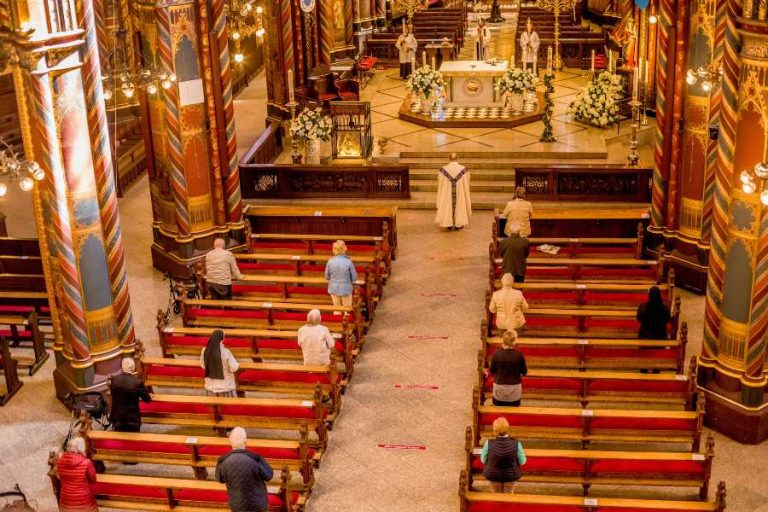
(ZENIT News / Cologne, 12.30.2025).- Across Germany, the removal of sacred space has become an increasingly familiar sign of a deeper ecclesial contraction. During 2025, at least 46 Catholic churches and chapels were formally desacralized, according to figures cited by the Neue Osnabrücker Zeitung from the German Bishops’ Conference. Although the total marks a decline from the 66 recorded the previous year, it confirms that the conversion of once-sacred buildings to secular use is no temporary phenomenon, but part of a sustained structural retreat.
Church officials acknowledge that the real number may be higher. Not all acts of desacralization are consistently published in diocesan bulletins, the primary source used for nationwide statistics. What is visible, however, is a pattern that mirrors the dramatic erosion of German Catholicism itself.
Fewer than 20 million people in Germany were formally registered as Catholics in 2024, the lowest figure in modern times after decades of steady decline. More striking still is the gap between nominal belonging and lived faith. Only about 6.6 percent of registered Catholics attend Sunday Mass regularly, translating into roughly 1.3 million worshippers in a country that once stood at the heart of European Catholic life.
This imbalance between institutional scale and actual participation has forced dioceses to rethink their territorial and pastoral models. Maintaining an extensive network of parishes, many of them sparsely attended, has become financially and logistically unsustainable. The result has been a wave of consolidations that are reshaping the ecclesial map.
Nowhere is this transformation more radical than in the Archdiocese of Freiburg. Long accustomed to overseeing more than a thousand parishes, it is preparing to operate with just 36 large pastoral units. Similar processes, completed or underway elsewhere, reflect a Church adjusting not only to shrinking congregations but also to a severe shortage of clergy.
The vocational collapse has become one of the defining features of the German situation. In 2024, only 29 diocesan priests were ordained nationwide, and eleven of the country’s 27 dioceses recorded no ordinations at all. The historical contrast is stark. During the years surrounding the Second Vatican Council, Germany produced at least 500 new priests annually. Even as recently as 2007, the number still exceeded one hundred.
This decline feeds a self-reinforcing cycle. Fewer priests lead to parish mergers and closures; fewer parishes mean reduced local presence, weaker sacramental life, and greater difficulty passing on the faith to new generations. The desacralization of churches, a canonical act that removes a building from worship and allows its use for non-religious purposes deemed appropriate, has become the most tangible symbol of that spiral.
Beyond logistics and numbers, the closures raise questions about identity and direction. They unfold against the backdrop of ongoing debates surrounding the German Synodal Path and the proposed Synodal Council, initiatives that have drawn criticism for positions viewed by many as doctrinally ambiguous or openly heterodox. In this context, some observers are no longer asking only how many churches will close, but what kind of Church will remain.
The issue has moved beyond Germany’s borders. Recent commentary in international Catholic media has questioned whether segments of the German ecclesial project still reflect a recognizably Catholic vision. The desacralized buildings scattered across cities and villages thus stand not merely as redundant infrastructure, but as markers of an unresolved crisis, one that touches belief, authority, and the future shape of Catholicism in one of Europe’s most influential nations.
What Germany’s Church is experiencing is not simply a matter of declining attendance or aging structures. It is a redefinition of presence itself, measured in fewer priests, fewer parishes, and fewer places where the sacred is publicly celebrated. The long-term consequences of that transformation, both for German society and for the wider Catholic Church, are still unfolding.
Thank you for reading our content. If you would like to receive ZENIT’s daily e-mail news, you can subscribe for free through this link.

Publicaciones relacionadas:
 According to Data of the Israeli Government, the Christian Population Is Growing in Israel
 USA, “Ecumenism” and “Inter-Religious Dialogue”: Six Out of Ten Americans Have Friends of Other Religions
 USA: “9 Days for Life” Unites Hundreds of Thousands in Prayer for the Protection of Life
 USA: Bishops Thomas and Barron Applaud Move to Defund Abortion and “Gender Transition” Industries, Call for Authentic Health Care
