

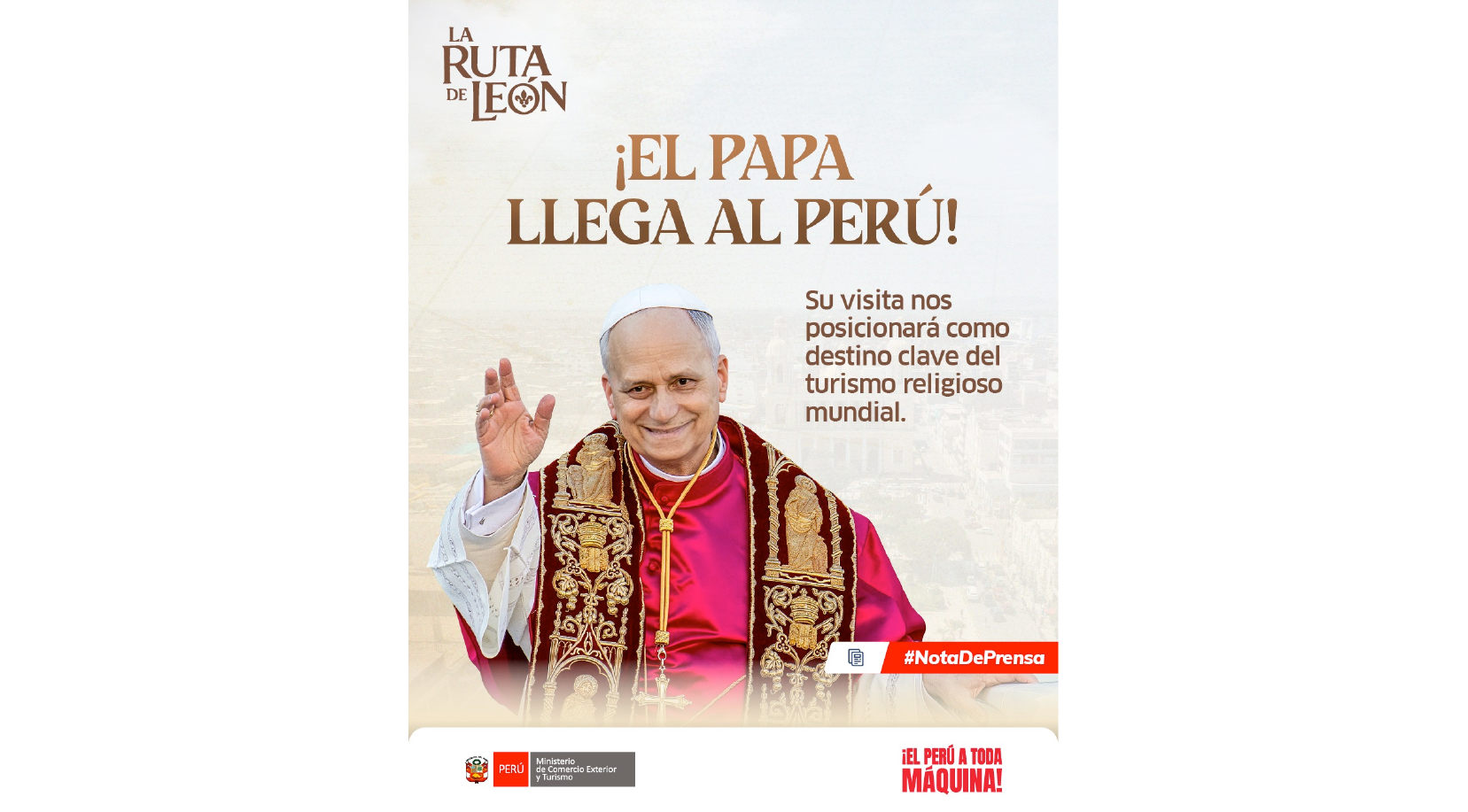
(ZENIT News / Roma, 02.08.2026).- While speculation swirled in recent weeks about a possible papal return to the United States, the Vatican has quietly clarified that Pope Leo XIV will not visit his native country in 2026. Instead, attention is shifting decisively southward, toward Peru—a nation already mobilizing state institutions, the Church, and the tourism sector in anticipation of a visit that now appears increasingly likely before the end of the year.
On February 8, the Holy See confirmed that Leo XIV, the first American-born pope, has no plans to travel to the United States during the coming year, despite the symbolic coincidence of the country’s semiquincentennial. The decision follows weeks of conjecture that a papal presence at the United Nations General Assembly in New York, or a combined trip with Mexico, might be in the works. Vatican officials put those rumors to rest, citing both practical and pastoral considerations.
Against that backdrop, Peru has emerged as a clear priority. The country’s foreign minister, Hugo de Zela, announced on February 1 that the pope had accepted an official invitation from the transitional government led by President José Jerí to visit Peru in 2026. While precise dates remain under discussion, both the government and the Peruvian Bishops’ Conference converge on a timeframe in the second half of the year, most likely between October and November, once the electoral cycle concludes after the April general elections.
For Peru, the anticipated visit is not only ecclesial but strategic. Teresa Mera, minister of Foreign Trade and Tourism, has publicly framed Leo XIV’s trip as a catalyst for positioning Peru as a global hub for religious tourism. Writing on an official government platform, Mera underscored that religious tourism accounts for nearly 20 percent of international tourist flows worldwide—a figure that places the sector among the most dynamic segments of global travel.
🇻🇦🇺🇸Confirmed: Pope Leo XIV will not visit the US in 2026
The director of the Holy See Press Office confirmed to Italian media on Sunday, February 8, that Pope Leo XIV will not visit the United States in 2026. pic.twitter.com/E6eGtGeCWF
— ZenitEnglish (@zenitenglish) February 8, 2026
“Religious tourism goes beyond faith and spirituality,” Mera said. “It is also a cultural expression that energizes the economy, creates jobs, and opens opportunities for regional development.” Her ministry, Mincetur, has been working in advance to ensure that Peru is “ready to receive the world.”
At the center of these preparations is “The Route of Leo,” a multisector initiative that brings together national, regional, and local governments, the Catholic Church, tourism associations, and private actors. The project spans four regions—Lambayeque, Piura, La Libertad, and Callao—and integrates 38 tourist sites, primarily churches and sanctuaries, complemented by cultural and natural attractions. Infrastructure upgrades, improved public spaces, and enhanced tourism services form part of the plan.
The symbolic heart of the route lies in northern Peru, where Leo XIV spent more than two decades as a missionary priest and later as bishop. Chiclayo, in particular, has already inaugurated a permanent museum exhibition titled “Along the Paths of Leo XIV,” designed to deepen visitors’ understanding of the pope’s pastoral roots and to strengthen local identity.
The Vatican’s travel calculus, however, extends beyond Peru. Officials have indicated that Leo XIV is expected to announce a trip to Africa after Easter, with Algeria and Angola among the confirmed destinations and others yet to be named. Spanish bishops, meanwhile, have told local media that the pope intends to visit Spain this year; a dedicated website and organizing committees in Madrid, Barcelona, and the Canary Islands are already operational.
The absence of a U.S. visit in 2026 reflects more than scheduling constraints. From the outset of his pontificate, Leo XIV has appeared cautious about being labeled an “American pope.” Although he has said, “I feel deeply American,” his first public appearance after election was notable for its use of Italian and Spanish rather than English. A high-profile visit to the United States during a major national anniversary—and in proximity to the November midterm elections—would almost inevitably have amplified political and national symbolism, something the Vatican traditionally seeks to avoid.
There are also diplomatic practicalities. The papal nuncio to the United States, Cardinal Christoph Pierre, recently turned 80, well beyond the customary retirement age of 75. With a transition at the nunciature expected soon, organizing a complex papal visit to the U.S. would pose significant challenges.
Historically, early returns to a pope’s homeland are not unprecedented. John Paul II drew massive crowds in Poland less than a year after his election, and Benedict XVI made Germany his first papal destination for World Youth Day 2005. Pope Francis, by contrast, never returned to Argentina after 2013, despite repeated expressions of personal desire to do so.
Thank you for reading our content. If you would like to receive ZENIT’s daily e-mail news, you can subscribe for free through this link.

Publicaciones relacionadas:
 Pope asks to define principles, norms, and guidelines for Latin rite priests accompanying Eastern rite Catholics arriving in the West
 What is the relationship between Sacred Scripture and Tradition? Pope Leo XIV responds
 Opus Dei before the Pope: what was said about the new statutes and some controversies in Argentina
 Pope Leo XIV summons bishops to Rome to discuss the reimplementation of the controversial Amoris Laetitia
