

Edward McNamara, LC
(ZENIT News / Rome, 02.15.2026).- Answered by Legionary of Christ Father Edward McNamara, professor of liturgy and sacramental theology at the Pontifical Regina Apostolorum university.
[Editor’s note: The following question was originally in French; however, it also applies to the text found in the English-language missal.]Q: The French version of the prayer after Communion for the Mass on the memorial of the Martyrdom of St. John the Baptist on August 29 says:
“Grant, O Lord, as we celebrate the heavenly birth of Saint John the Baptist, that we may revere, for what it signifies, the saving Sacrament we have received and, even more, may rejoice at its clear effects in us. Through Christ our Lord.”
The modern translation follows quite closely the Latin text: “Concede nobis, Domine, beati Ioannis Baptistae natale recensentibus, ut et salutaria sacramenta quae sumpsimus significata veneremur, et in nobis potius edita gaudeamus ….”
The expression “heavenly birth” (natale recensentibus) raises questions for me. Can John have been born (entered) into heaven on the day of his martyrdom, that is, before the death of Christ? I learned that he didn’t but rather that Jesus first entered into glory. And Jesus «descended into hell» by dying to deliver souls and bring them with him to heaven. The Catechism of the Catholic Church at No. 1023, on the subject of heaven, quotes Pope Benedict XII and refers to Lumen Gentium (note 10: DS 1000, cf. LG 49). According to Benedict XII: «By virtue of our apostolic authority, we define the following: According to the general disposition of God, the souls of all the saints … and other faithful who died after receiving Christ’s holy Baptism (provided they were not in need of purification when they died, … or, if they then did need or will need some purification, when they have been purified after death …) already before they take up their bodies again and before the general judgment — and this since the Ascension of our Lord and Savior Jesus Christ into heaven — have been, are and will be in heaven, in the heavenly Kingdom and celestial paradise with Christ, joined to the company of the holy angels. Since the Passion and death of our Lord Jesus Christ, these souls have seen and do see the divine essence with an intuitive vision, and even face to face, without the mediation of any creature.»
It is therefore clearly stated that the entry into heaven of the righteous who died before the death of Christ could not have taken place before the death of Jesus. I thus conclude that John the Baptist could not enter heaven on the day of his martyrdom, but only with all the others after the death of Jesus. — L.P., Trois-Rivières, Québec
A: The question can be addressed from several points of view such as the historical and the theological.
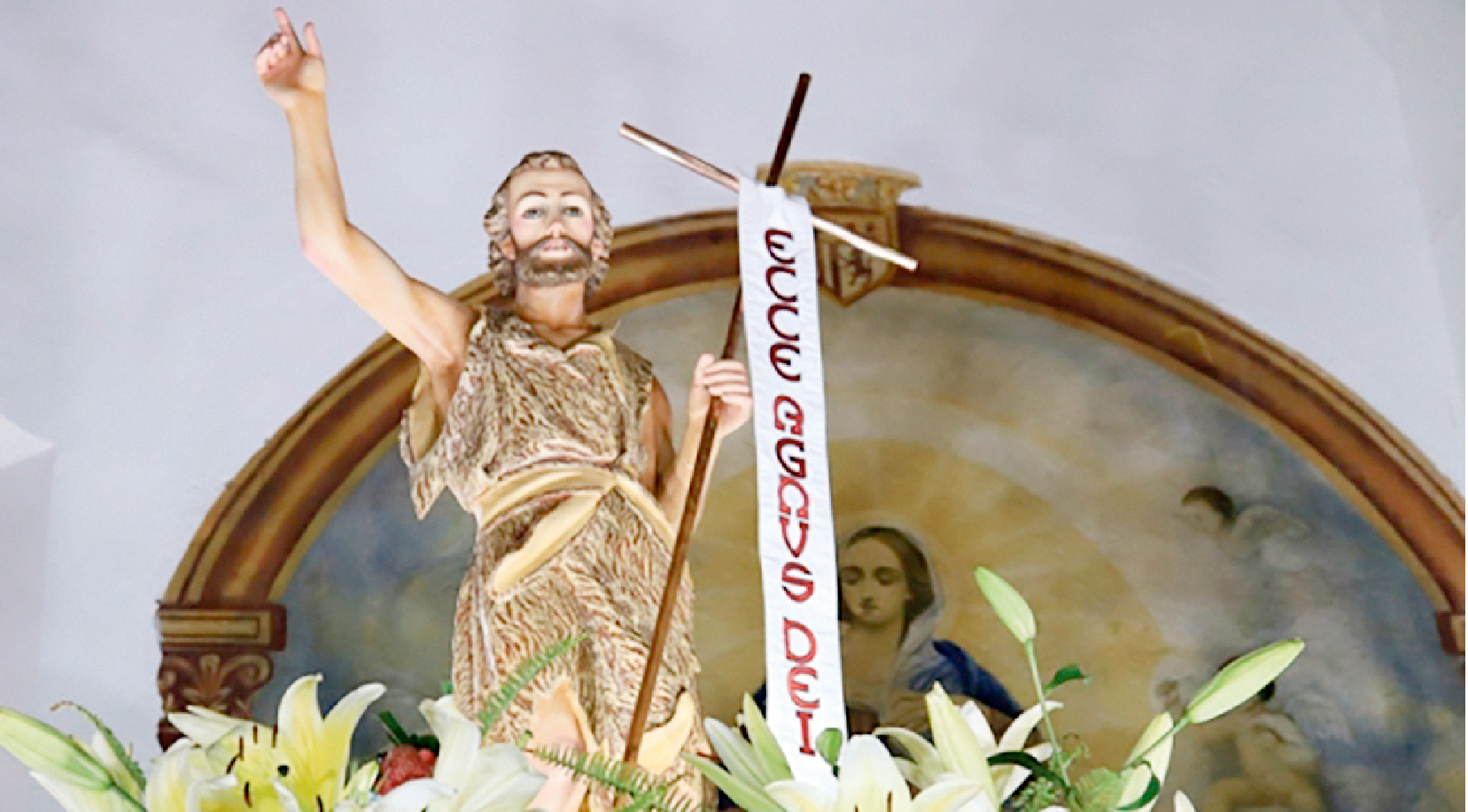
Historically, the feast of the martyrdom of St. John the Baptist is very ancient and appears in the sermons of several fathers from the fourth century onward. The liturgical texts are also found in the Gelasian and Gregorian sacramentaries and date from the early fifth century.
The feast day recalled the anniversary of the dedication of a Church in Sebaste (in Samaria) where the saint’s head was venerated. At the same time the beheading was always given less importance liturgically than the Nativity of St. John the Baptist. Interestingly, in commenting this fact, Durandus, bishop of Mende (1230-1296), explains that this is because at John’s birth “many rejoiced,” as the angel said, but at his death, he did not go straight to heaven, which was not yet opened by the death and resurrection of Christ.
It must be noted, however, that the text for the post-Communion of the 1962 missal differs in some ways from the present text. It says «Conferat nobis, Domine, sancti Ioannis Baptistae solemnitas: ut et magnifica sacramenta, quae sumpsimus, significata veneremur, et in nobis potius edita gaudeamus ….» Therefore, the prayer would probably begin: «Grant, O Lord, as we celebrate the feast of Saint John the Baptist» with no mention of his «heavenly birth.»
The term «heavenly birth» or its equivalent is quite common when applied to the saints. It usually refers to the day of death which, other things being equal, is usually chosen as the saint’s feast day unless some other consideration would outweigh it, such as always falling during Lent or coinciding with some other major feast.
In the case of St. John the Baptist, I unfortunately have been unable to find any study that explained the reason for this change and why the term «heavenly birth» was introduced along with its attendant theological scruple. I think it may have appeared logical given that the celebration specifically addresses the saint’s martyrdom in the other prayers and is also the subject of the Gospel reading.
A second approach would be from the point of view of liturgical theology. How much theological weight should we give to each and every prayer and rite in the missal?
While the adage «Lex orandi lex credendi» («The law of prayer determines the law of belief») is a valid principle, its use must not be exaggerated. The expression basically means that a longstanding widely disseminated liturgical practice can be a strong historical witness to the faith behind that practice. Thus, the ancient practice of baptizing infants later provided an underpinning to the faith in the doctrine of original sin.
The adage, however, does not convert every liturgical prayer and expression into a doctrinal definition. A liturgical prayer could be perfectly orthodox but lack the theological precision that would take all theological arguments into account.
Hence, the purpose of the expression «heavenly birth,» as applied to St. John the Baptist, could legitimately refer to the day of his martyrdom, while leaving aside the question of the state of his soul before Christ’s resurrection.
One must note that the Catechism, in quoting this document from Benedict XII, wisely omits the expression: «the souls of all the saints who left this world before the passion of our Lord Jesus Christ ….» In doing so, it sticks to settled doctrine and avoids the theological debates, still very much open to discussion, regarding the state of the souls of the just who died before Christ’s resurrection.
Limiting ourselves to the New Testament, apart from St. John the Baptist, we have saintly figures who probably predeceased the Lord such as John’s holy parents Elizabeth and Zechariah, the Holy Innocents, Simeon and Anna, and of course, St. Joseph. There is no theological consensus as to how they awaited Christ’s resurrection.
Some still speak of the hypothesis of the «Limbo of the Just»; others say that after death the righteous no longer perceived the passage of time so that, from their perspective, the passage to heaven after the Resurrection would have seemed immediate.
Still others propose that the righteous could have been in a blessed state similar to the poor Lazarus that our Lord described in the parable as being in the bosom of Abraham. The truth is, we lack sufficient data to solve the question in a definitive manner.
Therefore, even if the redactors of the aforementioned prayer realized the theological conundrum they were producing with the choice of the expression «heavenly birth,» they might have felt that this abstruse question could be left to one side while affirming the authenticity of John’s martyrdom and the certainty of his current glory in heaven.
* * *
Readers may send questions to zenit.liturgy@gmail.com. Please put the word «Liturgy» in the subject field. The text should include your initials, your city and your state, province or country. Father McNamara can only answer a small selection of the great number of questions that arrive.
Thank you for reading our content. If you would like to receive ZENIT’s daily e-mail news, you can subscribe for free through this link.

Publicaciones relacionadas:
 Vatican approves new lectionary for Advent in England, Wales and Scotland
 Questions about liturgy: Genuflections Toward the Tabernacle
 The traditional Latin Mass celebrated in St. Peter’s Basilica marks a new chapter under the pontificate of Pope Leo XIV
 Questions about liturgy: Adoration When There Is No Tabernacle
