

(ZENIT News / Rome, 02.20.2026).- The synodal process has often been described as a journey of listening. Now, in the Vatican, that journey is taking on a distinctly juridical dimension. Far from the aula of the Synod Hall, work is advancing on one of the most delicate undertakings in ecclesial governance: the revision of canon law in light of synodality.
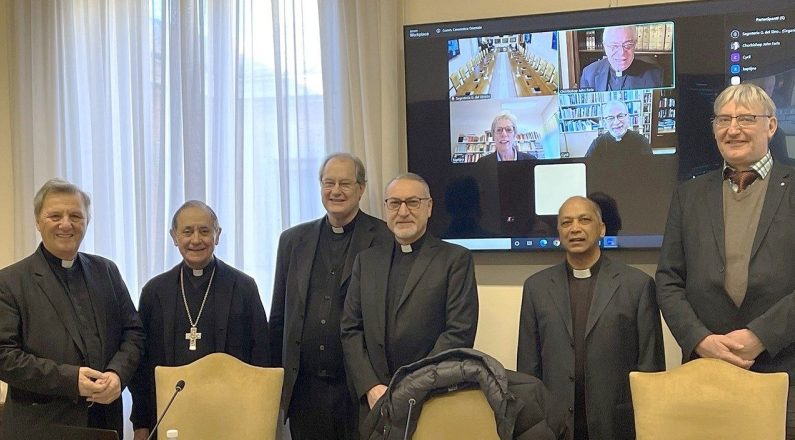
On 20 February 2026, the General Secretariat of the Synod announced the establishment of a new body, the Eastern Canonical Commission, tasked with drafting proposals to revise the Code of Canons of the Eastern Churches (CCEO). The Commission held its inaugural meeting the same day at the headquarters of the Synod’s Secretariat. Its creation signals that the reforming impulse of the 2021–2024 synodal pathway is now moving from pastoral discernment into normative architecture.
The revision of canonical texts — both the Latin Code of Canon Law and the CCEO — is widely considered one of the most sensitive phases of implementation. Law in the Catholic Church is not merely regulatory; it embodies ecclesiology. Adjusting its structures inevitably raises questions about authority, participation, subsidiarity, and the concrete exercise of communion among the Churches.
The new Commission does not begin from scratch. In December 2023, a Canonical Commission had already been constituted, concentrating primarily on the Latin Code while identifying certain areas of possible reform in the CCEO. The February 2026 initiative builds upon that work but responds more directly to repeated requests from several heads of the Eastern Catholic Churches sui iuris — self-governing Churches in full communion with Rome, each possessing its own liturgical, spiritual, and juridical patrimony.
According to the mandate, the Eastern Canonical Commission is formally a “Commission for Implementation,” as envisioned by the apostolic constitution Episcopalis communio (art. 21). It operates under the presidency of Cardinal Mario Grech, Secretary General of the Synod, who appoints its members after consultation with the Dicastery for Legislative Texts, in line with the norms of Praedicate Evangelium (arts. 178 and 84 §2).
In practical terms, the Commission’s short-term objective is to prepare draft legislative texts that translate into juridical form the proposals that emerged during the synodal process, particularly those enumerated in the 2023 Synthesis Report and the 2024 Final Document of the XVI Ordinary General Assembly of the Synod of Bishops. It will also take into account conclusions reached by Study Group 1, one of ten groups established by Pope Francis in 2024 following the first session of the Assembly. Study Group 1 has focused specifically on certain aspects of the relationship between the Eastern Catholic Churches and the Latin Church, and its two-day working session immediately preceded the Commission’s first meeting.
Coordination of the Commission’s work has been entrusted to Archbishop Juan Ignacio Arrieta Ochoa de Chinchetru, Secretary of the Dicastery for Legislative Texts, the curial body responsible, among other duties, for updating the current Eastern canonical legislation. This institutional link underscores that the reform effort is not an abstract academic exercise but part of the Church’s formal legislative process.
The composition of the Commission reflects both technical expertise and interdicasterial collaboration. Members have been selected primarily from among Eastern-rite consultors of the Dicastery for Legislative Texts and the Dicastery for the Eastern Churches. Among them are Corepiscopus John D. Faris of the Maronite Church in the United States; Professor Pablo Gefaell Chamochin of the Pontifical University of the Holy Cross; Professor Astrid Kaptijn of the University of Fribourg, who also serves as a consultor to the Dicastery for the Eastern Churches; Father Sunny Thomas Kokkaravalayil, S.J., pro-dean of the Faculty of Eastern Canon Law at the Pontifical Oriental Institute; Father Lorenzo Lorusso, O.P., of the Pontifical Gregorian University; Professor Péter Szabó of the Catholic University of Budapest; and Archbishop Cyril Vasiľ, S.J., of Košice for Byzantine-rite Catholics in Slovakia.
Cardinal Grech has framed the initiative explicitly within the “synodal spirit” that is to characterize this implementation phase. He has invited the Eastern Churches sui iuris, episcopal conferences, Catholic universities, ecclesial institutions and interested individuals to submit contributions to the General Secretariat of the Synod by 15 April 2026. The deadline is not incidental. It establishes a concrete horizon for consultation, reinforcing the claim that synodality is not confined to episcopal assemblies but extends to the broader People of God.
For readers less familiar with Eastern canon law, it is worth recalling that the CCEO, promulgated in 1990, governs the internal life of 23 Eastern Catholic Churches. While in full communion with the Bishop of Rome, these Churches maintain distinct canonical traditions shaped by centuries of theological and cultural development in the Christian East. Any revision, therefore, must balance two imperatives: fidelity to their particular identity and coherence within the universal communion of the Catholic Church.
The fact that the Vatican has deemed it “opportune” to create a dedicated Commission for the Eastern Code, rather than subsuming the matter under the broader Latin reform effort, signals an awareness of that specificity. It also reflects a theological conviction increasingly emphasized during the synodal process: unity does not require uniformity.
Whether the forthcoming drafts will significantly reshape the distribution of competencies, the functioning of synodal structures within the Eastern Churches, or the modalities of interaction with the Apostolic See remains to be seen. What is clear is that the Church’s experiment in synodality is now entering the demanding terrain of legal codification. The rhetoric of listening is giving way to the discipline of legislative drafting — a test that will reveal how deeply the synodal vision can be inscribed into the Church’s normative framework.
Thank you for reading our content. If you would like to receive ZENIT’s daily e-mail news, you can subscribe for free through this link.

Publicaciones relacionadas:
 Jewish and Catholic Considerations on Care in Terminal Illness: What Is Prohibited, What Is Permitted, What Is Obligatory
 Pope Francis announces financial cuts to the Vatican media
 Vatican Limits Traditional Latin Mass in Texas Diocese Following Bishop’s Removal
 From Oxford to the Catholic Liturgical Calendar: Vatican gives St. John Henry Newman a place in the Catholic Church’s daily prayer
