Edward McNamara, LC
(ZENIT News / Rome, 02.22.2026).- Answered by Legionary of Christ Father Edward McNamara, professor of liturgy and sacramental theology at the Pontifical Regina Apostolorum university.
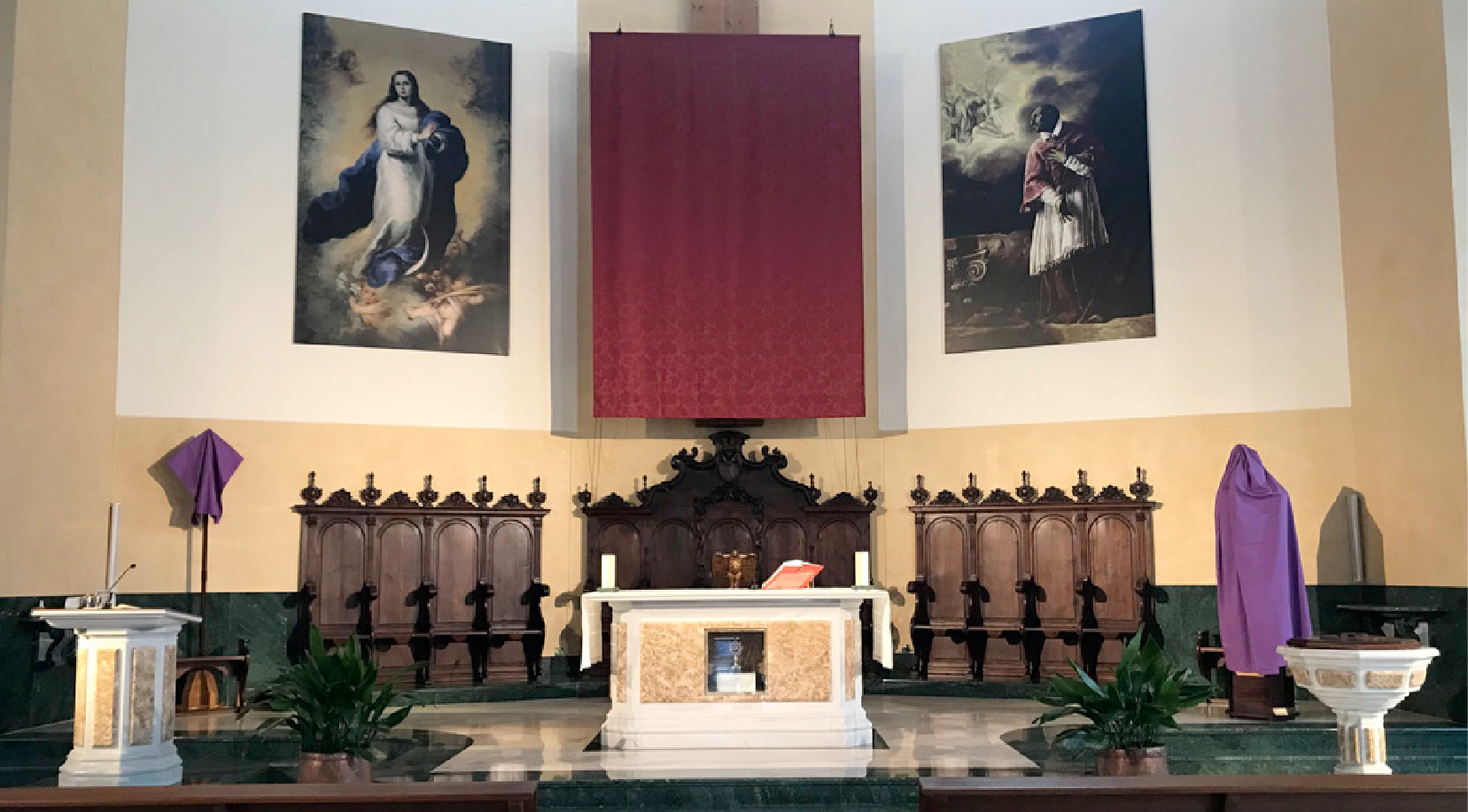
Q: I would like to ask about the sanctuary for Lent. In an effort to conform to the General Instruction of the Roman Missal [GIRM] guidelines for «moderation,» I would like to know if it is permissible to place a small “desert scene” on the ground in front of the altar? Our parish has done this for years, and in the last two years or so I have tried to minimize this to conform to a more moderate effect. We omit flowers; otherwise, our small sanctuary has only a hanging purple banner and an ambo banner, also in purple, along with a purple sash draped over the crucifix. — P.G., California
A: The norms of the GIRM referred to by our reader say:
«304. Out of reverence for the celebration of the memorial of the Lord and for the banquet in which the Body and Blood of the Lord are offered, there should be, on an altar where this is celebrated, at least one cloth, white in color, whose shape, size, and decoration are in keeping with the altar’s structure. When, in the Dioceses of the United States of America, other cloths are used in addition to the altar cloth, then those cloths may be of other colors possessing Christian honorific or festive significance according to longstanding local usage, provided that the uppermost cloth covering the mensa (i.e., the altar cloth itself) is always white in color.
«305. Moderation should be observed in the decoration of the altar. During Advent the floral decoration of the altar should be marked by a moderation suited to the character of this time of year, without expressing in anticipation the full joy of the Nativity of the Lord. During Lent it is forbidden for the altar to be decorated with flowers. Exceptions, however, are Laetare Sunday (Fourth Sunday of Lent), Solemnities, and Feasts. Floral decoration should always show moderation and be arranged around the altar rather than on the altar table.»
To this we may add some other documents:
The 2007 guidelines of the U.S. bishops’ conference, Built of Living Stones, has the following to say about decorations in general:
«§ 18 § Churches, therefore, must be places suited to sacred celebrations, dignified, and beautiful.
«§ 23 § ‘Gestures, language, and actions are the physical, visible, and public expressions by which human beings understand and manifest their inner life .… These human actions as well as physical objects are also signs by which Christians express and deepen their relationship to God.’
“The Liturgical Year: Seasonal Decorations
“§ 122 § During the liturgical year the Church unfolds the whole mystery of Christ, from his incarnation and birth through his passion, death, and resurrection to his ascension, the day of Pentecost, and the expectation of his coming in glory. In its celebration of these mysteries, the Church makes these sacred events present to the people of every age.
“§ 123 § The tradition of decorating or not decorating the church for liturgical seasons and feasts heightens the awareness of the festive, solemn, or penitential nature of these seasons. Human minds and hearts are stimulated by the sounds, sights, and fragrances of liturgical seasons, which combine to create powerful, lasting impressions of the rich and abundant graces unique to each of the seasons.
“§ 124 § Plans for seasonal decorations should include other areas besides the sanctuary. Decorations are intended to draw people to the true nature of the mystery being celebrated rather than being ends in themselves. Natural flowers, plants, wreaths and fabric hangings, and other seasonal objects can be arranged to enhance the primary liturgical points of focus. The altar should remain clear and free-standing, not walled in by massive floral displays or the Christmas crib, and pathways in the narthex, nave, and sanctuary should remain clear.
“§ 125 § These seasonal decorations are maintained throughout the entire liturgical season. Since the Christmas season begins with the Vigil Mass on Christmas Eve and ends with the baptism of the Lord, the placement and removal of Christmas decorations should coincide with these times. Since the Easter season lasts fifty days, planning will encompass ways to sustain the decor until the fiftieth day of Pentecost.
“§ 126 § In the course of the liturgical year, the feasts and memorials of Our Lady and of saints with special significance for the parish afford opportunities to show devotion by adorning their images with tasteful floral arrangements or plants.
“§ 127 § Fabric art in the form of processional banners and hangings can be an effective way to convey the spirit of liturgical seasons, especially through the use of color, shape, texture, and symbolic form. The use of images rather than words is more in keeping with this medium.
“§ 128 § Objects such as the Advent wreath, the Christmas crib, and other traditional seasonal appointments proportioned to the size of the space and to the other furnishings can enhance the prayer and understanding of the parish community.
“§ 129 § The use of living flowers and plants, rather than artificial greens, serves as a reminder of the gift of life God has given to the human community. Planning for plants and flowers should include not only the procurement and placement but also the continuing care needed to sustain living things.”
The UK Liturgy Office makes the following suggestions for Lent:
“During Lent the church is not to be decorated with flowers. Laetare Sunday (Fourth Sunday of Lent), Solemnities, and Feasts are exceptions to this rule. Flowers used on these days should be removed after Evening Prayer II.
“Artificial flowers and plants should not be used. Dried flowers, ferns and sprays may be used, particularly in winter months. Care should be taken to use flowers to guide the eye to the various centres of liturgical action — for example the entrance to the Church, the ambo, the altar, the presider’s chair; on other occasions the font, the place for reserving the sacred oils etc.
“Moderation should be observed when decorating altars. Floral decorations should always be modest and placed around the altar rather than on top of it.
“Banners The whole environment of the church can be enhanced through the use of banners and other visual media. These can be used to give focus to a particular liturgical season or occasion. Care should be taken that these complement and do not detract from the liturgical celebration or design of the building itself. Banners and other materials should not be fixed to the altar, ambo, font, as this leads to a secondary symbol obscuring a primary one. A parish might commission a series of banners, for example, for the liturgical cycle and its patronal Feast which can be used annually and so become part of the way that parish enters into the keeping of each season.”
Although it does not refer to the sanctuary area, the following document can help us to understand the sense of how the church should be decorated during Lent. In 2000 the Congregation for Divine Worship responded to a question on the practice, introduced into some parishes, of replacing holy water with sand during the season of Lent. The reply (Prot. N. 569/00/L March 14, 2000) said the following:
“This Congregation for Divine Worship has received your letter sent by fax in which you ask whether it is in accord with liturgical law to remove the Holy Water from the fonts for the duration of the season of Lent.
“This Dicastery is able to respond that the removing of Holy Water from the fonts during the season of Lent is not permitted, in particular, for two reasons:
“1. The liturgical legislation in force does not foresee this innovation, which in addition to being praeter legem is contrary to a balanced understanding of the season of Lent, which though truly being a season of penance, is also a season rich in the symbolism of water and baptism, constantly evoked in liturgical texts.
“2. The encouragement of the Church that the faithful avail themselves frequently of her sacraments and sacramentals is to be understood to apply also to the season of Lent. The ‘fast’ and ‘abstinence’ which the faithful embrace in this season does not extend to abstaining from the sacraments or sacramentals of the Church. The practice of the Church has been to empty the Holy Water fonts on the days of the Sacred Triduum in preparation of the blessing of the water at the Easter Vigil, and it corresponds to those days on which the Eucharist is not celebrated (i.e., Good Friday and Holy Saturday).”
From all of the above, I think I can answer the specific requests of our correspondent.
The altar is a central and primary liturgical symbol of Christ. Therefore, during Lent, the Church underlines the season precisely through the omission of any particular decoration before it, floral or otherwise. This would mean that substituting floral decorations of the altar with desert symbolism could actually undercut rather than enhance the whole point that the Church wishes to make by leaving the altar despoiled of flowers.
That said, I would not exclude the use of some kind of desert symbolism in some other part of the church building with catechetical or mystagogical goals, albeit not at the holy water stoups.
It would, however, be possible to use an antependium, or frontal. This cloth generally reaches the ground in front of the altar. It is usually a good-quality fabric and often embroidered with liturgical symbols. It may be white or the color of the liturgical season. Its use would not normally be recommendable if the altar is itself a significant work of art that is best left exposed. Some churches use a smaller version of the antependium that forms a kind of fringe on the upper part of the altar.
The documents cited all offer support for a discreet and tasteful use of banners and similar accruements such as a seasonal ambo cover. If used, the chalice veil can also correspond to the liturgical season. A small seasonal cloth can also cover the altar lectern that sustains the missal.
This list is not exhaustive, but the above cited documents all recommend that all these elements serve to enhance, but not obscure, overwhelm, or detract from, the liturgical celebration of the different seasons.
* * *
Readers may send questions to zenit.liturgy@gmail.com. Please put the word «Liturgy» in the subject field. The text should include your initials, your city and your state, province or country. Father McNamara can only answer a small selection of the great number of questions that arrive.
Thank you for reading our content. If you would like to receive ZENIT’s daily e-mail news, you can subscribe for free through this link.