

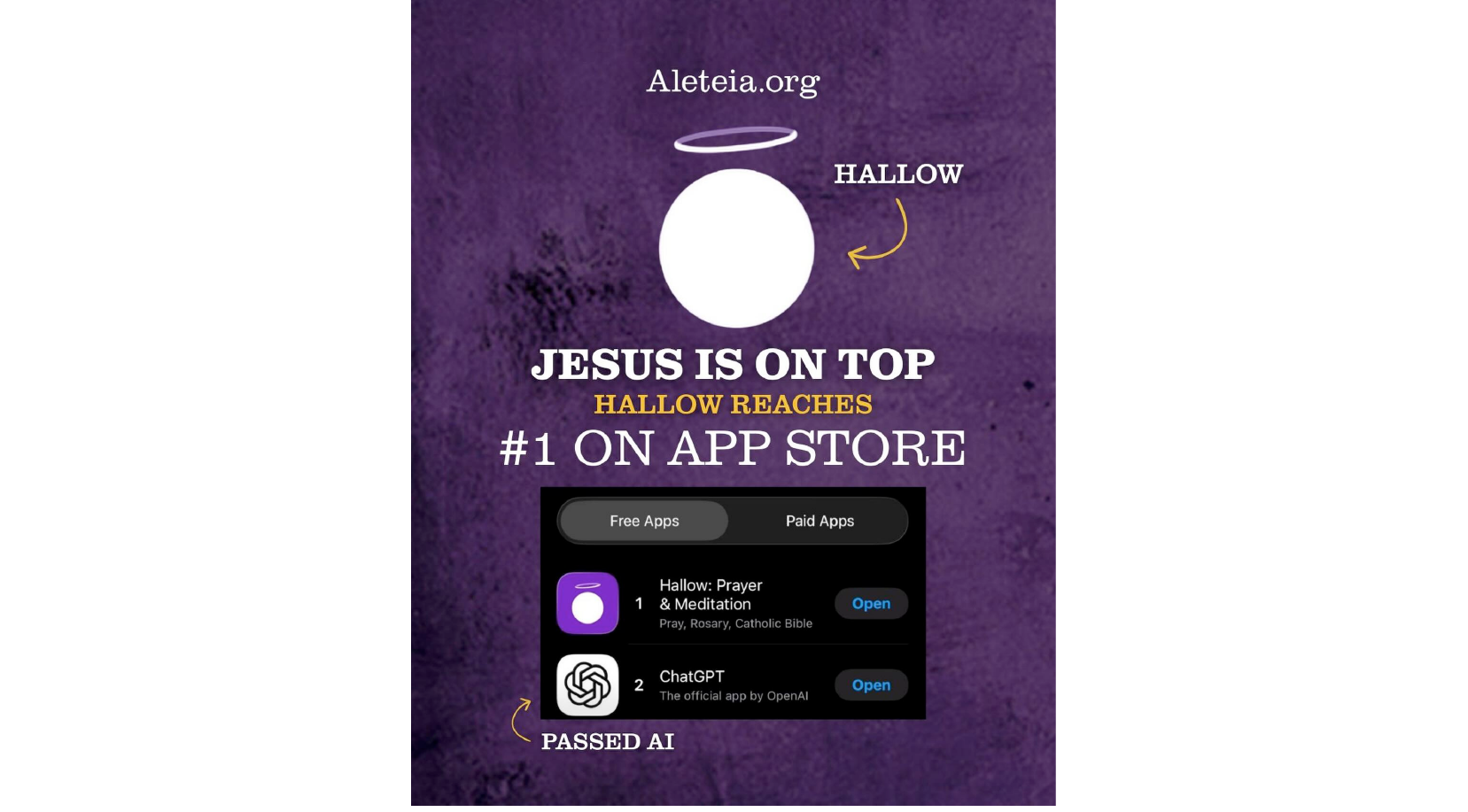
(ZENIT News / Washington, 02.22.2026).- On a day when Catholics around the world lined up to receive ashes traced in the shape of a cross, a Catholic prayer app achieved something few religious platforms ever have: it became the most downloaded app in the United States.
On Feb. 18, 2026 — Ash Wednesday — Hallow rose to first place on Apple’s App Store rankings, surpassing mainstream digital heavyweights such as ChatGPT and WhatsApp. For several hours, the most sought-after download on one of the world’s largest tech marketplaces was not a game, a productivity tool, or a social media platform, but a guided prayer application rooted in Catholic spirituality.
The moment marked the second time in the company’s history that it has reached the top position, following a similar surge in 2024. But this year’s milestone coincided precisely with the liturgical beginning of Lent, giving the achievement a symbolic weight that its founders were quick to recognize.
“GOD! YOU’VE DONE IT AGAIN!” wrote co-founder Alex Jones in a celebratory post on X, adding that for the second time in App Store history, “Jesus is #1.” The exuberant tone underscored what for the company is not merely a business success, but a mission-driven endeavor framed explicitly in theological terms.
Founded as a prayer and meditation platform, Hallow blends elements of mindfulness culture with traditional Catholic contemplative practice. It now offers more than 10,000 audio-guided sessions — an extensive catalog that ranges from the Rosary and Ignatian meditation to sleep prayers and Scripture reflections.
Its voice roster reads like a cross-section of contemporary Catholic media and celebrity culture. Among those lending their voices are actor Jonathan Roumie, known for portraying Jesus in “The Chosen”; Father Mike Schmitz, whose “Bible in a Year” podcast became the most successful religious podcast to date; Bishop Robert Barron; actor Mark Wahlberg; Sister Miriam James Heidland, SOLT; Jeff Cavins; and theologian Scott Hahn. Hollywood actor Chris Pratt and Mother Olga of the Sacred Heart have also participated in Lenten programming.
The strategy is clear: pair theological substance with recognizable voices capable of drawing in Catholics who may not otherwise seek out devotional content.
This year’s surge was tied directly to the launch of Hallow’s Lenten initiative, Pray40: The Return. The program invites users to journey through Lent alongside reflections inspired by Fyodor Dostoevsky’s novel “The Brothers Karamazov” and Father Henri Nouwen’s spiritual classic “The Return of the Prodigal Son.” The theme centers on spiritual homecoming — an interpretive bridge between literature, Scripture, and personal conversion.
The campaign’s description leans into the emotional arc of the parable of the Prodigal Son: humanity’s distance from God, and the Father’s initiative in running toward the repentant child. The framing resonates in a season traditionally marked by fasting, repentance, and renewed prayer.
A market for faith
Religious apps are no longer niche curiosities. The Bible app developed by YouVersion has surpassed one billion downloads globally, demonstrating sustained demand for digital faith tools. Hallow’s rise to No. 1 does not mean it has reached those cumulative figures, but it signals something notable: at key liturgical moments, Catholic devotional life can generate concentrated digital momentum powerful enough to compete with secular tech titans.
Importantly, Hallow’s ranking refers to overall downloads in Apple’s App Store, not to podcast charts. Father Mike Schmitz’s “Bible in a Year” remains the most successful religious podcast in history, but it occupies a different category. The app’s top placement indicates that, at least on Ash Wednesday, users actively sought out a structured prayer experience on their phones.
That phenomenon reflects a broader shift in how religious practice intersects with technology. For centuries, spiritual disciplines were mediated through parish life, printed missals, and devotional booklets. Today, the smartphone has become an extension of daily routine — and increasingly, of prayer life.
Testimonials shared by Jones on Instagram suggest that the app is drawing not only regular churchgoers but also those returning after long absences. One user wrote that she had not observed Lent since early childhood but was now participating alongside her entire family. Another described two years of using the app as transformative for both “life and soul.” A recent subscriber reported sensing a renewed connection during Mass after only two days of guided prayer.
Such responses align closely with the stated aim of Pray40: to foster a return — not only in metaphor, but in practice.
The ecclesial dimension
Hallow’s ascent also reveals something about contemporary Catholic identity in the United States. While institutional affiliation in many Western countries continues to decline, digital Catholic initiatives have demonstrated surprising vitality. The app’s success does not negate broader secularization trends, but it complicates them.
The involvement of clergy, theologians, and public figures signals an effort to maintain doctrinal continuity while adapting to new media ecosystems. Unlike generic meditation platforms, Hallow’s content is explicitly sacramental and Christ-centered, drawing on the Church’s spiritual tradition rather than abstract wellness language.
Ash Wednesday, with its stark reminder — “Remember that you are dust” — may seem an unlikely launchpad for a tech triumph. Yet the day’s penitential gravity perhaps amplifies the hunger for structured spiritual guidance. In an era defined by constant digital noise, a guided examination of conscience or a narrated Scripture meditation can function as a countercultural act.
The symbolic resonance of the moment is difficult to ignore: on the first day of Lent 2026, a Catholic prayer platform briefly outpaced the dominant instruments of the digital age.
For its founders and users alike, that was more than a metric. It was interpreted as a sign — not of technological conquest, but of spiritual appetite.
Thank you for reading our content. If you would like to receive ZENIT’s daily e-mail news, you can subscribe for free through this link.

Publicaciones relacionadas:
 First Female Montessori Congregation Is Born in the United States
 Andrea Boccelli, a great «feminist» film (on International Women’s Day) and a fascinating trailer not to be missed
 Impressive Via Crucis and the Crucifixion of Jesus Returns to the Center of London and Is Seen by 20,000 People
 One amputee, another with brain damage, and another malnourished: Vatican welcomes three children affected by the war in Gaza
