

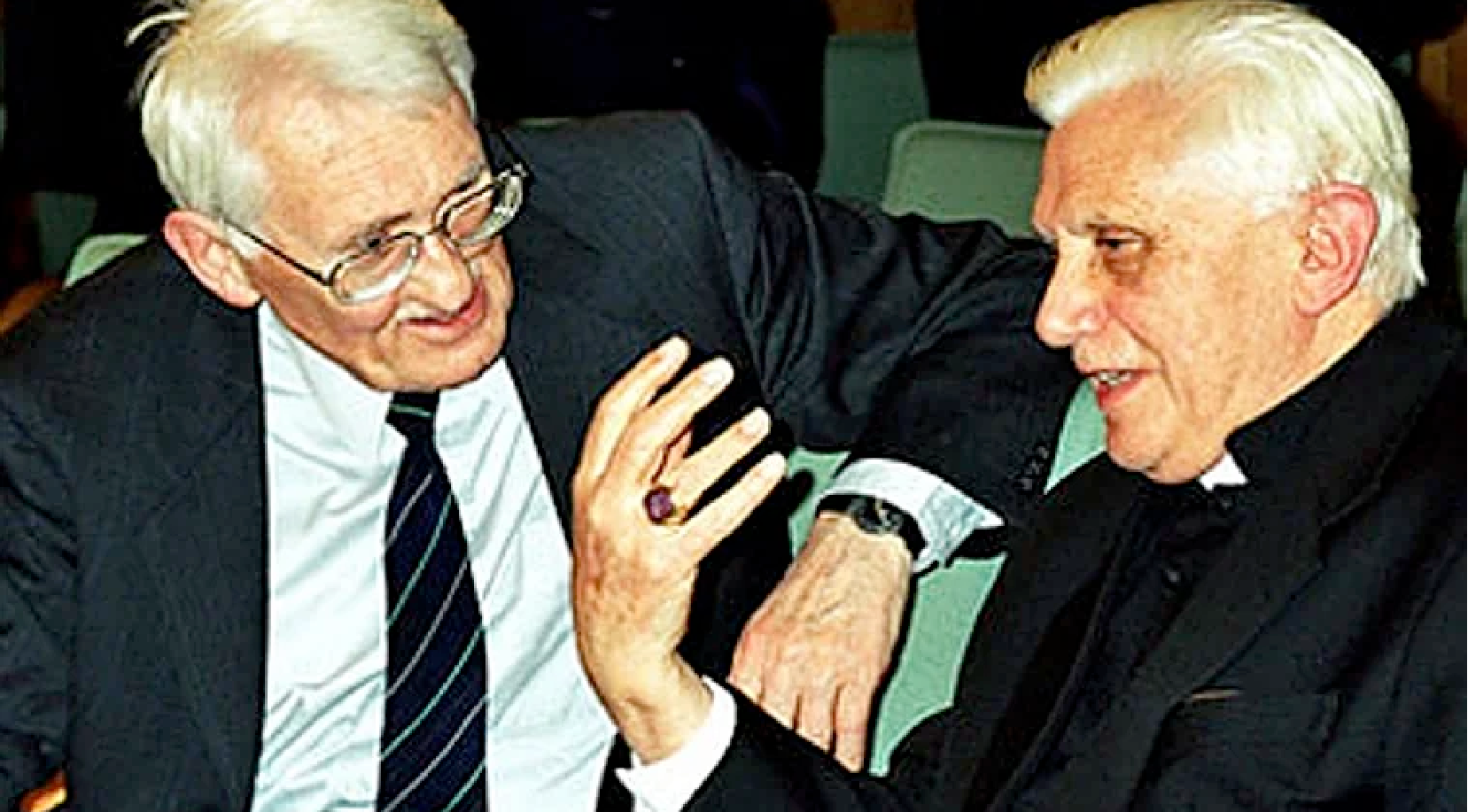
(ZENIT News / Cologne, 03.16.2026).- The death of Jürgen Habermas on March 14 at the age of 96 closes more than a biographical chapter in European intellectual history; it marks the fading of one of the last voices that attempted to hold together, within a single framework, democracy, reason and moral responsibility in a fractured age. He died at his home in Starnberg, near Munich, surrounded by his family, as confirmed by his publisher Suhrkamp Verlag.
For decades, Habermas had been synonymous with the intellectual legacy of the Frankfurt School, the influential circle of thinkers that sought to reinterpret Marxism in light of the cultural and political catastrophes of the twentieth century. A student and later assistant of Theodor W. Adorno, he would go on to reshape that tradition, shifting its focus from economic critique to the structures of communication, public discourse and democratic legitimacy.
At the heart of his philosophical project lay a deceptively simple intuition: that rationality, properly understood, is not imposed but emerges through dialogue. His theory of communicative action—developed during his years at the Goethe University Frankfurt—proposed that social norms are legitimate only insofar as they can be accepted by all those affected, under conditions free from coercion. In this sense, democracy was not merely a system of institutions but a moral practice rooted in argument, reciprocity and mutual recognition.
Yet the arc of Habermas’s thought did not end with procedural rationality. In the later decades of his life, especially after the shock of the September 11 attacks and the resurgence of religious fundamentalism, he turned increasingly toward a question that had long remained at the margins of his work: whether reason alone could sustain the moral foundations of modern societies.
It was in this context that his now-famous dialogue with Joseph Ratzinger took place in 2004 at the Catholic Academy of Bavaria. The encounter—later published under the title “Dialectics of Secularization”—has since become a reference point for understanding the evolving relationship between faith and reason in contemporary Europe.
Habermas, who described himself as a “methodical atheist,” made a striking concession. The liberal democratic state, he argued, depends on ethical resources it cannot generate by itself. Purely secular rationality, while indispensable, struggles to produce binding moral motivations or a shared sense of justice. Religion, by contrast, preserves moral intuitions, narratives and symbolic languages capable of sustaining solidarity.
His reflections went further. In one of his most debated formulations, he suggested that the normative self-understanding of modernity—its commitment to human rights, equality, individual conscience and democratic participation—owes an unacknowledged debt to the ethical heritage of biblical traditions. Without this inheritance, he warned, modernity risks drifting into what he saw as a cold and ultimately unstable form of rationalism.
This did not mean a return to confessional politics. On the contrary, Habermas insisted that religious contributions to public debate must be translated into a language accessible to all citizens. Here lay one of the central tensions of his thought: religion was necessary as a moral reservoir, yet it had to submit to the procedural norms of secular reason in order to enter the public sphere.
The exchange with Ratzinger revealed both convergence and divergence. Both thinkers rejected relativism and fundamentalism alike, and both acknowledged that modern democracies require more than technical rationality. But where Habermas grounded legitimacy in discursive consensus, Ratzinger pointed to revelation and a broader metaphysical understanding of reason. The German philosopher remained wary of any attempt to reintroduce theology as a foundational authority, while the future pope questioned whether reason, severed from its metaphysical roots, could avoid self-dissolution.
The debate did not end there. Figures such as yhe cardinal Camillo Ruini later challenged Habermas’s framework, arguing that it underestimated the radical novelty of the Christian claim: not merely a moral system, but the revelation of a personal God who enters history. For critics, the demand that religion translate itself entirely into secular categories risked reducing its essence.
And yet, even among his interlocutors, there was recognition of the singular importance of Habermas’s effort. At a time when much of European thought oscillated between secular self-sufficiency and cultural pessimism, he attempted a more demanding path: an “alliance,” however fragile, between modern rationality and the moral intuitions preserved by religious traditions.
This concern was not abstract. Habermas saw in contemporary societies a growing risk of moral exhaustion. The language of rights, he believed, could persist institutionally while losing its deeper motivational force. Without shared ethical horizons, democratic life could degenerate into technocracy, market logic or identity conflict—developments that have become increasingly visible in the early twenty-first century.
His own intellectual biography gave this concern a particular depth. Born in 1929 in Düsseldorf, marked in childhood by a speech impairment that made communication difficult, he would go on to become the philosopher of dialogue par excellence. Language, for him, was not only a theoretical problem but a personal conquest—a medium through which human dignity is both expressed and recognized.
There were, of course, ambiguities. Habermas’s support for certain Western military interventions, including NATO’s bombing of Serbia in 1999, raised questions about the consistency of his commitment to dialogue as the primary means of resolving conflict. Critics pointed to a tension between his normative ideals and his political judgments.
Still, his legacy resists reduction to any single controversy. Awarded the Prince of Asturias Prize for Social Sciences in 2003, he remained, until his final years, a central interlocutor in debates on democracy, law, bioethics and the future of Europe.
What endures most is perhaps not a system, but a question—one that Habermas himself left unresolved. Can modern societies, built on pluralism and procedural reason, sustain the moral depth required for their own survival? Or do they depend, in ways they cannot fully acknowledge, on traditions—religious among them—that precede and exceed rational justification?
In an era marked by polarization, technological acceleration and renewed ideological conflict, that question appears less theoretical than ever. Habermas did not provide a definitive answer. But in insisting that reason must remain open to dialogue with what lies beyond itself, he ensured that the conversation would not end with him.
Thank you for reading our content. If you would like to receive ZENIT’s daily e-mail news, you can subscribe for free through this link.

Publicaciones relacionadas:
 War in Ukraine? Leader of the Eastern Greek-Catholic Church, the Most Numerous in Communion with the Pope, Responds
 From cancer to the Church through a miracle: Jordan Peterson’s wife converts to Catholicism, thanks to the Rosary
 First Catholic priest killed by paramilitary militias in Sudan
 Navigating Compassion: Sailor Honored for Transforming a Journey into a Lifeline
