

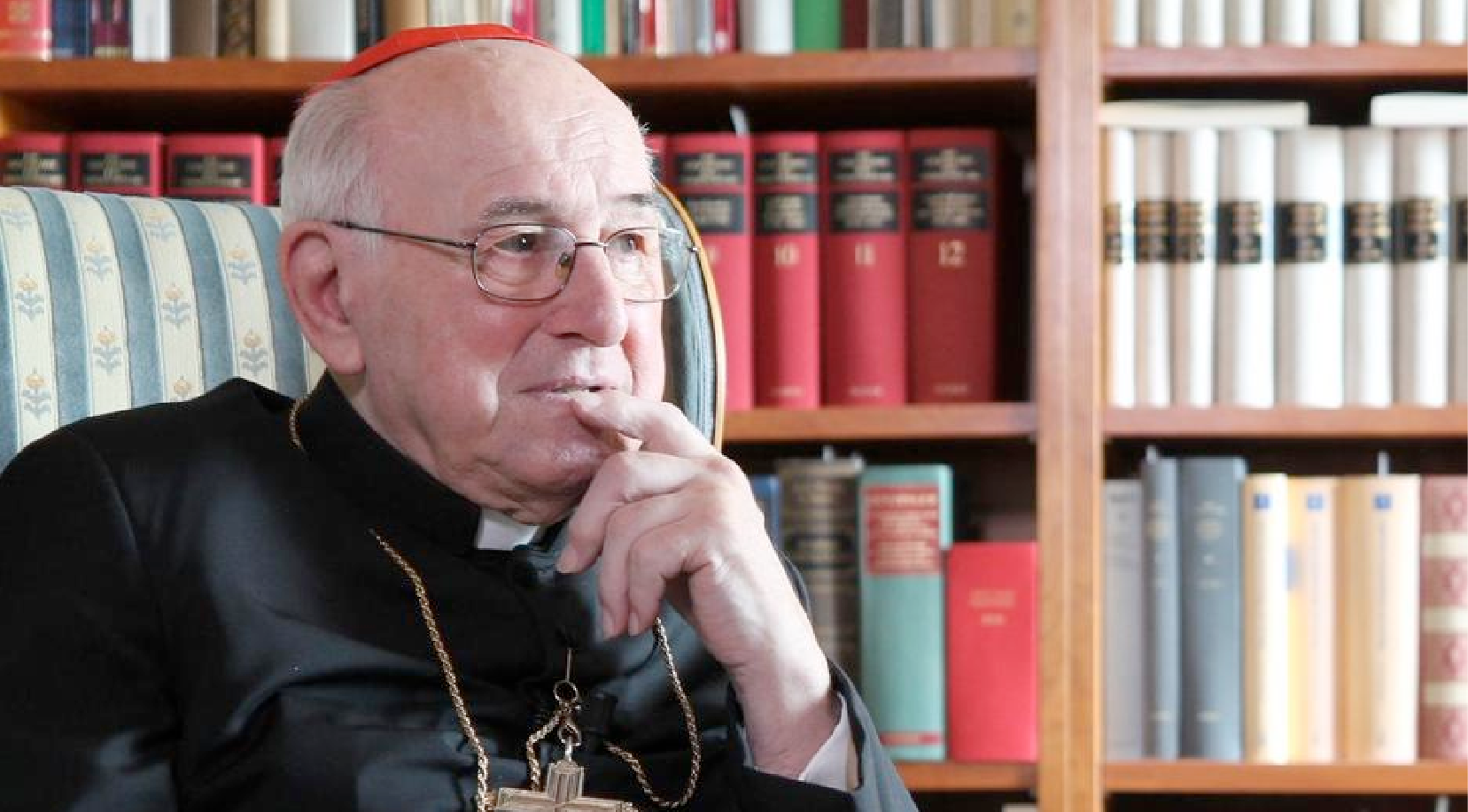
Cardenal Walter Brandmüller
(ZENIT News / Rome, 03.19.2026).- It was not with «Sacrosanctum Concilium» of Vatican II, but rather with the implementation of the liturgical reform after the council that a rift was opened in large parts of the Catholic world. What arose from it was an unhealthy conflict between “progressives” and “retrogrades.” Should one be surprised ? Not at all. This only demonstrates what a central role the liturgy occupies in the lives of the faithful.
The so-called “liturgical conflict,” moreover, is not a phenomenon that arose only after Vatican II, nor even exclusively in the Catholic sphere. When Patriarch Nikon and Tsar Alexis I introduced a liturgical reform in Orthodox Russia in 1667, various communities broke away, some even rejecting the priesthood itself, with divisions that persist to this day.
Also in the Catholic and Protestant West, during the Enlightenment, vehement disputes were ignited over the introduction of new hymnals. In Catholic France, the replacement of the ancient Gallican liturgy with the new Missale Romanum in the mid-nineteenth century met with fierce opposition.
In short, in all these cases it was not a matter, as for Arius or Luther, of dogma, of revealed truth. Rather, these questions became a matter of dispute in intellectual circles.
What does, however, affect the daily life of piety are the rites, customs, and concrete forms of religiosity experienced every day. It is there that conflict is ignited, sometimes even over secondary details, like variations in the texts of hymns or prayers. And the more irrational the reason for the dispute appears, the more violent the clash becomes.
Such a minefield is certainly no place for a bulldozer. In most cases, it is not the doctrine of faith that is directly affected. What is affected is religious sentiment, cherished devotional formulas, habit. And this often penetrates deeper than an abstract theological formula : because it touches on vital experience.
Likewise, it is equally erroneous to invoke the slogan “beneath the cassocks, the musty odor of a thousand years” to demand demolitions and ruptures with tradition, since this would ultimately disregard not only the Christian but also the human essence of inherited tradition. This is generally true of any attempt at reform, especially when it affects daily religious practice, like for example the reorganization of parishes, which impacts the daily lives of the faithful.
Yet, surprisingly, such distrust or even rejection of innovations did not manifest itself when Pius XII first reformed the Easter Vigil in 1951, and then, in 1955, the entire Holy Week liturgy. I myself experienced this personally, as a seminarian and young priest. And except for perplexed reactions in some rural contexts, in the places where these reforms were implemented with fidelity they were greeted with joyful anticipation, if not with enthusiasm.
Yet today, with hindsight, one must ask why instead the reforms of Paul VI generated certain reactions, all too well known. In the first case, the Church experienced a liturgical upswing ; in the second, many saw a liturgical break with tradition taking place.
After the pontificate of Pius XII, the election of John XXIII was perceived in various ecclesiastical circles as a liberation from magisterial constraints. The door also opened to dialogue with Marxism, existentialist philosophy, the Frankfurt School, Kant, and Hegel – and with this, to a radically different way of understanding theology. The hour of theological individualism had struck, of the farewell to what was dismissed as “pastism.”
The consequences for the liturgy were grave. Arbitrariness, proliferation, unbridled individualism led, in not a few places, to the replacement of the Mass with personal compositions, even collected in ring binders prepared by the celebrants. The result was liturgical chaos and an unprecedented exodus from the Church, which, despite the Pauline reform, continues to this day.
In response, groups and circles arose determined to counter the chaos with unwavering fidelity to Pius XII’s «Missale Romanum.» So the more arbitrariness and disorder reigned on the one hand, the more the rejection of any development hardened on the other, despite the positive experiences already achieved with Pius XII’s reforms. Thus, Paul VI’s reform of the missal – which was not without its flaws – also encountered criticism and resistance. And while these objections often had their reasons, they were not justified. The “Novus Ordo” had been promulgated by the pope : despite legitimate criticism, it had to be accepted in obedience.
The apostle Paul writes that Christ “became obedient unto death, even death on a cross,” and with His death He redeemed the world. If, therefore, in the Eucharistic celebration Christ’s obedience unto death is made present, this celebration cannot take place in disobedience.
And yet, what happened ? For some, the reforms were not enough : they continued with their liturgy in ring binders, the fruit of individual creativity. Others, instead, made opposition with fidelity to the “Mass of all time,” forgetting – or ignoring – that the rite of the Holy Mass has developed and transformed over the centuries, taking on different forms in both the East and the West, according to the respective cultural contexts. In truth, the only “Mass of all time” is limited to the words of consecration, which, moreover, are handed down with different formulations in the Gospels and in Paul. This, and only this, is the “Mass of all time.” Where there was no desire to acknowledge this, the sides were drawn up, and the struggle continues to this day.
It must not be forgotten, however, that the authentic liturgy, conscientiously celebrated in the name of the Church, is in many places a peaceful and daily reality. But the question remains : how was such a lacerating conflictual development possible ? A look at history reveals something.
The battles fought after the Council of Trent did not concern the nature of the Holy Eucharist. Pius V’s new «Missale Romanum» was gradually introduced in various countries, lastly in France at the end of the 19th century, without causing conflict, while old local rites, like the Ambrosian in Milan, or those specific to religious orders, continued without difficulty.
It was only at the beginning of the 20th century, in the context of modernism, that the dispute over the sacrifice of the Mass resurfaced, but now not so much over the rite as over the essence of the sacrifice itself. The outbreak of the First World War, with its devastating consequences for Europe, prevented an adequate solution, leaving the issue to smolder under cover, unresolved. And in the years that followed, the liturgical movement, important in the postwar period, also concerned itself – with a few exceptions – not with the essence but rather with the performance of the liturgy, particularly of the sacrifice of the Mass by the community of the faithful.
The seizure of power by the communist, fascist, and national socialist dictatorships, followed by the Second World War with its consequences, further prevented a definitive solution.
It was Pius XII who, in the midst of the postwar problems and aware of the unresolved questions relating to the holy sacrifice of the Mass, took up the subject again in his encyclical Mediator Dei of 1947 : he reiterated and clarified the dogma of the Council of Trent and finally provided guidelines for a worthy liturgical celebration.
Yet the controversies did not cease ; on the contrary, they were ignited again, not so much over the rite as over the nature of the Eucharistic sacrifice. The excessive emphasis – to the point of true absolutization – on the convivial nature of the Holy Mass led, and still leads, to grave liturgical abuses, sometimes even blasphemous. Abuses born from fundamental misunderstandings of the mystery of the Eucharist.
Added to this is the fact that it almost always depends on individual priests whether the Holy Mass is celebrated according to the scrupulously observed “Novus Ordo” or whether free rein is given to the celebrants’ subjective ideas. Cases in which episcopal authorities have intervened against abuses have been rather rare. It is not yet sufficiently understood that this dissolution of liturgical unity is the fruit of uncertainty or even of a loss of authentic faith, and constitutes a threat to unity in the faith itself.
It is therefore necessary – if there is the desire to avoid or heal fatal fractures in ecclesial unity – to reach a peace, or at least a truce, on the liturgical front. This is why it is worthwhile to return to the title of Bertha von Suttner’s famous pacifist novel, published since 1889 in 37 editions and 15 translations : «Die Waffen nieder!»: Lay down your arms !
This means, first of all, disarming the language when speaking of liturgy. Likewise, it would be necessary to avoid any kind of mutual accusation. Neither side should bring into doubt the seriousness of the other’s intentions. In short, tolerance must be exercised and controversy avoided. Both sides should ensure a liturgy that scrupulously respects the respective norms. Experience shows that this warning applies not only to the innovators, but also to the supporters of the “old Mass.”
Both sides should impartially study chapter II of the conciliar constitution «Sacrosanctum Concilium» and evaluate the subsequent developments in its light. It would then become clear how far post-conciliar practice has strayed from the constitution, which, it should not be forgotten, was also endorsed by Archbishop Marcel Lefebvre.
Only in this way, in silence and with great patience, will it be possible to work toward a reform of the reform that truly corresponds to the provisions of Sacrosanctum Concilium. Then the time may come when a reform capable of honoring the requirements of both sides will be presented.
But until then, once again, for the love of God : “Lay down your arms!”
***
(Translated by Matthew Sherry : traduttore@hotmail.com)
Thank you for reading our content. If you would like to receive ZENIT’s daily e-mail news, you can subscribe for free through this link.

Publicaciones relacionadas:
 Does anyone who attends traditional Latin Mass accept the Pope? Scientific study reveals 5 impressive facts (against common beliefs)
 New Brazilian cardinal confirms: new Amazonian rite and viri probati are on the table
 For the first time an archbishop of Tehran, Iran, among the Pope’s electors
 Cardinals, the first consistory of Leo XIV, and Cardinal Zen’s public objections
